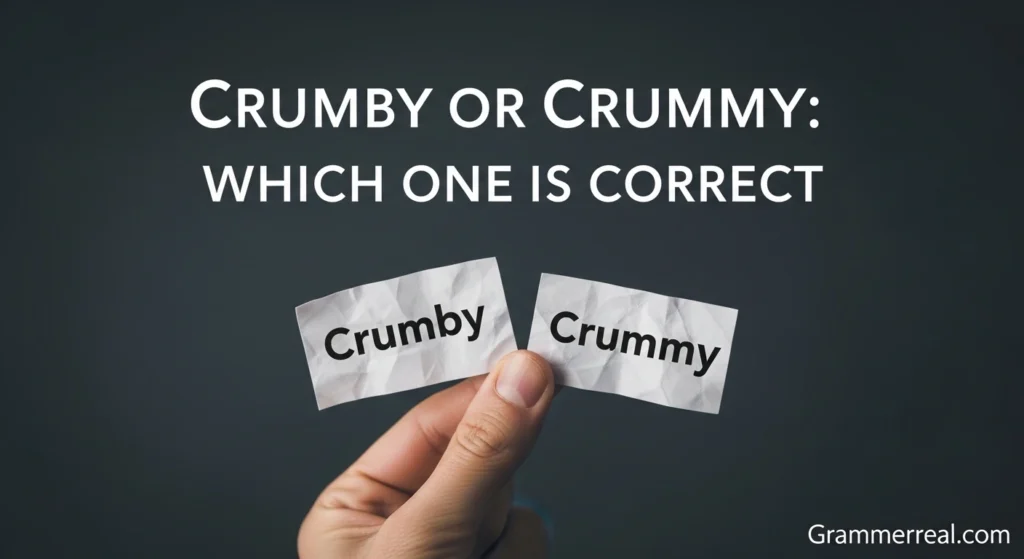
Many English learners feel confused about crumby or crummy because both spellings look very similar.
When two words look almost the same, it becomes easy to make a mistake. Also, both words sound the same when we say them. Because of this, students often think both spellings are correct. However, in modern English, only one spelling is standard and widely accepted. Therefore, it is important to understand the correct form clearly. In this article, you will learn the real difference between crumby and crummy in very simple language. You will also see clear examples, easy explanations, and helpful tips. By the end, you will know which spelling to use and why.
The Simple and Clear Answer
The correct and common spelling is crummy.
The spelling crumby is not standard in modern English. Some people write it, but most dictionaries and teachers prefer crummy. Therefore, you should always use crummy in your writing.
This rule is simple.
Crummy = correct Crumby = not standard
What Does Crummy Mean?
The word crummy is an adjective. An adjective describes a noun. Crummy has two main meanings.
First meaning: full of crumbs. Second meaning: bad, unpleasant, or poor in quality.
Let us understand both meanings with easy examples.
Meaning 1: Full of Crumbs
A crumb is a small piece of bread, cake, or biscuit. When something has many crumbs on it, we can describe it as crummy.
Examples:
The table looks crummy after breakfast. His shirt became crummy after eating cookies. The kitchen floor is crummy because of the bread pieces.
In these sentences, crummy describes something covered with crumbs.
Meaning 2: Bad or Poor Quality
Crummy is often used in informal speech to describe something unpleasant or disappointing.
Examples:
I had a crummy day at school. That was a crummy movie. The weather is crummy today. He feels crummy because he is sick.
In these examples, crummy means bad, unpleasant, or not good.
Why Is “Crumby” Not Preferred?
Many learners think crumby is correct because it comes from the word crumb. They believe that adding “y” to crumb should make crumby. However, English spelling does not always follow simple rules. Over time, the spelling crummy became the accepted and common form.
Most dictionaries list crummy as the correct spelling. Because of this, teachers and examiners expect students to use crummy. If you write crumby in an exam, it may be marked as incorrect.
Therefore, it is safer to use crummy.
Simple Comparison Examples
Correct spelling: The room looks crummy after the party.
Incorrect spelling: The room looks crumby after the party.
Correct spelling: We had a crummy experience at the hotel.
Incorrect spelling: We had a crumby experience at the hotel.
Using the correct spelling improves your writing quality.
Grammar Explanation
Crummy is an adjective. It describes a noun.
Examples:
Crummy food Crummy service Crummy weather Crummy mood
In each example, crummy gives extra information about the noun.
You can also use it after linking verbs like is, was, or feels.
The food is crummy. The day was crummy. I feel crummy today.
These sentence patterns are very common in spoken English.
Is Crummy Formal or Informal?
Crummy is informal. People use it in casual conversation.
For example:
Informal: It was a crummy meal. Formal: It was a poor-quality meal.
In academic essays or business reports, you should use formal words like poor, unpleasant, unsatisfactory, or disappointing. However, in friendly conversations, crummy sounds natural.
Common Student Mistakes
First mistake: Spelling it as crumby Wrong: The desk is crumby. Right: The desk is crummy.
Second mistake: Using it in very formal writing Instead of writing, “The company gave crummy service,” use “The company gave poor service.”
Third mistake: Confusing it with crumb Remember that crumb is a noun, but crummy is an adjective.
Understanding these small differences helps you write better English.
Short Practice Story
Let us read a short example to understand better.
Yesterday, Ahmed had a crummy day. First, he woke up late. Then, he dropped his toast on the floor, and it made the kitchen look crummy with crumbs everywhere. Later, he watched a movie, but it was crummy and boring. Finally, he went to bed early and hoped the next day would be better.
In this story, crummy describes both crumbs and a bad experience.
Why Correct Spelling Is Important
Correct spelling makes your writing clear and professional. Even small spelling mistakes can change how people see your work. In exams, correct spelling helps you get better marks. In professional writing, correct spelling builds trust.
Therefore, learning the difference between crumby or crummy is important. It may look like a small detail, but it improves your overall English skills.
Easy Memory Trick
Here is a simple trick to remember the correct spelling.
Think of the word funny. It has double “n.”
Now think of crummy. It has double “m.”
Both words follow a similar pattern. So remember that crummy has double “m.”
You can also remember this sentence:
A crummy day feels funny in a bad way.
This helps you remember the spelling pattern.
Quick Review
Crummy is the correct spelling. Crumby is not standard. Crummy means full of crumbs or bad in quality. Crummy is informal.
If you follow these simple points, you will not make mistakes.
Conclusion
In conclusion, the confusion between crumby or crummy is mainly about spelling. The correct and accepted spelling in modern English is crummy. The word crummy can describe something covered with crumbs or something unpleasant and of poor quality. Although some people write crumby, it is not the preferred spelling in dictionaries and formal education. Therefore, you should always choose crummy in your writing. By remembering the double “m” rule and practicing simple sentences, you can avoid this mistake easily. Small grammar and spelling rules make a big difference in clear communication.
FAQs
1. Which spelling is correct: crumby or crummy?
The correct spelling is crummy.
2. Is crumby used in modern English?
It is sometimes seen, but it is not the standard spelling.
3. What does crummy mean?
Crummy means full of crumbs or bad in quality.
4. Is crummy an adjective?
Yes, crummy is an adjective.
5. Can crummy describe a bad day?
Yes, you can say “I had a crummy day.”
6. Is crummy formal English?
No, it is informal.
7. Why do people spell it crumby?
They follow the spelling of crumb and make a mistake.
8. How can I remember the correct spelling?
Remember that crummy has double “m,” like funny.
9. Can I use crummy in exams?
Yes, but only in informal writing. Avoid it in formal essays.
10. Should I avoid using crumby?
Yes, you should avoid crumby and use crummy instead.