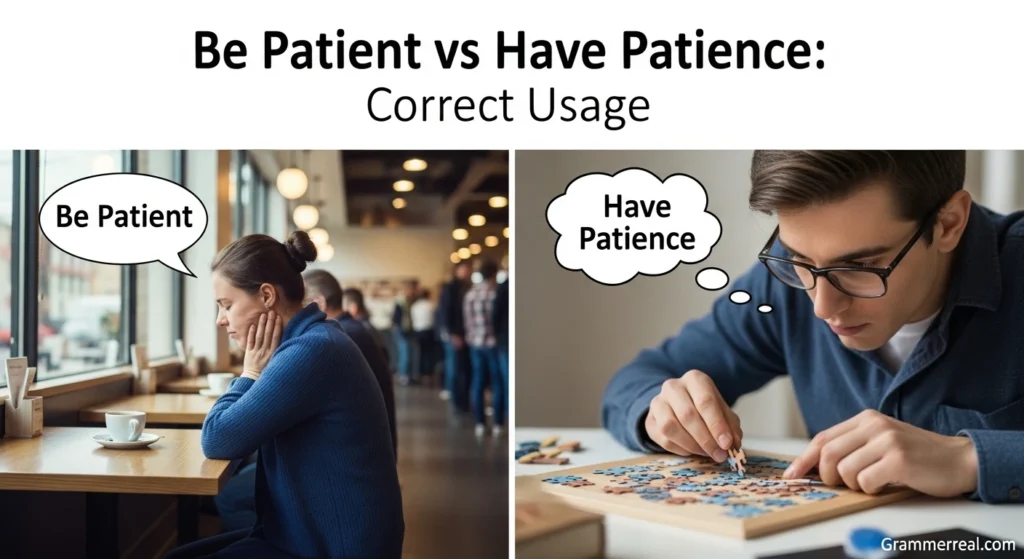
People often hesitate when choosing between be patient vs have patience because both expressions talk about calm behavior and self-control. At first, they seem to mean the same thing. However, grammar and usage show a clear difference.
One phrase describes a state or behavior, while the other describes a quality or trait. Because of this, learners sometimes use them in the wrong place. This confusion appears in spoken English, writing tasks, and exams. Moreover, formal and informal situations may prefer one form over the other. Understanding be patient vs have patience helps you sound natural and correct. This article explains the difference using very simple words. By the end, you will know which phrase fits your sentence best.
Understanding the Basic Difference
The difference between be patient vs have patience depends on function and focus.
- Be patient describes how someone should act.
- Have patience describes a quality or ability someone possesses.
Both ideas connect, but grammar changes their use.
What Does “Be Patient” Mean?
The phrase be patient is usually a command or advice. It tells someone to stay calm and wait without anger or stress.
Simple meaning of be patient
- stay calm
- wait quietly
- avoid getting angry
Examples of “be patient” in sentences
- Please be patient while we fix the issue.
- You should be patient with children.
- Be patient, the results will come soon.
- Try to be patient during the process.
In these examples, the speaker gives advice or instruction.
What Does “Have Patience” Mean?
The phrase have patience describes a personal quality. It shows that someone already has the ability to stay calm.
Simple meaning of have patience
- possess calmness
- show self-control
- have tolerance
Examples of “have patience” in sentences
- She has patience with difficult students.
- He does not have patience for delays.
- You need to have patience in this job.
Here, patience acts like a trait or skill.
Grammar Structure of Be Patient vs Have Patience
Grammar helps explain the difference clearly.
Structure of “be patient”
- Verb: be
- Adjective: patient
- Function: describes behavior
Structure of “have patience”
- Verb: have
- Noun: patience
- Function: describes a quality
Because of this structure, the phrases cannot replace each other in every sentence.
Verb and Word Form Difference
The word patient is an adjective. The word patience is a noun.
- Be + adjective → be patient
- Have + noun → have patience
This simple rule helps avoid mistakes.
Contextual Examples of Be Patient vs Have Patience
Context always decides the correct phrase.
- Be patient while I explain.
- She has patience when teaching beginners.
The first sentence gives instruction. The second sentence describes ability.
Usage in Daily Life
Both phrases appear often in daily English.
Common uses of “be patient”
- customer service
- instructions
- advice
Examples:
- Be patient, your order is processing.
- Please be patient with new staff.
Common uses of “have patience”
- personality description
- job requirements
- general statements
Examples:
- Teachers must have patience.
- He has patience with long tasks.
Tone and Politeness
Tone changes slightly between the two phrases.
- Be patient sounds direct and instructive.
- Have patience sounds descriptive and neutral.
Choosing the right phrase improves politeness and clarity.
Common Mistakes With Be Patient vs Have Patience
Learners often mix these phrases incorrectly.
Using “have patience” as a command
Incorrect: Have patience while waiting. Correct: Be patient while waiting.
Using “be patient” to describe a trait
Incorrect: She is be patient by nature. Correct: She has patience by nature.
Ignoring grammar structure
Adjectives and nouns need correct verbs.
Formal and Informal Writing
Both phrases work in formal and informal writing.
Formal examples
- Employees should be patient during changes.
- This role requires patience and focus.
Informal examples
- Be patient, I am coming.
- He does not have patience for noise.
Meaning stays the same, but sentence style may change.
American vs British English Usage
There is no major difference between American and British English.
- Both forms are correct
- Meanings remain the same
- Usage rules are shared
Learners can use both confidently.
Idiomatic and Natural Expressions
Some expressions prefer one form.
Common with be patient:
- be patient with someone
- be patient about something
Common with patience:
- lose patience
- test someone’s patience
Examples:
- Please be patient with me.
- The delay tested her patience.
Sentence Placement and Grammar Role
Both phrases usually appear near the verb.
Examples:
- Try to be patient during the wait.
- He has patience when dealing with clients.
Correct placement improves flow.
Choosing the Right Phrase Easily
You can use a simple test:
- Giving advice or instruction? → use be patient
- Describing a quality or ability? → use have patience
This rule works in most cases.
Practical Tips to Avoid Errors
Here are easy tips:
- Check if the sentence gives advice
- Look for adjective vs noun
- Read the sentence aloud
- Avoid direct translation
- Practice with examples
With practice, usage becomes natural.
Grammar Rules Applied in This Article
This article follows clear grammar rules.
- Correct verb forms
- Proper subject–verb agreement
- Accurate articles and prepositions
- Clear modifiers
- Complete sentence structure
These rules support clarity and correctness.
Writing Techniques Used
Several techniques improve readability.
- Simple vocabulary
- Short paragraphs
- Clear headings
- Logical flow
- Natural transitions
As a result, the article stays easy to read.
How This Practice Improves Writing
Learning be patient vs have patience improves writing skills.
- It improves word choice
- It strengthens grammar awareness
- It reduces confusion
- It improves tone control
- It builds confidence
Small grammar differences matter.
Rewritten and Polished Explanation
In simple terms, be patient tells someone how to act, while have patience describes a quality someone has. Both expressions relate to calm behavior, but grammar changes their role. Choosing the correct phrase depends on whether you give advice or describe ability. This difference improves clarity and accuracy.
Conclusion
In conclusion, the difference between be patient vs have patience lies in grammar and function. Be patient uses an adjective to give advice or instruction. Have patience uses a noun to describe a personal quality. Both expressions are correct and useful. Using the right one makes English sound natural and clear. With practice, this choice becomes easy.
FAQs
1. Are be patient and have patience the same?
They are related but not the same.
2. Which one is used as advice?
Be patient.
3. Which one describes a quality?
Have patience.
4. Can both be used in formal writing?
Yes, both are correct.
5. Is patience a noun?
Yes, patience is a noun.
6. Is patient an adjective here?
Yes, patient works as an adjective.
7. Can I say “be patience”?
No, that is incorrect.
8. Is there a difference in British English?
No major difference exists.
9. Can both appear in the same text?
Yes, if used correctly.
10. What is the easiest way to remember the difference?
Advice → be patient, quality → have patience.



