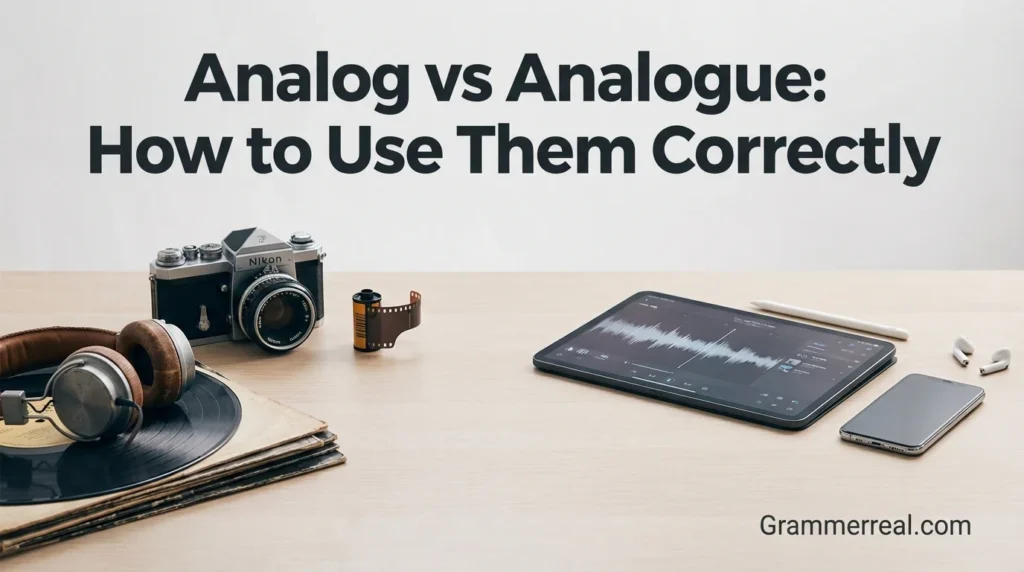
The topic “Analog vs analogue” often confuses English learners, writers, students, and even professionals. Many people wonder whether analog and analogue mean the same thing or if they are used in different situations.
The truth is that both words are correct, but their usage depends on spelling traditions and context. One form is more common in American English, while the other is preferred in British English. This small spelling difference can affect how clear, natural, and correct your writing appears. Understanding analog vs analogue helps improve spelling accuracy and confidence. It also helps writers adjust their language for different audiences. In this article, we will explain the meaning, usage, grammar, and examples of analog and analogue in very simple language. By the end, you will know exactly which word to use and when.
This article is written with clear structure, short sentences, and easy words. Each section focuses on one idea to avoid confusion. The goal is to make learning smooth, simple, and useful for everyday writing.
What Does “Analog” Mean?
Analog is a word used mainly in American English. It can be used as both an adjective and a noun, depending on the sentence.
As an adjective, analog describes something that works with continuous signals, not digital ones.
Examples:
- An analog clock uses hands, not numbers on a screen.
- The radio uses analog signals.
- He prefers analog recording methods.
As a noun, analog refers to a system or method that is not digital.
Examples:
- Vinyl records are a popular analog format.
- The device works in analog, not digital.
In American English, analog is the standard spelling in all contexts.
What Does “Analogue” Mean?
Analogue is the spelling commonly used in British English. It has the same meaning as analog, but the spelling is longer.
As an adjective:
- An analogue clock hangs on the wall.
- The system uses analogue technology.
- She studies analogue photography.
As a noun:
- Vinyl is an analogue medium.
- This machine is an analogue of older systems.
In British English, analogue is the preferred spelling in both technical and general writing.
Are Analog and Analogue the Same?
Yes, analog and analogue mean the same thing. The difference is mainly spelling, not meaning.
The key points are:
- Analog = American English spelling
- Analogue = British English spelling
Both words describe:
- Continuous signals
- Non-digital systems
- Similar comparisons between things
So, the choice between analog vs analogue depends on the type of English you are using.
Why Do Two Spellings Exist?
English has developed in different ways in different regions. American English often uses shorter spellings, while British English keeps older or longer spellings.
Examples of similar spelling differences:
- Color (American) / Colour (British)
- Center (American) / Centre (British)
- Program (American) / Programme (British)
The same pattern applies to analog vs analogue. Over time, both spellings became correct in their own regions.
Analog vs Analogue in Technology
In technology, these words are very common.
Analog in American English
- analog signal
- analog device
- analog sound
- analog system
Example sentences:
- The studio uses analog equipment.
- This camera records in analog format.
Analogue in British English
- analogue signal
- analogue device
- analogue sound
- analogue system
Example sentences:
- The lab studies analogue electronics.
- He repairs analogue machines.
The meaning stays the same, but the spelling changes.
Contextual Examples in Daily Use
Education
- The teacher explained analog circuits. (American)
- The teacher explained analogue circuits. (British)
Music
- Many artists love analog sound.
- Many artists love analogue sound.
Timekeeping
- An analog clock shows time with hands.
- An analogue clock shows time with hands.
These examples show that both words fit naturally in similar sentences.
Common Mistakes with Analog and Analogue
Many writers make mistakes when using analog vs analogue.
Mixing spellings in one text
- Incorrect: This analog device supports analogue signals.
- Better: This analog device supports analog signals.
Consistency is important.
Thinking one spelling is wrong
Both spellings are correct. The key is choosing the right one for your audience.
Using the wrong form for the audience
- American readers expect analog.
- British readers expect analogue.
Knowing your audience helps avoid confusion.
Analog vs Analogue as a Noun
Both words can be nouns, but this usage is less common than adjective use.
Examples:
- Vinyl is an analog.
- Vinyl is an analogue.
In this case, the word refers to something that represents or matches another thing in a similar way.
This noun usage appears more often in technical or academic writing.
Analog and Analogue in Comparisons
The words are also used when comparing two things that are similar.
Examples:
- This chart is an analog of real behavior.
- This model is an analogue of the real system.
Here, the word means “a similar example” or “a matching form.”
This meaning is used in both American and British English.
American vs British English Differences
American English
- Uses analog
- Uses shorter spellings
- Common in technical writing and everyday speech
Examples:
- analog watch
- analog recording
- analog signal
British English
- Uses analogue
- Keeps traditional spelling
- Common in education and formal writing
Examples:
- analogue watch
- analogue recording
- analogue signal
Both forms are correct in their own systems.
Idiomatic and Natural Usage
While analog and analogue are technical words, they also appear in natural language.
Examples:
- Life has no analog in games.
- The story is an analogue of real events.
These uses show that the words can describe similarity, not just technology.
Practical Tips to Remember the Difference
Here are simple tips to help you choose the right word:
- Think about your audience
- American audience → analog
- British audience → analogue
- Stay consistent
- Use one spelling throughout the text.
- Remember spelling patterns
- Color → analog
- Colour → analogue
- Do not mix styles
- Choose one type of English and stick to it.
- Both mean the same
- Focus on spelling, not meaning.
These tips make the choice easy and stress-free.
Sentence Examples for Practice
Correct usage:
- The analog system needs repair.
- She studies analogue electronics.
- This is a clear analog of human behavior.
- That machine is an analogue of the old model.
- He prefers analog sound quality.
Incorrect usage:
- The analog system uses analogue parts.
- This analogue device is common in American texts.
Why This Difference Matters in Writing
Using the correct spelling improves writing in many ways:
- It shows attention to detail.
- It respects language variety.
- It avoids reader confusion.
- It improves clarity and trust.
- It makes writing look polished.
Small spelling choices can change how professional writing appears.
Reflection on Grammar Rules and Writing Techniques
This topic highlights several important writing rules:
- Spelling consistency is essential.
- Subject-verb agreement keeps sentences correct.
- Clear sentence structure improves readability.
- Simple words help learning and understanding.
- Balanced sentence length keeps the flow smooth.
Writing about analog vs analogue also improves awareness of language variety. It teaches writers to think about audience and purpose before choosing words.
This exercise strengthens grammar skills and helps writers become more careful and confident.
Conclusion
In conclusion, analog vs analogue is not about right or wrong meaning, but about spelling and usage. Analog is the preferred spelling in American English, while analogue is standard in British English. Both words share the same meaning and are used in similar ways. The most important rule is to stay consistent and choose the spelling that matches your audience. By understanding this difference, writers can improve clarity, accuracy, and confidence. Simple spelling choices like this help make writing clear and professional.
FAQs
1. Are analog and analogue the same word?
Yes, they have the same meaning but different spellings.
2. Which spelling is used in American English?
American English uses analog.
3. Which spelling is used in British English?
British English uses analogue.
4. Can both be used as adjectives?
Yes, both can describe systems, signals, or devices.
5. Can both be used as nouns?
Yes, though noun use is less common.
6. Is one spelling more correct than the other?
No, both are correct in their own language systems.
7. Should I mix analog and analogue in one article?
No, stay consistent with one spelling.
8. Do the words only relate to technology?
No, they can also describe similarities between things.
9. Which form should students use?
Use the form taught in your region or required by your school.
10. How can I remember the difference easily?
Think: American = analog, British = analogue.



