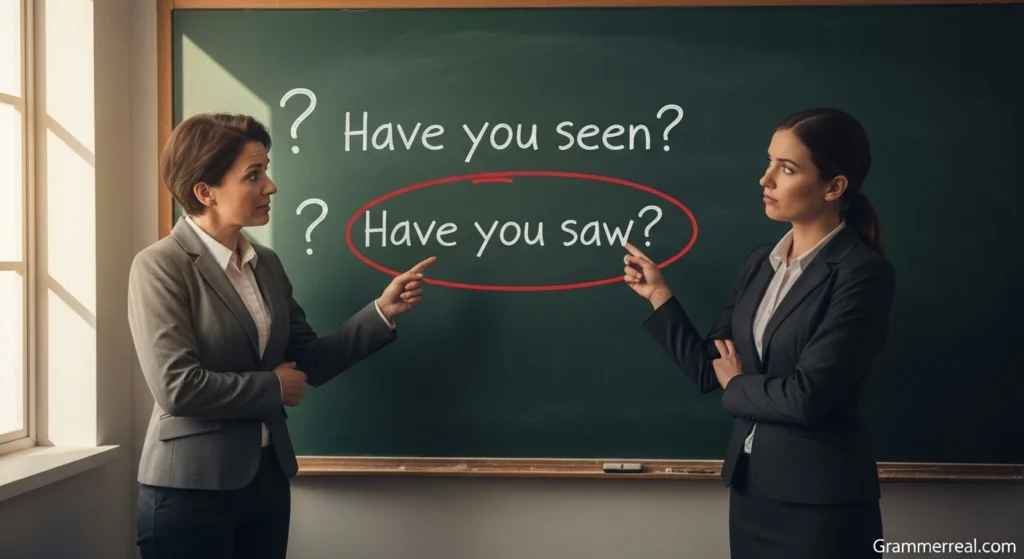
Many English learners ask about have you seen vs have you saw because both phrases look similar, but only one is correct in standard English. This confusion happens because the verbs see, saw, and seen are different forms of the same verb.
If you do not know when to use each form, it is easy to make mistakes in speaking and writing. The good news is that the rule is simple once you understand it clearly. Have you seen is correct because it uses the helping verb have with the past participle seen. Have you saw is incorrect because saw is the simple past form, not the past participle. Learning this small grammar point can make your English sound more natural and polished. In this guide, you will learn the difference between have you seen vs have you saw, common mistakes, examples, language variations, and easy tips to remember the rule. By the end, you will feel more confident using these forms in everyday English.
Understanding have you seen vs have you saw
The short answer is simple:
- Have you seen = Correct
- Have you saw = Incorrect
Why? Because the verb have needs the past participle form of the main verb.
The verb see has three important forms:
- Base form: see
- Past simple: saw
- Past participle: seen
So:
- I see the bird every day.
- I saw the bird yesterday.
- I have seen the bird before.
Because have needs seen, the correct question is:
- Have you seen my keys?
Not:
- Have you saw my keys?
This is the core rule behind have you seen vs have you saw.
Why “have you seen” is correct
The phrase have you seen uses the present perfect tense. This tense connects the past with the present.
Structure:
Have + subject + past participle
Examples:
- Have you seen my phone?
- Have you seen that movie?
- Have you seen Sarah today?
- Have you seen the news?
In these examples, the action happened at an unknown time before now, or it still matters now.
For example:
- Have you seen my wallet? This means I cannot find it now, and I am asking if you know where it is.
That is why have you seen sounds natural and correct.
Why “have you saw” is wrong
The phrase have you saw mixes two grammar forms that do not belong together.
- Have needs a past participle.
- Saw is past simple, not past participle.
So the sentence is grammatically wrong.
Incorrect:
- Have you saw my bag?
- Have you saw this film?
- Have you saw John today?
Correct versions:
- Have you seen my bag?
- Have you seen this film?
- Have you seen John today?
Many learners make this mistake because saw is common and easy to remember. However, grammar requires seen after have, has, or had.
Verb forms of “see” explained simply
To master have you seen vs have you saw, memorize the verb chart below.
Verb FormWordExampleBase FormseeI see birds outside.Past SimplesawI saw birds yesterday.Past ParticipleseenI have seen birds before.
Use this pattern with other subjects:
- She has seen it.
- They have seen it.
- We had seen it earlier.
Never say:
- She has saw it.
- They have saw it.
- We had saw it.
Present perfect vs past simple
Another way to understand have you seen vs have you saw is to learn the difference between two tenses.
Present Perfect
Form:
have/has + past participle
Examples:
- I have seen that show.
- Have you seen my coat?
- She has seen this place before.
Use it when:
- Time is not specific
- The result matters now
- Life experience is discussed
Past Simple
Form:
subject + past verb
Examples:
- I saw that show yesterday.
- Did you see my coat?
- She saw this place last year.
Use it when:
- Time is finished or specific
- Yesterday, last week, in 2020, this morning, etc.
So compare:
- Have you seen my glasses? (I need them now.)
- Did you see my glasses yesterday? (Specific past time)
Everyday examples of have you seen vs have you saw
Here are common daily situations.
Looking for something
Correct:
- Have you seen my keys?
- Have you seen the charger?
- Have you seen my notebook?
Wrong:
- Have you saw my keys?
Talking about movies
Correct:
- Have you seen Titanic?
- Have you seen the new comedy?
- Have you seen that series?
Wrong:
- Have you saw Titanic?
Asking about people
Correct:
- Have you seen Emma today?
- Have you seen the teacher?
- Have you seen my brother?
Wrong:
- Have you saw Emma today?
Travel and experience
Correct:
- Have you seen Paris?
- Have you seen the mountains?
- Have you seen snow before?
Wrong:
- Have you saw Paris?
Common mistakes learners make
Many students struggle with have you seen vs have you saw for clear reasons.
1. Mixing past simple with present perfect
Wrong:
- I have went there.
- She has ate lunch.
- Have you saw him?
Correct:
- I have gone there.
- She has eaten lunch.
- Have you seen him?
2. Using “saw” after helping verbs
Wrong:
- I have saw it.
- She has saw it.
- They had saw it.
Correct:
- I have seen it.
- She has seen it.
- They had seen it.
3. Forgetting the time marker
Wrong idea:
- Have you seen him yesterday?
Better:
- Did you see him yesterday?
Because yesterday is a finished time.
4. Memorizing only one verb form
Many learners remember see = saw but forget seen. Learn all three forms together.
American vs British English differences
When comparing have you seen vs have you saw, both American English and British English agree that have you seen is correct and have you saw is incorrect.
However, there are small usage differences in tense preference.
British English
British speakers often use present perfect for recent actions.
- Have you seen John yet?
- I have just eaten.
- Have you finished?
American English
American speakers also use present perfect, but they sometimes use past simple in casual speech where British speakers prefer present perfect.
- Did you eat yet?
- Did you see John?
Still, no standard variety accepts:
- Have you saw John?
So the grammar rule stays the same.
Idiomatic expressions with “seen”
The word seen appears in many common expressions. Learning them helps your English sound natural.
1. Have you seen…?
Used to ask if someone knows or noticed something.
- Have you seen my pen?
- Have you seen the email?
2. Seen better days
Means something is old or damaged.
- This sofa has seen better days.
3. I have seen enough
Means you do not need more proof.
- I have seen enough. Stop the argument.
4. Seen it all
Means someone has much experience.
- My grandfather has seen it all.
5. Long time no see
A common friendly greeting.
- Long time no see!
Even though this phrase is informal, it is widely used.
Practical tips to remember the rule
If you often forget have you seen vs have you saw, use these easy tips.
Tip 1: After have/has/had, use the third form
Examples:
- have seen
- has gone
- had written
So:
- have seen ✔
- have saw ✘
Tip 2: Learn verbs in sets of three
Memorize:
- see – saw – seen
- go – went – gone
- eat – ate – eaten
- write – wrote – written
Tip 3: Listen to real English
Watch films, shows, or interviews. You will hear:
- Have you seen this?
- Have you seen him?
You will almost never hear have you saw from careful speakers.
Tip 4: Practice speaking aloud
Say these ten times:
- Have you seen my phone?
- Have you seen this movie?
- Have you seen my bag?
Repetition builds memory.
Tip 5: Write your own examples
Create simple sentences:
- Have you seen my shoes?
- I have seen that place.
- She has seen the message.
Mini grammar lesson: why “seen” needs a helper
The word seen usually needs a helping verb.
Examples:
- I have seen it.
- She has seen it.
- They had seen it.
- It was seen by many people.
By itself, seen usually does not stand alone in a full sentence.
Wrong:
- I seen it. (informal in some dialects, but not standard)
Correct:
- I saw it. or
- I have seen it.
This small detail helps you avoid many mistakes.
Sentence comparison practice
Read these pairs carefully.
Pair 1
- Have you seen my wallet? ✔
- Have you saw my wallet? ✘
Pair 2
- I saw your wallet yesterday. ✔
- I seen your wallet yesterday. ✘ (not standard)
Pair 3
- She has seen that movie. ✔
- She has saw that movie. ✘
Pair 4
- Did you see him last night? ✔
- Have you seen him last night? Usually wrong because of the specific time phrase.
Short conversation examples
At home
A: Have you seen my glasses? B: Yes, they are on the table.
At school
A: Have you seen the teacher today? B: Yes, she is in Room 4.
Talking about movies
A: Have you seen that new action film? B: Yes, I watched it last weekend.
At work
A: Have you seen my email? B: Yes, I replied this morning.
How this grammar improves your writing
Using the correct form in have you seen vs have you saw improves your writing in many ways.
1. It builds trust
Correct grammar makes your message clearer and stronger.
2. It avoids confusion
Readers quickly understand your meaning.
3. It improves flow
Good tense use makes sentences smoother.
4. It helps formal writing
School, business, and exams often expect standard grammar.
5. It strengthens speaking too
When you practice writing, your speaking also improves.
Writing techniques used in this guide
This guide uses several simple writing methods to help learning.
Clear structure
Each section focuses on one idea, so the topic is easy to follow.
Short and long sentences mixed
Short sentences give impact. Longer sentences explain details.
Repetition for memory
Key patterns such as have + seen appear many times.
Real examples
Daily-life examples make grammar easier to remember.
Simple vocabulary
Plain language helps learners at every level.
Quick memory formula
Remember this:
- Did + see
- Have + seen
- Yesterday + saw
Examples:
- Did you see him?
- Have you seen him?
- I saw him yesterday.
This formula solves many mistakes fast.
Practice exercise
Choose the correct answer.
- Have you ___ my bag? (a) saw (b) seen
- I ___ her yesterday. (a) saw (b) seen
- She has ___ that movie. (a) saw (b) seen
- Did you ___ him last night? (a) see (b) seen
Answers:
- seen
- saw
- seen
- see
Conclusion
The difference between have you seen vs have you saw is simple once you know the verb forms. Have you seen is correct because have must be followed by the past participle seen. Have you saw is incorrect because saw is the past simple form. Use saw for finished past time, such as yesterday or last week. Use have seen when the time is not specific or when the result matters now. By learning the forms see, saw, seen, you can speak and write with more confidence. Practice common examples, repeat the pattern aloud, and notice it in real conversations. Small grammar improvements like this create clearer and stronger English.
FAQs
1. Is “have you saw” ever correct?
No. In standard English, it is incorrect. Use have you seen.
2. Why is “have you seen” correct?
Because have requires the past participle form, which is seen.
3. What is the past tense of see?
The past tense is saw.
4. What is the past participle of see?
The past participle is seen.
5. Can I say “Did you seen”?
No. Say Did you see.
6. Can I say “I have saw it”?
No. Say I have seen it.
7. Which is correct: “I seen it” or “I saw it”?
In standard English, use I saw it.
8. Do Americans say “have you seen”?
Yes. Americans and British speakers both use have you seen.



