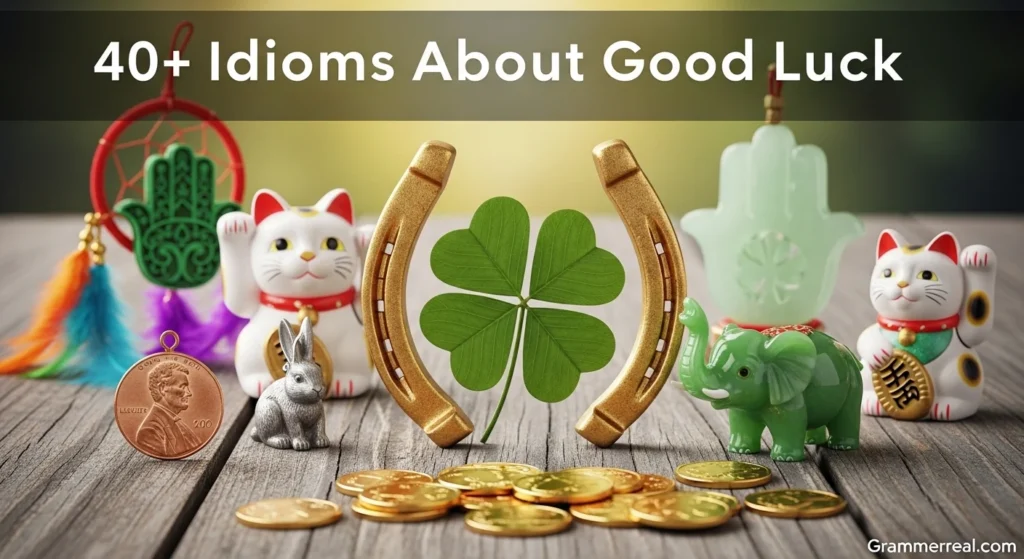
The warm glow of sunlight spills through the window, catching the edges of a four-leaf clover pressed in an old book. Outside, the scent of rain-laden earth drifts in, and you feel a subtle thrill, a whisper of hope that something wonderful is about to happen. This fleeting moment captures the essence of good luck—an invisible force, a delightful twist of fate, a sudden opportunity that sparks joy and possibility. Good luck has always fascinated humans. Across cultures and centuries, people have woven stories, superstitions, and sayings around it, turning chance encounters and fortunate events into something we can talk about, remember, and even celebrate.
Idioms about good luck are not just playful expressions. They are linguistic treasures that carry wisdom, humor, and a bit of magic. They help us express hope, optimism, surprise, and gratitude and they can lift our spirits, enrich our writing, and even bring a sense of connection to others. By learning and using these idioms, we can add color to everyday conversations, inspire positivity, and reflect the human fascination with fortune’s twists and turns.
In this article, we will explore the world of idioms about good luck, uncover their meanings, explore examples, and give you practical ways to use them in daily life, writing, and social interactions. Let’s dive into this journey where words meet chance and imagination.
The Concept of Good Luck in Everyday Life
Good luck is more than just fortune smiling upon us. It can be the sudden parking spot we find on a crowded street, the unexpected praise from a teacher, or the chance encounter that changes our life. Idioms about good luck capture these moments in playful, memorable ways. When we say someone is “in the right place at the right time,” we are talking about good luck. When we describe a surprising turn of events as a “stroke of luck,” we are using language to make sense of fortune.
Understanding these idioms not only helps you communicate better, it also lets you reflect on life’s uncertainties with humor and grace. Good luck reminds us that life is unpredictable, and sometimes, magic is hidden in the smallest moments.
Why Learning Idioms About Good Luck Is Useful
Idioms about good luck are powerful tools for communication. They can:
- Add color and life to everyday speech.
- Make your writing more engaging and expressive.
- Connect you with cultural stories and traditions.
- Help you express feelings of hope, surprise, and gratitude.
- Serve as creative prompts for journaling, storytelling, or social media posts.
By learning these idioms, you not only improve your language skills but also gain a playful perspective on life’s unpredictable nature.
A Stroke of Luck
Meaning and Explanation
A “stroke of luck” refers to an unexpected and fortunate event. It’s sudden, like a brush of magic, turning a potential setback into a joyful surprise.
Example Sentence
Finding a $20 bill on the sidewalk just before lunch was a stroke of luck for Ayesha, who had forgotten her wallet at home.
Alternative Expressions
- A lucky break
- A fortunate twist
- Serendipity
Sensory and Emotional Details
Imagine your heart skipping a beat as you realize your lost keys are right where you left them. That rush of relief and delight embodies a stroke of luck perfectly.
Born with a Silver Spoon in One’s Mouth
Meaning and Explanation
This idiom describes someone who is naturally fortunate, often born into wealth or privilege. It highlights luck tied to circumstances beyond one’s control.
Example Sentence
Rashid was born with a silver spoon in his mouth, giving him the confidence and resources to pursue his dreams freely.
Alternative Expressions
- Privileged from birth
- Fortunate from the start
- Born lucky
Cultural Reference
This idiom originated in 18th-century England, where silver spoons symbolized wealth and high status. Using it in conversation or writing evokes both imagery and history.
The Luck of the Draw
Meaning and Explanation
“The luck of the draw” means that outcomes are determined by chance rather than skill. It reminds us that luck can favor anyone unpredictably.
Example Sentence
Winning the raffle was entirely the luck of the draw, but Sam felt overjoyed when his ticket was called.
Alternative Expressions
- Pure chance
- A roll of the dice
- Random fortune
Mini Story
Legend has it that miners in old California called their sudden gold finds “the luck of the draw,” as strikes depended on chance rather than planning. The phrase still conveys surprise and delight today.
Down on One’s Luck
Meaning and Explanation
This idiom describes someone experiencing a period of misfortune, often temporary, implying that luck can change at any moment.
Example Sentence
After losing his job and car in the same week, Omar felt down on his luck but remained hopeful.
Alternative Expressions
- Having bad luck
- In an unlucky streak
- Out of fortune
Sensory Details
Picture walking in the rain with torn shoes, feeling the cold seep in, yet imagining brighter days ahead. This imagery conveys the essence of being down on one’s luck.
Luck of the Irish
Meaning and Explanation
A traditional expression celebrating the belief that the Irish are especially lucky. Often used in a cheerful or humorous tone.
Example Sentence
Winning the lottery on St. Patrick’s Day seemed like the luck of the Irish for Fatima.
Alternative Expressions
- Fortunate fate
- Serendipitous charm
Cultural Reference
This idiom ties into Irish folklore, shamrocks, and tales of leprechauns hiding pots of gold, making it both cultural and playful.
Hit the Jackpot
Meaning and Explanation
To “hit the jackpot” means to achieve a big success or gain unexpectedly, usually in a financial or career sense.
Example Sentence
After publishing her first book, Hina felt like she had hit the jackpot when it became a bestseller overnight.
Alternative Expressions
- Score big
- Win big
- Strike gold
Emotional Detail
Imagine the rush of excitement, the flutter of heartbeats, and the overwhelming joy of sudden success—it’s the essence of hitting the jackpot.
Lucky Break
Meaning and Explanation
A “lucky break” is a small or sudden event that improves a situation unexpectedly.
Example Sentence
Getting called in for an interview despite missing the initial notice was a lucky break for Jamal.
Alternative Expressions
- Fortunate opportunity
- Break of fortune
- Serendipitous chance
Storytelling Twist
Many famous authors began their careers due to lucky breaks—like being spotted by an editor who happened to stumble across their manuscript.
Knock on Wood
Meaning and Explanation
A superstitious phrase used to prevent bad luck after mentioning something positive.
Example Sentence
I’ve never been late to work this month—knock on wood!
Alternative Expressions
- Touch wood (British)
- Cross your fingers
Sensory Detail
Imagine lightly tapping a wooden table, hoping your words of optimism remain true. It’s a tiny, physical gesture connected to hope.
Fortune Smiles
Meaning and Explanation
Used when luck favors someone, often in a poetic or dramatic sense.
Example Sentence
Fortune smiled on Leena when she discovered a scholarship waiting for her.
Alternative Expressions
- Fate favors
- Luck is on one’s side
Literary Touch
Writers often use this idiom in novels or poetry to convey pivotal moments where characters experience a sudden positive turn.
On a Roll
Meaning and Explanation
To be “on a roll” means experiencing continuous good luck or success.
Example Sentence
Ahmed was on a roll this week, winning his debates and receiving praise from teachers.
Alternative Expressions
- Riding high
- Experiencing a lucky streak
Emotional Detail
Picture a ball rolling downhill effortlessly, gathering speed and momentum—this is exactly how it feels to be on a roll.
Make One’s Lucky Star Shine
Meaning and Explanation
This idiom means to take advantage of favorable circumstances to achieve success.
Example Sentence
By seizing the unexpected opportunity, Nida made her lucky star shine.
Alternative Expressions
- Ride one’s luck
- Seize the moment
Cultural Reference
In astrology and folklore, lucky stars symbolize destiny and guidance. This idiom poetically connects actions with fortune.
Luck Is on One’s Side
Meaning and Explanation
A simple idiom meaning someone is experiencing good luck at a particular moment.
Example Sentence
With the weather perfect for the festival, luck was on their side.
Alternative Expressions
- Fate favors someone
- Fortune favors someone
Sensory Detail
Imagine a gentle breeze pushing your sailboat perfectly toward the shore—luck truly on your side.
Touch of Luck
Meaning and Explanation
A subtle or slight instance of good luck, often making a noticeable difference.
Example Sentence
Winning the small prize felt like a touch of luck for Maria, brightening her week.
Alternative Expressions
- Hint of fortune
- Spark of luck
Emotional Detail
Picture a warm sunbeam breaking through clouds, small but impactful—just like a touch of luck.
Lucky Streak
Meaning and Explanation
A “lucky streak” refers to experiencing a series of fortunate events in a row.
Example Sentence
Sami enjoyed a lucky streak this week, from acing his exam to finding a rare book in the library.
Alternative Expressions
- Winning streak
- Series of fortunate events
Mini Story
Athletes often talk about being in the “zone,” where everything seems to go perfectly. This feeling is often described as a lucky streak.
Luck of the Hunt
Meaning and Explanation
This idiom emphasizes that success can depend on timing and opportunity rather than effort alone.
Example Sentence
Finding the vintage guitar at the market was truly the luck of the hunt for Rashid.
Alternative Expressions
- Fortune of timing
- Serendipitous discovery
Sensory Detail
Picture sifting through items in a bustling market, your heart racing with anticipation—then suddenly, the perfect treasure appears.
Lucky Charm
Meaning and Explanation
An object, person, or ritual believed to bring good luck.
Example Sentence
She wore her grandmother’s ring as a lucky charm before the big performance.
Alternative Expressions
- Talisman
- Amulet
- Good luck token
Cultural Reference
Lucky charms appear in many cultures—from horseshoes to rabbit feet—each carrying symbolic power and history.
Serendipity
Meaning and Explanation
Finding something valuable or pleasant by chance, often unexpectedly.
Example Sentence
It was pure serendipity when he bumped into an old friend at the café.
Alternative Expressions
- Happy accident
- Fortunate coincidence
- Unexpected delight
Emotional Detail
Imagine stumbling upon a hidden garden during a walk—serendipity brings delight and wonder in its quiet, unpredictable way.
Fortune Favors the Bold
Meaning and Explanation
This idiom suggests that those who take risks or act courageously are more likely to experience good luck.
Example Sentence
By pitching his innovative idea fearlessly, Ahmed realized that fortune favors the bold.
Alternative Expressions
- Risk brings reward
- Brave actions attract luck
Storytelling Twist
Many great explorers and inventors relied on boldness and daring. Their triumphs were often described as luck favoring the brave, blending courage and chance.
Interactive Exercises for Practicing Good Luck Idioms
- Daily Journal Prompt: Write a short paragraph describing a small lucky event you experienced today. Use at least two idioms from this article.
- Storytelling Challenge: Craft a 300-word story where the main character experiences a lucky streak. Include sensory details and at least three idioms.
- Social Media Game: Post a photo or story of something positive happening in your day, and caption it with an idiom like “A stroke of luck” or “On a roll.”
Bonus Tips for Using Good Luck Idioms
- Use them in writing to make narratives more engaging.
- Add idioms in daily conversation to sound expressive and cheerful.
- On social media, idioms can highlight positivity and charm.
- Pair idioms with sensory details to make storytelling vivid.
- Experiment with cultural idioms to connect with different audiences.
Conclusion
Idioms about good luck are not just expressions; they are mini-stories, cultural reflections, and sparks of imagination. They help us celebrate life’s surprises, express hope, and add color to our conversations and writing. Whether it’s a “stroke of luck,” a “lucky streak,” or “fortune favoring the bold,” each idiom carries a sense of joy, magic, and possibility. By practicing these idioms, using them creatively, and noticing moments of luck in our own lives, we enrich both language and experience.
Remember, luck is a feeling, a story, a moment. And through idioms, we give words to its magic, turning fleeting fortune into timeless tales.
FAQs
1. What does “a stroke of luck” mean?
It means an unexpected and fortunate event that brings happiness or advantage. For example: “Finding the lost wallet was a stroke of luck.”
2. Can idioms about good luck be used in writing?
Yes! They add color, emotion, and relatability to stories, essays, and social media posts.
3. What is the difference between “lucky break” and “stroke of luck”?
A lucky break usually refers to a smaller, sudden opportunity or advantage, while a stroke of luck is often a more impactful, surprising fortunate event.
4. Are good luck idioms the same in all cultures?
No. Different cultures have unique idioms, symbols, and superstitions. For example, “Luck of the Irish” is specific to Irish folklore.
5. How can I practice using these idioms daily?
Notice small fortunate events, write them down, and describe them using idioms. You can also add them to conversations and social media captions creatively.



