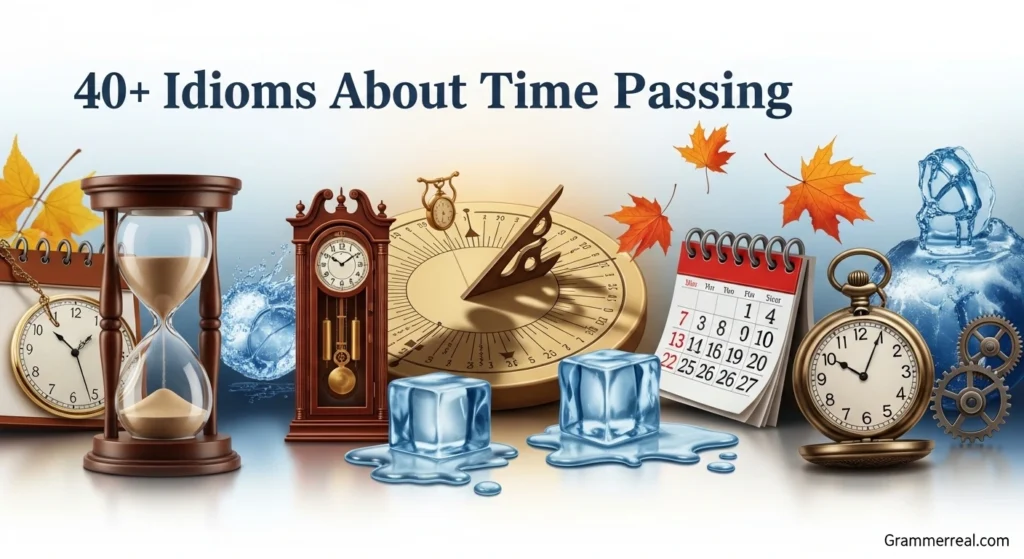
The clock ticks softly in the background, each second slipping away like grains of sand through your fingers. A golden sunset melts into deep indigo, and before you know it, the day has quietly folded into memory.
You feel it in the fading warmth of tea gone cold, in the way laughter echoes just a little longer before dissolving into silence. Time, though invisible, leaves traces everywhere—on faces, in stories, and inside the rhythm of our lives. We often struggle to describe this steady, unstoppable movement, yet language offers us a powerful tool: idioms about time passing. These expressions capture emotions, experiences, and subtle shifts that plain words often fail to convey. They allow us to paint time not as a number, but as a feeling, a journey, a transformation. In daily conversations, storytelling, and creative writing, these idioms enrich expression and deepen meaning. Understanding and using them well helps you communicate more vividly, connect emotionally, and express ideas with elegance and clarity.
What Are Idioms About Time Passing
Idioms about time passing are phrases that describe the movement of time in a figurative, imaginative way. Instead of saying “time passed quickly,” you might say “time flew.” These expressions rely on metaphor and shared cultural understanding, which makes them both powerful and memorable.
Moreover, idioms go beyond literal meaning. They carry emotional weight, tone, and context. For example, “time drags on” feels heavy and slow, while “time flies” feels light and swift. Because of this, idioms help speakers express not only what happens, but also how it feels.
In addition, these idioms appear frequently in literature, everyday speech, and even social media. Therefore, learning them improves both comprehension and expression.
Why Idioms About Time Passing Matter in Daily Life
Time shapes every aspect of life. From deadlines to memories, from growth to change, everything depends on time. However, simply stating facts about time often feels flat. That’s where idioms step in.
First, they add color to communication. Instead of saying “it has been a long time,” you can say “it feels like ages,” which instantly sounds more engaging.
Second, they help express emotions. For instance, “time stood still” captures a powerful emotional moment much better than a literal description.
Finally, they improve storytelling. Whether you write a blog, post on social media, or tell a personal story, idioms make your language more vivid and relatable.
The Beauty of Figurative Language in Expressing Time
Language becomes magical when it transforms abstract ideas into sensory experiences. Time, which we cannot see or touch, suddenly becomes something that flies, crawls, slips, or races.
For example, when you say “the years slipped away,” you almost feel time sliding quietly, unnoticed. Similarly, “the moment stretched forever” creates a sense of tension or anticipation.
Thus, idioms act like bridges between thought and feeling. They translate invisible experiences into something readers and listeners can imagine.
Common Themes in Time-Related Idioms
Idioms about time often follow certain themes. Recognizing these patterns makes them easier to understand and use.
- Speed: fast or slow passage of time
- Loss: time slipping away or being wasted
- Change: transformation over time
- Memory: how time affects perception
Because these themes repeat across cultures, many idioms feel familiar even if you hear them for the first time.
Time Flies
Meaning and Explanation
“Time flies” means that time passes very quickly, especially when you are enjoying yourself. It highlights the surprising speed of time.
Example Scenario
You spend an evening with close friends, laughing, sharing stories, and eating together. Suddenly, you check the clock—it’s midnight. You might say, “Wow, time really flies when we’re together.”
Alternative Ways to Express It
- Time goes by quickly
- The hours flew past
- The day vanished in a blink
Sensory and Emotional Detail
Imagine a bird soaring across the sky, disappearing before you fully notice its movement. That is how this idiom feels—light, swift, and almost magical.
Mini Storytelling Element
A child waits eagerly for their birthday party. The hours before the party crawl painfully. Yet once the celebration begins, laughter fills the air, balloons float, and suddenly the day ends. The child whispers, “I wish it lasted longer… time flies.”
Time Drags On
Meaning and Explanation
“Time drags on” describes a situation where time feels painfully slow, often due to boredom, discomfort, or anticipation.
Example Scenario
You sit in a waiting room before an important interview. Every minute feels like ten. You might think, “Why is time dragging on like this?”
Alternative Ways to Express It
- Time moves slowly
- The minutes crawl
- It feels endless
Sensory and Emotional Detail
This idiom feels heavy, like walking through thick mud. Each step takes effort, and progress seems painfully slow.
Mini Storytelling Element
A student stares at the clock during a difficult exam. The ticking sound grows louder, almost mocking. The hands barely move. In that moment, time doesn’t flow—it drags.
Time Slips Away
Meaning and Explanation
“Time slips away” suggests that time passes quietly and often unnoticed, usually leading to regret.
Example Scenario
You plan to finish a project but keep delaying it. Suddenly, the deadline arrives. You sigh and say, “I didn’t realize how fast time slipped away.”
Alternative Ways to Express It
- Time runs out
- Time fades away
- Time disappears
Sensory and Emotional Detail
Picture sand slipping through your fingers. You try to hold it, but it escapes no matter what you do. That’s how this idiom feels—gentle yet unstoppable.
Mini Storytelling Element
An artist promises to start painting again “tomorrow.” Days turn into weeks, and weeks into months. One day, they look at a blank canvas and realize time has quietly slipped away.
Comparing Fast vs Slow Time Idioms
Some idioms describe speed, while others emphasize slowness. This contrast helps you express precise emotions.
For example, “time flies” suits joyful moments, while “time drags” fits boredom or anxiety. Choosing the right idiom creates a stronger emotional connection with your audience.
Therefore, always consider the feeling you want to convey before selecting an idiom.
Using Time Idioms in Storytelling
Stories come alive when you use idioms effectively. Instead of explaining emotions directly, you can show them through language.
For instance, instead of writing “the day passed quickly,” you can write “the day flew by in a blur of laughter and sunlight.”
As a result, readers feel the experience rather than just understand it.
Cultural Influence on Time Idioms
Different cultures view time in unique ways. Some see it as linear, while others see it as cyclical.
Because of this, idioms reflect cultural attitudes. For example, some languages emphasize patience, while others focus on urgency.
Learning idioms from various cultures expands your understanding of both language and perspective.
Emotional Impact of Time Passing Expressions
Time-related idioms often carry strong emotional undertones. They can express joy, regret, nostalgia, or urgency.
For example:
- “Time flies” = happiness
- “Time slips away” = regret
- “Time drags” = frustration
Using these expressions correctly allows you to communicate emotions more effectively.
Tips for Remembering Idioms About Time Passing
Learning idioms can feel overwhelming, but simple strategies help.
First, connect each idiom with an image. Visual memory strengthens recall.
Second, use them in sentences regularly. Practice builds confidence.
Finally, group idioms by theme. This makes learning more organized and effective.
Creative Writing Ideas Using Time Idioms
Try weaving idioms into creative pieces. For example, write a short story where time behaves differently for each character.
Alternatively, describe a single day using multiple idioms to show emotional shifts.
These exercises sharpen both creativity and language skills.
Interactive Exercise: Fill in the Idiom
Complete the sentences:
- During the vacation, ______ flew by.
- While waiting for the results, time ______ on.
- Before I knew it, time ______ away.
Try writing your own sentences afterward.
Interactive Exercise: Rewrite with Idioms
Take a plain sentence like:
“The meeting was very long and boring.”
Rewrite it using an idiom:
“The meeting dragged on endlessly.”
Practice transforming simple sentences into expressive ones.
Using Time Idioms in Social Media and Daily Conversations
Short, expressive phrases work perfectly on social media. For example:
- “Time flies when you’re with the right people.”
- “Can’t believe how fast time slipped away this year.”
These expressions feel relatable and engaging, which makes your content more appealing.
Bonus Tips for Writing with Time Idioms
Use idioms sparingly. Too many can overwhelm your writing.
Also, match the tone. A serious piece may not suit playful idioms.
Finally, combine idioms with sensory details for stronger impact.
Common Mistakes to Avoid
Avoid mixing idioms incorrectly. For example, “time flew slowly” sounds confusing.
Also, don’t overuse clichés without adding originality.
Instead, pair idioms with fresh descriptions to keep your writing engaging.
Expanding Your Vocabulary Beyond Common Idioms
Explore less common expressions like:
- Time marches on
- Time heals all wounds
- In the blink of an eye
These add variety and depth to your language.
Building Confidence in Using Idioms Naturally
Confidence grows with practice. Start small by using one idiom per conversation or paragraph.
Gradually, you will notice that these expressions become a natural part of your speech and writing.
Final Thoughts on Idioms About Time Passing
Time never pauses, yet language allows us to capture its movement in beautiful, meaningful ways. Idioms about time passing transform ordinary expressions into vivid experiences, helping us communicate not just events, but emotions and memories.
Conclusion
As you move through your days, notice how time feels—fast, slow, fleeting, or heavy. Then, try expressing those feelings through idioms. With practice, your language will become richer, more expressive, and more engaging. In the end, while time itself cannot be controlled, the way you describe it can shape how others experience your stories.
FAQs
1. What are idioms about time passing?
Idioms about time passing are figurative expressions that describe how time moves, often using imagery or metaphor instead of literal language.
2. Why should I learn time-related idioms?
They improve communication, make writing more engaging, and help express emotions more clearly.
3. Can I use these idioms in formal writing?
Yes, but use them carefully. They work best in creative or semi-formal contexts rather than highly technical writing.
4. How can I remember idioms easily?
Associate them with images, practice regularly, and use them in real conversations.
5. Are idioms the same in every language?
No, idioms vary across languages and cultures, though some ideas about time are universal.



