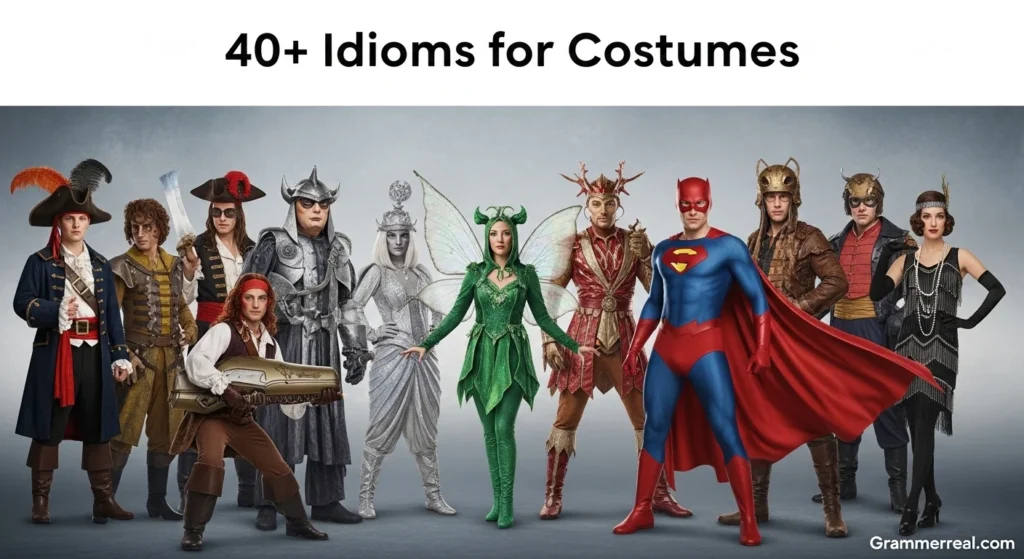
Imagine stepping into a room filled with soft rustling fabrics, bright sequins catching the light, and the faint scent of fabric freshener mixed with stage makeup. You hear heels tapping, jackets swishing, and laughter echoing like music. Costumes do more than cover the body. They tell stories, build characters, and express moods without saying a single word.
Idioms for costumes add another layer to this magic. They turn simple clothing ideas into expressive phrases. These idioms help writers, students, speakers, and creators describe outfits in a lively and imaginative way. They make language colorful, fun, and easier to remember.
Using costume-related idioms can also make your writing more engaging. It helps you describe characters, fashion, or even personality in a creative way. As a result, your words feel alive, almost like a costume itself, dressing up your thoughts in style.
Understanding Idioms for Costumes in Simple Words
Idioms are phrases that carry meanings different from their literal words. When we talk about idioms for costumes, we use clothing-related expressions to describe ideas, behavior, or identity.
For example, when someone says, “wear many hats,” they don’t mean actual hats. They mean a person does many roles. These expressions help you communicate deeper meaning in a simple, creative way.
Moreover, these idioms make your writing more interesting. They also help readers connect quickly because they often relate to everyday experiences. Clothing is something everyone understands, so costume idioms feel familiar and easy to grasp.
Why Costume Idioms Matter in Everyday Life
Costume idioms help you speak and write with more color and personality. Instead of saying something plain, you can use a phrase that paints a picture.
For instance, saying “he fits the role like a glove” feels more vivid than just saying “he is perfect for the role.” This small change makes your words more powerful and memorable.
In addition, these idioms help in storytelling. Writers use them to build scenes, describe characters, and create emotional depth. Teachers use them to explain ideas in a fun way. Even in daily conversations, they make speech sound more natural and expressive.
“Fit Like a Glove” – Perfect Match Explained
This idiom means something fits perfectly, like a costume tailored just for someone.
Meaning and Explanation
“Fit like a glove” shows that something matches perfectly in size, style, or purpose. It creates a clear image of comfort and precision.
Example Sentence
“The costume fit her like a glove, and she looked ready for the stage.”
Alternative Expressions
- Perfect fit
- Ideal match
- Tailor-made
Sensory and Emotional Feel
You can almost feel the soft fabric hugging the body just right. There is comfort, confidence, and a sense of belonging in this phrase.
Mini Story
A young actor steps onto the stage wearing a costume designed just for him. The audience watches in silence. As he moves, the costume flows with him. He smiles because he knows the role belongs to him. The outfit does not just fit his body; it fits his identity.
“Wear Many Hats” – Playing Many Roles
This idiom means a person handles many responsibilities or roles.
Meaning and Explanation
When someone wears many hats, they take on different tasks. Each “hat” represents a role or duty.
Example Sentence
“She wears many hats at work, acting as a manager, designer, and mentor.”
Alternative Expressions
- Multi-tasker
- Jack of all trades
- Many roles
Sensory and Emotional Feel
Imagine someone changing hats quickly, each one showing a different identity. There is movement, energy, and adaptability.
Real-Life Example
In a small business, one person may answer emails, design products, and handle customers. This person truly “wears many hats.”
Cultural Note
This idiom often appears in workplaces and education. It reflects modern life where people juggle multiple responsibilities.
“Dressed to Kill” – Making a Bold Impression
This idiom means dressing in a very stylish or impressive way.
Meaning and Explanation
“Dressed to kill” shows confidence, style, and attention to detail. It suggests someone wants to make a strong impression.
Example Sentence
“She walked into the party dressed to kill, and everyone turned to look.”
Alternative Expressions
- Dressed sharply
- Dressed to impress
- Looking stunning
Sensory and Emotional Feel
You can picture shining fabric, confident steps, and bright lights. The feeling is bold, powerful, and full of energy.
Mini Story
A young girl prepares for her first big event. She chooses her outfit carefully, stands in front of the mirror, and smiles. When she steps outside, people notice her immediately. She feels strong, confident, and proud.
Using Costume Idioms in Writing
Costume idioms can improve your writing by adding creativity and depth. They help you describe characters and scenes more vividly.
For example, instead of writing “he was very confident,” you can write “he walked in dressed to kill, full of confidence.”
This small change makes your writing more engaging. It also helps readers visualize the scene better.
Costume Idioms in Daily Conversation
People use idioms naturally in conversations. Costume idioms can make your speech more expressive and interesting.
For example, you might say:
- “She fits the role like a glove.”
- “He wears many hats at work.”
- “They showed up dressed to kill.”
These phrases make your conversation feel smooth and natural. They also help you connect with others more easily.
Creative Uses of Costume Idioms in Storytelling
Writers often use idioms to build characters and scenes. Costume idioms help create strong visual images.
For example, describing a character as “wearing many hats” shows their busy life. Saying someone is “dressed to kill” shows confidence and charm.
These small details can make a story more engaging. They help readers imagine the characters clearly.
Cultural Meaning Behind Costume Idioms
Costumes play a big role in culture. Different cultures use clothing to express identity, tradition, and status.
Costume idioms reflect this connection. They show how clothing goes beyond fashion. It becomes a symbol of personality and role.
For example, wearing traditional clothing in a ceremony shows respect and identity. Similarly, idioms use clothing to represent deeper meanings.
How to Create Your Own Costume Idioms
You can create your own idioms by combining clothing ideas with actions or meanings.
For example:
- “Buttoned up thoughts” (means very organized thinking)
- “Loose sleeves, open mind” (means flexible thinking)
These creative phrases can make your language unique and expressive.
Match the Meaning
Try matching the idiom with its meaning:
- Fit like a glove
- Wear many hats
- Dressed to kill
Meanings: A. Handling many roles B. Perfect fit C. Very stylish and impressive
(Answers: 1-B, 2-A, 3-C)
Create Your Own Sentence
Write a sentence using one of these idioms:
- Fit like a glove
- Wear many hats
- Dressed to kill
Try to make your sentence vivid and creative.
Story Building
Write a short story using at least two costume idioms. Focus on creating a character who changes roles or dresses for a special event.
Tips for Using Costume Idioms Effectively
Use idioms naturally in your writing or speech. Do not force them into every sentence.
Keep your language simple and clear. This makes your message easy to understand.
Practice regularly. The more you use idioms, the more natural they will feel.
Costume Idioms in Social Media and Content
Costume idioms can make your social media posts more engaging. They add personality and style to your content.
For example:
- “Ready to shine and dressed to kill”
- “Today I wear many hats, and I love it!”
These expressions attract attention and create a friendly tone.
Avoiding Overuse of Idioms
Using too many idioms can confuse readers. Balance is important.
Use idioms where they add value. Combine them with simple sentences to keep your writing clear.
Emotional Impact of Costume Idioms
These idioms often carry emotional meaning. They express confidence, flexibility, and identity.
For example, “fit like a glove” gives a sense of comfort and belonging. “Dressed to kill” gives a feeling of power and confidence.
Fun Activity: Idiom Detective
Read a paragraph and find any costume idioms. Then explain their meaning in your own words.
This activity improves understanding and creativity.
Final Thoughts on Idioms for Costumes
Costume idioms add color, creativity, and meaning to language. They help you express ideas in a fun and memorable way.
They also connect language with everyday life. Clothing becomes more than fabric—it becomes expression.
Using these idioms can make your writing stronger, your speech smoother, and your storytelling more vivid.
Conclusion
Costume idioms bring life into language like bright threads in a woven cloth. They allow you to express ideas in a creative and simple way. They help you describe roles, confidence, and identity with ease.
When you use idioms like “fit like a glove,” “wear many hats,” and “dressed to kill,” you add depth to your words. You make your message clearer, more engaging, and more enjoyable to read.
Keep practicing, keep exploring, and let your language shine like a well-crafted costume on a bright stage.
FAQs
1. What are idioms for costumes?
Idioms for costumes are phrases related to clothing that express deeper meanings. They use fashion ideas to describe behavior, roles, or personality in a creative way.
2. Why should I use costume idioms in writing?
Costume idioms make your writing more colorful and engaging. They help readers understand your message quickly and enjoy the imagery you create.
3. Can I use costume idioms in daily conversation?
Yes, you can use them in everyday speech. They make your conversation sound natural, expressive, and more interesting.
4. How can I learn more costume idioms?
You can read books, watch movies, and practice writing. The more you see and use idioms, the easier they become to remember.
5. Are costume idioms easy to understand?
Yes, most costume idioms are easy to understand because they relate to clothing, something familiar to everyone. With practice, they become even easier to use.