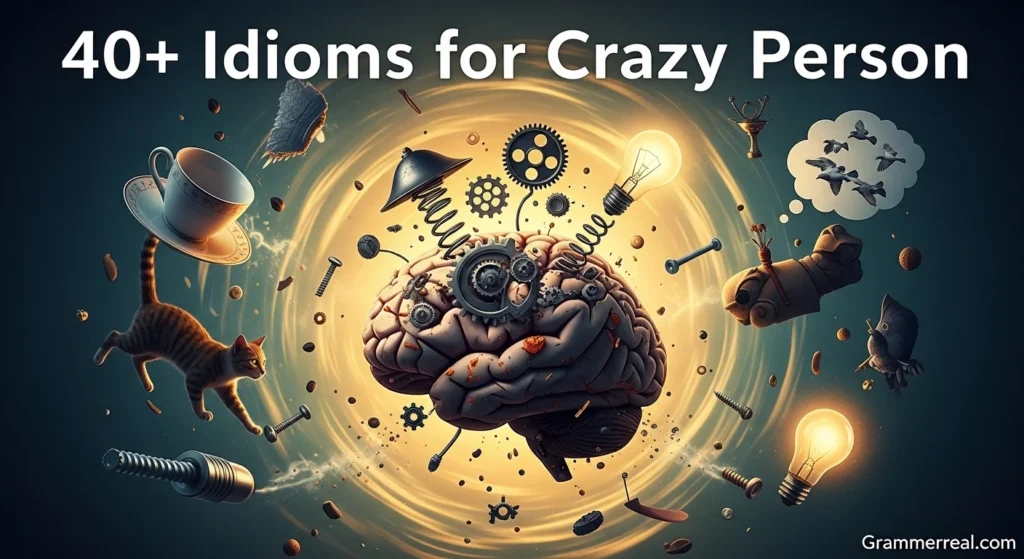
The room seemed to spin as laughter echoed from the corner, mismatched shoes clattering across the floor, and wild ideas leaping from every conversation. Someone was talking to the air as if invisible friends had gathered for tea, while another danced on the edge of reason with a grin that was both mischievous and terrifying.
Moments like these make you wonder—what do we call someone who walks the line between eccentric brilliance and utter madness? Language, rich and playful, gives us a treasure trove of expressions—idioms that capture the essence of a “crazy person.” Understanding and using these idioms isn’t just a fun exercise; it allows us to paint vivid character sketches, connect culturally, and even add humor or subtle critique to conversations.
Idioms for crazy people often carry layers of emotion, cultural context, and humor. They can evoke images of someone who is unpredictably eccentric, wildly imaginative, or hilariously irrational. In this article, we will explore some of the most colorful idioms, learn how to use them creatively, and discover tips and exercises for making them a lively part of your language arsenal.
What Is an Idiom and Why It Matters
Idioms are expressions where the meaning isn’t literal but figurative, often reflecting culture, humor, or shared human experiences. For example, calling someone “mad as a hatter” doesn’t mean they run a hat shop; it evokes the image of eccentric, unpredictable behavior. Knowing idioms for crazy people helps writers, speakers, and even social media enthusiasts capture personality in a way that feels playful and authentic. It is an art form, a linguistic paintbrush to color the personality canvas.
The Power of Words: Why Idioms for Crazy People Are Useful
Using these idioms can make conversations more expressive, writing more colorful, and humor more relatable. They allow us to:
- Express emotions vividly without long explanations.
- Create memorable character descriptions in storytelling.
- Engage readers with humor or wit.
- Connect culturally with references that others intuitively understand.
Now, let’s dive into some of the most illustrative idioms, their meanings, examples, and creative ways to use them.
Mad as a Hatter
Meaning/Explanation: This idiom describes someone completely eccentric or behaving in a wildly unpredictable way. Its origin traces back to 18th-19th century England, where hat makers often suffered mercury poisoning, affecting their mental health.
Example Sentence/Scenario: “After hearing his latest conspiracy theory, I realized he was mad as a hatter.”
Alternative Expressions:
- Nutty as a fruitcake
- Off one’s rocker
- Bonkers
Sensory/Emotional Detail: Imagine the smell of felt and mercury, the endless tapping of tools, the nervous energy vibrating in the workshop—this captures the chaotic essence of someone “mad as a hatter.”
Mini Storytelling: In Lewis Carroll’s Alice’s Adventures in Wonderland, the Mad Hatter embodies whimsy and madness. Picture him pouring tea at an odd angle, talking nonsense yet somehow wise in his own peculiar way. Using this idiom evokes both charm and unpredictability.
Off One’s Rocker
Meaning/Explanation: Refers to someone acting irrationally or seemingly losing touch with reality. It paints a vivid picture of a rocker chair tipping over, symbolizing instability.
Example Sentence/Scenario: “When he suggested we swim in the storm, I knew he was completely off his rocker.”
Alternative Expressions:
- Out to lunch
- Loopy
- Losing one’s marbles
Sensory/Emotional Detail: Visualize the creaking of a wooden rocking chair tipping too far, the wind catching a loose hat, and the dizzying feeling of imbalance. This idiom brings humor and relatability.
Cultural Reference: In comedy sketches, a character who is “off their rocker” often delivers the funniest, most unpredictable lines, showing that perceived madness can be entertaining and creative.
Crazy as a Bedbug
Meaning/Explanation: This American idiom conveys someone who is unpredictably wild or irrational. Bedbugs are tiny, elusive, and hard to catch, mirroring how unpredictable crazy behavior can be.
Example Sentence/Scenario: “She went crazy as a bedbug trying to organize her closet in one afternoon.”
Alternative Expressions:
- Batty
- Wacky
- Out of one’s mind
Sensory/Emotional Detail: Imagine the frantic scurrying of tiny insects, the itching, and the chaotic search for order. The imagery makes this idiom playful yet vivid.
Storytelling Tip: Writers often use this idiom for comic relief, showing a character’s over-the-top reactions in mundane situations.
Nuts to the Core
Meaning/Explanation: Suggests someone is completely irrational or mentally unstable, “nuts” being a metaphor for their brain.
Example Sentence/Scenario: “Even after all the warnings, he went ahead with the dangerous stunt—totally nuts to the core.”
Alternative Expressions:
- Bonkers
- Loopy
- Crackers
Sensory Detail: Imagine cracking open a nut, and instead of a kernel, chaos spills out—an image both humorous and memorable.
Tip for Writing: Use this idiom when you want readers to feel both amusement and disbelief at a character’s actions.
Bats in the Belfry
Meaning/Explanation: Refers to someone with quirky, strange, or erratic ideas. “Bats in the belfry” evokes the image of bats fluttering wildly in a bell tower.
Example Sentence/Scenario: “She claims she can talk to plants—definitely bats in the belfry.”
Alternative Expressions:
- A few screws loose
- Flying off the handle
- Wacky
Sensory Detail: Hear the echoing flaps of wings in a dark tower, the nervous skittering, the chaotic energy—it mirrors a mind filled with strange, unpredictable thoughts.
Mini Storytelling: Writers love this idiom for whimsical or eccentric characters, giving readers a humorous mental image of someone whose ideas fly wildly like bats at midnight.
Loony Tunes of Daily Life
Meaning/Explanation: Describes someone who behaves in absurd or ridiculous ways, often humorously. It’s playful, referencing the chaotic antics of cartoon characters.
Example Sentence/Scenario: “Watching him juggle eggs while balancing on one leg, I knew he was living in loony tunes of daily life.”
Alternative Expressions:
- Nutty
- Zany
- Outrageous
Sensory Detail: Imagine bright, exaggerated colors, slapstick motions, the exaggerated sound of clanging pots, the laughter that follows. This idiom is ideal for light-hearted, humorous writing.
Nutty as a Fruitcake
Meaning/Explanation: Someone who is eccentric, quirky, or mentally unpredictable. Fruitcakes are dense, overflowing with nuts and fruits—messy, chaotic, and surprising—much like the person described.
Example Sentence/Scenario: “My neighbor’s elaborate Halloween decorations make him nutty as a fruitcake.”
Alternative Expressions:
- Bonkers
- Mad
- Wacky
Sensory Detail: Picture biting into a thick, textured fruitcake, discovering hidden surprises and odd textures—the idiom mirrors the quirky unpredictability of a person’s behavior.
Cracking Up Completely
Meaning/Explanation: Refers to someone losing composure or sanity temporarily, often under stress or absurd circumstances.
Example Sentence/Scenario: “She was cracking up completely after realizing she’d locked her keys in the car… again.”
Alternative Expressions:
- Losing it
- Going bonkers
- Freaking out
Sensory/Emotional Detail: Hear the high-pitched laughter, the frantic energy, the sense of chaos building until it bursts—perfect for storytelling and humor.
Out to Lunch
Meaning/Explanation: Suggests someone is mentally absent, distracted, or acting irrationally.
Example Sentence/Scenario: “When he wore his pajamas to the board meeting, everyone knew he was out to lunch.”
Alternative Expressions:
- Daydreaming
- Spaced out
- Scatterbrained
Sensory Detail: Visualize an empty cafeteria seat, a mind wandering through clouds of fantasy, disconnected from reality.
Off the Rails
Meaning/Explanation: Someone acting wildly, unpredictably, or outside of societal norms. Often implies a sudden departure from reason.
Example Sentence/Scenario: “The party went off the rails when the fireworks started indoors.”
Alternative Expressions:
- Wild
- Unhinged
- Chaotic
Sensory Detail: Imagine a speeding train careening around bends, sparks flying, the crowd shouting in exhilaration and fear.
Screwy or Twisted
Meaning/Explanation: Describes someone with bizarre or odd behaviors or thoughts.
Example Sentence/Scenario: “Her theory about talking to trees is a little screwy, but strangely convincing.”
Alternative Expressions:
- Wacky
- Nutty
- Eccentric
Sensory Detail: Visualize twisted metal shapes, spiraling patterns, the sense of unconventional thinking expressed visually.
Lunatic Fringe
Meaning/Explanation: Refers to the most extreme or eccentric individuals in a group.
Example Sentence/Scenario: “The debate team’s lunatic fringe kept proposing impossible theories.”
Alternative Expressions:
- Extremist
- Outliers
- Oddballs
Sensory/Emotional Detail: Picture a distant edge of a crowd, voices shouting wildly, unconventional ideas bouncing in the air.
Whacky Wonder
Meaning/Explanation: A lighthearted idiom for someone delightfully eccentric.
Example Sentence/Scenario: “Her hat collection made her the whacky wonder of the neighborhood.”
Alternative Expressions:
- Zany
- Eccentric
- Out-of-the-box
Sensory Detail: Imagine vibrant, quirky colors, laughter ringing through a sunny street.
Out of One’s Mind
Meaning/Explanation: Someone who behaves irrationally or unpredictably.
Example Sentence/Scenario: “He tried to ride a unicycle on the freeway—completely out of his mind.”
Alternative Expressions:
- Insane
- Bonkers
- Loopy
Sensory Detail: Feel the dizziness, adrenaline, and thrill of taking a wild, unpredictable leap.
Crazy Like a Fox
Meaning/Explanation: Someone who seems eccentric or crazy but is clever or cunning underneath.
Example Sentence/Scenario: “Her chaotic office style hid a system only she could understand—crazy like a fox.”
Alternative Expressions:
- Sly genius
- Cleverly eccentric
- Strategically unpredictable
Sensory Detail: Picture a fox weaving through the forest, sly eyes sparkling, unpredictable yet brilliant.
Bonkers and Bizarre
Meaning/Explanation: Emphasizes both craziness and oddity, often humorous.
Example Sentence/Scenario: “The magician’s disappearing act went bonkers and bizarre when the rabbit refused to appear.”
Alternative Expressions:
- Outlandish
- Weirdly funny
- Loopy
Sensory Detail: Imagine laughter echoing, eyebrows raising, chaos unfolding in unexpected ways.
Frenzied and Freakish
Meaning/Explanation: Denotes someone energetically or wildly irrational.
Example Sentence/Scenario: “During the Black Friday sale, shoppers became frenzied and freakish, grabbing items like wild animals.”
Alternative Expressions:
- Manic
- Hysterical
- Wild
Sensory Detail: Hear screaming, feel jostling, see chaos magnified to absurd levels.
Interactive Exercise: Play with Crazy Idioms
To practice using idioms for crazy people creatively:
- Pick 3 idioms from this list.
- Write a short story (100–200 words) featuring a character acting according to each idiom.
- Try describing emotions or actions using sensory details: smell, sound, or sight.
- Share with a friend and guess which idioms inspired the scenes.
Bonus Tips for Writing & Social Media:
- Use idioms in captions or tweets for humorous exaggeration.
- Mix two idioms for creative effect, e.g., “off his rocker and nutty as a fruitcake.”
- Apply in dialogue to give characters a playful, memorable voice.
Conclusion
Idioms for crazy people are more than quirky phrases—they are windows into culture, humor, and human psychology. They allow writers to paint vivid personalities, enable speakers to express amusement or surprise, and help social media posts leap off the screen with energy. From mad as a hatter to crazy like a fox, these idioms remind us that eccentricity and unpredictability can be entertaining, enlightening, and unforgettable. By practicing them, experimenting with contexts, and adding sensory and emotional depth, you can make language as lively and colorful as the characters it describes.
FAQs
1. What is the best idiom to describe a playful, harmless crazy person?
“Crazy like a fox” or “whacky wonder” are ideal, as they imply eccentricity without negativity.
2. Can these idioms be used in professional writing?
They are best in creative writing, storytelling, and light-hearted contexts rather than formal business reports.
3. Are there cultural differences in idioms for crazy people?
Yes. British, American, and other cultures often have unique expressions like “mad as a hatter” (UK) vs. “crazy as a bedbug” (US).
4. How can I use these idioms in social media?
Use them in captions, tweets, or comments to add humor, vivid imagery, or personality flair.
5. Are idioms for crazy people always negative?
Not always. Many idioms highlight playful eccentricity, creativity, or clever unpredictability rather than outright insult.