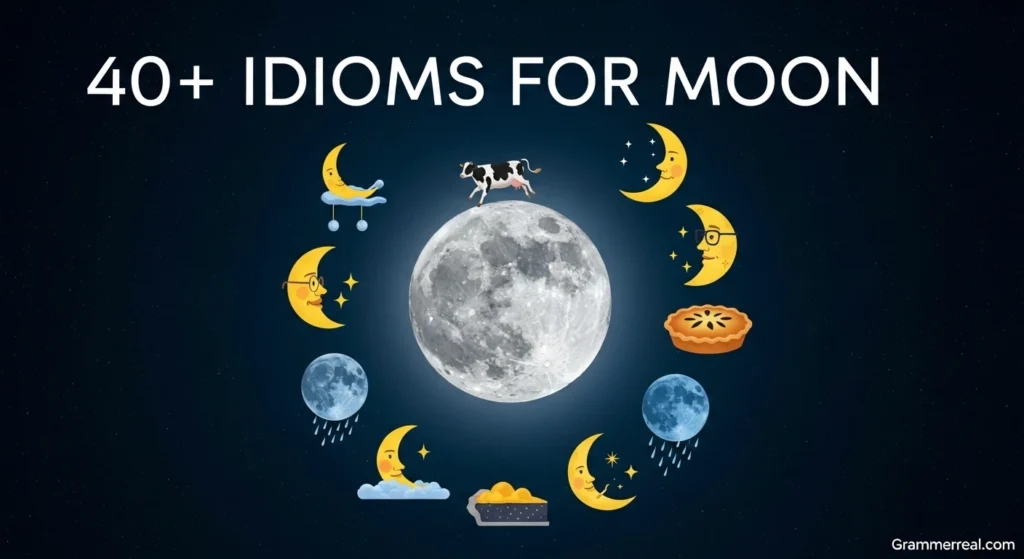
The night feels quiet. A soft silver light spreads across the sky. The moon hangs above the rooftops like a glowing lamp. Stars blink slowly, and the air feels calm and cool. In moments like this, people often look up and feel wonder. Because of that feeling, the moon has always lived inside stories, poems, and everyday speech. Many beautiful expressions come from the moon, and these expressions are called idioms for moon.
Idioms make language colorful. They help us speak in a way that feels alive instead of plain. When we use moon idioms, we do more than talk about the sky. We talk about dreams, love, change, mystery, and hope. That is why learning moon idioms is useful for writers, students, and anyone who wants to speak in a more interesting way.
In this long guide, you will learn many moon idioms, simple meanings, easy examples, small stories, and fun exercises. The language stays easy, so everyone can understand it. Step by step, the moon will help your words shine brighter.
What Are Idioms for Moon and Why People Use Them
Idioms are special phrases. Their meaning is different from the simple meaning of the words. For example, when someone says “over the moon,” they do not mean flying to the sky. They mean feeling very happy.
People use moon idioms because the moon has always been part of human life. Long ago, people watched the moon to know time, weather, and seasons. Later, poets and storytellers used the moon to show feelings. Because of that, many idioms about the moon became common in daily talk.
Also, moon idioms make speech more fun. Instead of saying “I am very happy,” you can say “I am over the moon.” The second sentence feels warmer and more alive.
Another reason people like moon idioms is emotion. The moon looks calm, bright, and mysterious. So these idioms often show strong feelings like love, surprise, dreams, or change.
When you learn these idioms, your speaking becomes richer. Your writing becomes smoother. And your ideas sound more creative.
Why Idioms for Moon Are Important in Writing and Speaking
First, moon idioms help you explain feelings in a simple way. Instead of long sentences, one idiom can show the whole emotion.
Second, these idioms make stories more beautiful. When you write about night, dreams, or love, moon idioms fit naturally.
Third, they help in conversation. People enjoy listening to colorful language. Because of that, using idioms makes you sound confident and friendly.
Another reason is memory. Idioms are easy to remember because they create pictures in the mind. When you hear “once in a blue moon,” you imagine a rare blue moon in the sky. So the meaning stays in your mind longer.
Finally, moon idioms connect language with culture. Many countries have stories about the moon. When you use these idioms, you share a small part of that history.
Over the Moon
Meaning: Very happy, full of joy This idiom shows a feeling so big that normal words are not enough.
Example sentence: She was over the moon when she got the job.
Small story: Ali studied for many months. He felt tired and worried. Then one day, the teacher told him he passed the exam. At that moment, he felt over the moon. He smiled all day and called his family to share the news.
Alternative ways to say it: Very happy Extremely excited Full of joy On top of the world
Emotional detail: This idiom feels warm and bright, like moonlight on a clear night.
Tip for use: Use this idiom when the happiness feels strong and real, not small.
Once in a Blue Moon
Meaning: Something that happens very rarely
Example sentence: He visits us once in a blue moon.
Mini storytelling: There was an old friend who moved to another city. He loved his hometown, but work kept him busy. Because of that, he came back only once in a blue moon. When he finally arrived, everyone felt excited to see him again.
Alternative ways to say it: Very rarely Almost never Not often
Emotional detail: This idiom gives a feeling of waiting a long time for something special.
Tip for use: Use it when you want to show that something is not common.
Ask for the Moon
Meaning: To ask for something impossible
Example sentence: You are asking for the moon if you want everything perfect.
Small story: Sara wanted the best phone, the best laptop, and the best car at the same time. Her brother laughed and said she was asking for the moon. He meant that she wanted too much at once.
Alternative ways to say it: Want too much Ask the impossible Expect too much
Emotional detail: This idiom feels playful but also honest.
Tip for use: Use it when someone wants more than what is possible.
The Moon in Old Stories and Poems
Long ago, people believed the moon had magic. Some thought it watched the earth. Others believed it controlled dreams. Because of these ideas, the moon became a strong symbol in stories.
Poets wrote about lovers meeting under the moon. Travelers looked at the moon to find their way. Farmers watched the moon to know when to plant seeds.
Because of that long history, moon idioms feel natural. When you use them, your words sound like part of a story.
Even today, songs and movies still use the moon to show feelings. That is why these idioms never become old.
How Moon Idioms Make Writing More Beautiful
Good writing needs pictures in the mind. Moon idioms help create those pictures.
For example, saying “The night was bright” sounds normal. But saying “The moon painted the night silver” feels stronger.
Also, idioms make readers feel emotion. When they read “over the moon,” they feel happiness. When they read “once in a blue moon,” they feel waiting.
Another benefit is rhythm. Idioms sound smooth, so sentences feel easy to read.
Because of these reasons, writers often use moon idioms in stories, poems, and even social posts.
Tips for Using Idioms for Moon Correctly
First, understand the meaning before using the idiom.
Second, do not use too many idioms in one sentence. Too many can make writing confusing.
Third, choose the idiom that matches the feeling. Happy → over the moon Rare → once in a blue moon Impossible → ask for the moon
Also, try reading your sentence aloud. If it sounds natural, the idiom fits well.
Finally, practice often. The more you use idioms, the easier they become.
Using Moon Idioms in Creative Writing
When writing stories, moon idioms help show mood.
For example: The village slept under the moon, and she felt over the moon after hearing the good news.
Here the moon shows night, and the idiom shows emotion.
You can also use them in poems. The moon already feels poetic, so the idioms match perfectly.
Another idea is mixing idioms with description. The sky was quiet, and happiness made him feel over the moon.
This makes writing simple but strong.
Using Moon Idioms in Social Media Posts
Short posts need strong words. Idioms help a lot.
Examples: Over the moon today Haven’t seen you in a blue moon Don’t ask for the moon, just try your best
These sentences feel friendly and natural.
Also, moon idioms fit photos of night, sky, travel, or happy moments.
Because of that, they are perfect for captions.
Using Moon Idioms in Daily Conversation
You do not need to be a writer to use idioms.
You can say: I am over the moon today. We meet once in a blue moon. He is asking for the moon.
These sentences sound natural in daily talk.
Also, idioms make conversation more interesting. People enjoy listening when language feels colorful.
So practice using them with friends, family, or classmates.
Interactive Exercise – Fill the Right Moon Idiom
Try to complete the sentences.
- She was ______ after winning the prize.
- We go to that restaurant ______.
- You are ______ if you want everything perfect.
Answers: Over the moon Once in a blue moon Asking for the moon
Practice again with your own sentences.
The more you try, the easier it becomes.
Creative Practice – Write Your Own Moon Sentences
Now make your own lines.
Write one happy sentence using “over the moon.” Write one rare moment using “once in a blue moon.” Write one impossible wish using “ask for the moon.”
You can also write a small story about a night under the moon.
Try to add feelings, sounds, and light.
This practice makes your language stronger.
Bonus Tips for Using Moon Idioms in Daily Life
Use idioms when telling stories. Use them in messages to friends. Use them in school writing. Use them in captions and posts.
Also, listen when others speak. When you hear idioms, try to understand them.
Another tip is reading poems and stories. Writers use many moon expressions, so you can learn naturally.
Slowly, these idioms will become part of your normal language.
Conclusion
The moon has always inspired people. It shines quietly, yet everyone sees its light. In the same way, moon idioms make language bright without making it hard.
When you say “over the moon,” people feel your joy. When you say “once in a blue moon,” they understand rarity. When you say “ask for the moon,” they see the impossible wish.
These small phrases carry big meaning. Because of that, they are useful in writing, speaking, and daily life.
Keep practicing them. Use them in stories. Use them in conversation. Use them when you want your words to feel warm and alive.
Just like the moon lights the night, these idioms will light your language.
FAQs
1. What are idioms for moon?
Idioms for moon are phrases that use the moon to show feelings, ideas, or situations in a creative way.
2. Why do people use moon idioms?
People use them because they sound interesting, emotional, and easy to remember.
3. What does over the moon mean?
It means feeling very happy or excited.
4. What does once in a blue moon mean?
It means something happens very rarely.
5. How can I learn idioms faster?
Practice daily, read stories, listen to conversations, and try making your own sentences.