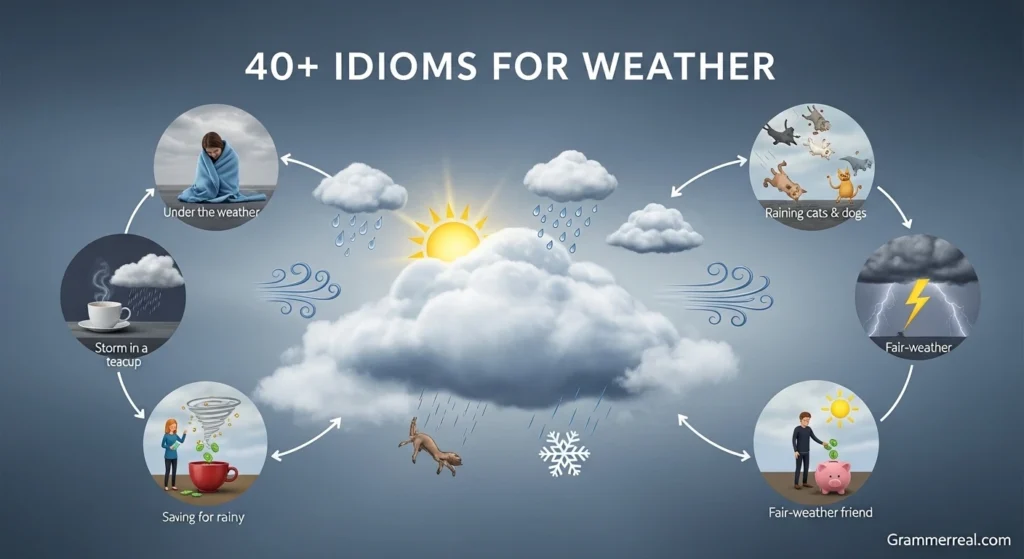
The wind moves first. Leaves shake, clouds roll slowly, and the air feels heavy or light. Sometimes the sun burns your skin. Sometimes rain taps on the roof like small fingers. Weather changes all the time, and people talk about these changes every day. Long ago, people watched the sky to understand life. Farmers looked at clouds. Sailors listened to the wind. Travelers watched the color of the sunset. Because of this, many idioms for weather were born.
Weather idioms are special phrases. They do not always mean real rain, real snow, or real wind. Instead, they show feelings, problems, luck, or hope. When someone says, “It’s raining cats and dogs,” no animals fall from the sky. The person only means heavy rain. These phrases make language colorful, alive, and fun to hear.
Learning weather idioms in English helps you speak in a natural way. Movies use them. Stories use them. Friends use them in daily talk. When you know these idioms, you understand jokes, songs, and books better. Also, your writing becomes more interesting because you can show emotions like a storm, calm, or sunshine.
In this article, you will learn many useful idioms about weather, their meanings, and how to use them in real life. You will see examples, short stories, practice ideas, and creative tips. Step by step, the sky will open, and language will shine like sunlight after rain.
What are idioms for weather and why people use them
Idioms for weather are phrases that use weather words but give a different meaning. These meanings often show feelings, situations, or life events. People use them because weather is something everyone understands. Everyone knows rain, wind, heat, and cold. Because of that, weather idioms feel natural and easy to imagine.
For example, a storm can show trouble. Sunshine can show happiness. Fog can show confusion. When we speak like this, our words feel strong and clear.
People also use weather idioms in English conversation because they make speech friendly. Instead of saying, “I am very happy,” someone may say, “I feel on cloud nine.” Instead of saying, “Things are getting worse,” someone may say, “A storm is coming.”
These phrases help speakers sound natural, not robotic. They also help writers paint pictures in the reader’s mind.
Another reason people love weather idioms is culture. Old stories, poems, and songs used nature a lot. Because of that, many idioms come from history. When you learn them, you also learn a small piece of culture.
So, weather idioms are not only words. They are pictures, feelings, and stories inside language.
How weather idioms make writing more alive
Simple words tell information, but idioms tell a story. When you use idioms for weather, your writing feels warm and human. Readers can see the scene, not only read it.
For example, look at these two sentences:
- The day was bad.
- The day started bright, but dark clouds came quickly.
The second sentence feels stronger because it shows weather. When you add idioms, the effect becomes even better.
Example:
- Trouble started.
- A storm was brewing.
Now the reader feels danger, not just reads about it.
Writers use weather idioms to show mood. Happy scenes use sunshine. Sad scenes use rain. Confusing scenes use fog. Angry scenes use thunder. Because of this, weather idioms work like colors in painting.
If you want your stories, posts, or essays to feel alive, learning weather idioms helps a lot.
Raining cats and dogs
This is one of the most famous weather idioms in English.
Meaning
It means very heavy rain.
Example
Yesterday it was raining cats and dogs, so we stayed inside all day.
Alternative ways
- Pouring rain
- Heavy rain
- Downpour
- Rain like a waterfall
Small story
A boy planned to play cricket outside. He waited all week. However, the sky turned dark. Soon, rain fell hard and fast. His mother looked outside and said, “It’s raining cats and dogs. Today we stay home.”
The boy felt sad, but later he watched a movie and laughed. The storm ended, and the day still felt good.
Tip
Use this idiom in stories, daily talk, or social media when rain feels strong and loud.
Practice
Write one sentence about a rainy day using this idiom.
Under the weather
This idiom does not talk about real weather.
Meaning
It means feeling sick or tired.
Example
I will not go to school today. I feel under the weather.
Alternative ways
- Not feeling well
- Sick
- Weak
- Tired
Mini storytelling
A worker woke up early. His head hurt. His body felt heavy. The sun was bright, but he could not enjoy it. He called his boss and said, “I feel under the weather today. I need rest.”
The boss understood because everyone feels like this sometimes.
Emotional detail
This idiom often shows quiet weakness, not big pain.
Practice
Think about the last time you felt tired. Write one sentence using this idiom.
A storm is coming
This idiom shows trouble.
Meaning
Problems will start soon.
Example
Everyone stayed quiet because they knew a storm was coming.
Alternative ways
- Trouble is near
- Problems will start
- Bad time ahead
- Hard situation coming
Mini story
Two friends argued many times. Small fights happened every day. One day, their teacher saw them and said, “I feel a storm is coming. You must fix this now.”
Soon, a big fight started. The teacher was right.
Writing tip
Use this idiom before a big event in a story. It makes readers feel suspense.
Practice
Write a short line about a coming problem using this idiom.
More popular idioms for weather in daily life
People use many weather idioms every day. These phrases help speech sound natural.
Examples:
- On cloud nine – very happy
- Break the ice – start talking
- Calm before the storm – quiet before trouble
- Snowed under – too busy
- In the dark – confused
- Weather the storm – survive trouble
Each idiom shows a picture. When you imagine the picture, you remember the meaning easily.
Try to learn idioms in small groups. Use them in sentences. Say them aloud. Slowly, they will become part of your speech.
How to remember weather idioms easily
Many students forget idioms because they try to memorize only the meaning. Instead, use pictures, stories, and feelings.
First, imagine the weather. Second, connect the weather with emotion. Third, make your own sentence.
Example:
Storm → danger → problem coming Sunshine → happy → good day Fog → cannot see → confusion
Also, write idioms in a notebook. Use colors. Draw small pictures. This method helps memory work better.
Another good trick is repetition. Use one idiom many times in one day. After that, it feels natural.
Using weather idioms in stories and essays
Writers love idioms about weather because they create mood quickly.
When you write a happy story, use sunshine, rainbow, or clear sky. When you write a sad story, use rain, cold, or dark clouds and when you write suspense, use storm, wind, or thunder.
Example:
Instead of writing He was scared.
Write Dark clouds filled his mind, and he felt a storm inside.
The second line feels stronger.
Try to use idioms at the start, middle, and end of your writing. This makes the story feel smooth.
Using weather idioms in daily conversation
Weather idioms are perfect for friendly talk.
People say:
- The future looks bright
- Things are cloudy
- I am on cloud nine
- That idea came out of the blue
These phrases sound natural. Native speakers use them often. When you use them, your English sounds more real.
Start with easy idioms. Use them with friends. Use them online and use them in messages. Practice makes them easy.
Creative exercise – make your own weather idiom sentences
Try this exercise.
Choose weather Rain, sun, wind, snow, storm, fog
Choose feeling Happy, sad, confused, angry, tired
Make sentence
Example: My mind is full of fog today. Her smile is sunshine. Problems fell like heavy rain.
Write five sentences like this. This exercise helps you think like a writer.
Cultural and literary use of weather idioms
Old stories used weather a lot. Poets talked about storms and stars. Farmers watched the sky every day. Because of this, weather became part of language.
In movies, storms show danger. In songs, rain shows sadness and in books, sunshine shows hope.
When you learn weather idioms in English, you understand stories better. You also feel the emotion the writer wants to show.
That is why idioms are not only grammar. They are part of culture.
Bonus tips for social media, writing, and speaking
Use weather idioms in posts. They make captions interesting.
Example: Today feels like sunshine. Busy like a snowstorm. Calm before the storm.
In stories, use idioms to show mood. In conversation, use them to sound friendly.
Do not use too many in one line. Use them slowly. This keeps writing clear.
Practice every day. One idiom daily is enough.
Practice prompts for readers
Try these prompts.
Write about a rainy day using one idiom, write about a happy day using sunshine idiom, write about a problem using storm idiom write about confusion using fog idiom and write about success using bright sky idiom.
Read your sentences aloud. If they sound natural, you did well.
Common mistakes when using weather idioms
Some learners translate from their own language. This makes mistakes.
Wrong: Rain is falling cats and dogs.
Correct: It is raining cats and dogs.
Also, do not change idioms too much. Keep the form correct.
Another mistake is using too many idioms together. This makes writing hard to read.
Use one or two at a time.
Building strong vocabulary with weather idioms
Weather idioms help vocabulary grow fast. When you learn one idiom, you also learn many words.
Storm → wind, rain, thunder Sun → light, warm, bright Fog → gray, unclear, hidden
Because of this, idioms help speaking, writing, and reading at the same time.
Practice daily. Repeat often. Use in real life.
Language grows like a tree when you water it every day.
Conclusion
The sky changes every day, and language changes with it. That is why idioms for weather feel so natural and powerful. They come from real life, real feelings, and real stories. When people talk about storms, sunshine, rain, or fog, they are not only talking about the sky. They are talking about life.
Learning weather idioms makes your English more alive. Your speech sounds friendly. Your writing feels colorful and your stories become easy to imagine. Step by step, these small phrases help you speak like a real user of the language, not only a learner.
Practice often. Use idioms in daily talk. Write small sentences. Try creative exercises. Slowly, the words will feel easy, like talking about the weather with a friend.
Language is like the sky. Sometimes cloudy, sometimes bright, but always beautiful when you understand it.
FAQs
1. What are idioms for weather?
Weather idioms are phrases that use weather words but give a different meaning. They show feelings, situations, or life events instead of real weather.
2. Why are weather idioms important in English?
They make speaking natural, help understanding movies and books, and make writing more interesting and colorful.
3. What is the easiest weather idiom to learn?
“Raining cats and dogs” is very easy because it clearly shows heavy rain and people use it often.
4. How can I remember idioms easily?
Use pictures, stories, and your own sentences. Practice daily and repeat the idiom in real conversation.
5. Can I use weather idioms in writing and social media?
Yes. They are perfect for stories, captions, essays, and daily conversation because they show emotion in a simple way.



