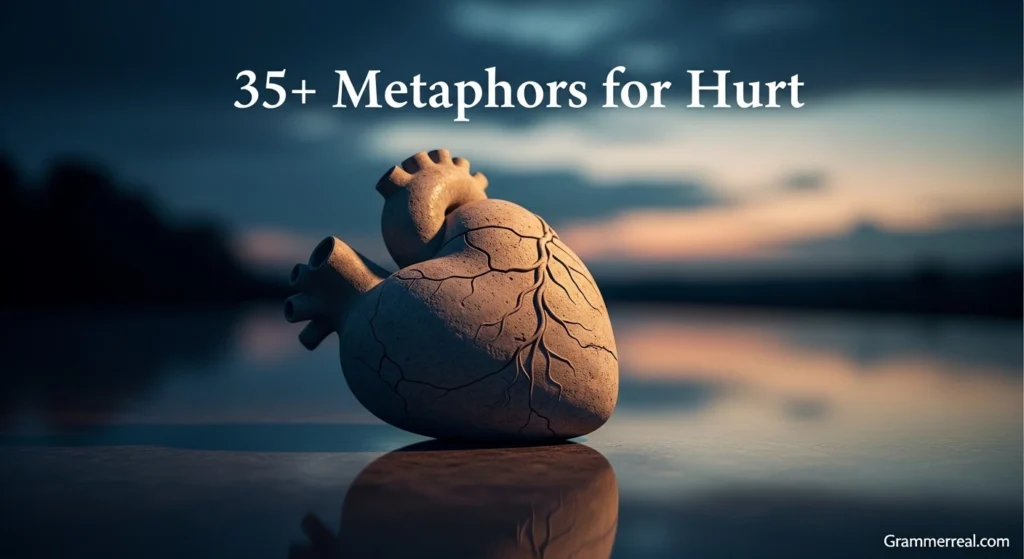
It feels like a sharp wind brushing your skin on a cold night. It feels like a tiny crack inside your chest that no one else can see. Hurt does not always shout. Sometimes, it whispers. Sometimes, it sits quietly like a heavy stone in your pocket, pulling you down with every step.
You may feel hurt after harsh words, lost love, broken trust, or even small moments that stay in your heart longer than they should. Because hurt is hard to explain, people often use metaphors. A metaphor gives shape to feelings. It turns pain into something we can see, touch, or imagine.
In this article, you will explore metaphors for hurt in a simple and friendly way. You will learn how to use them in writing, daily life, and even social media. You will also find examples, tips, small stories, and fun exercises to help you practice.
Why Metaphors for Hurt Matter in Emotional Expression
Metaphors are more than poetic decoration—they’re emotional bridges. When you say, “I’m hurting,” it’s true, but vague. When you say, “It feels like carrying broken glass inside my ribs,” suddenly, someone sees it.
Metaphors help:
- Express complex feelings
- Create empathy in readers or listeners
- Make abstract pain tangible
- Offer comfort through shared imagery
In literature, heartbreak is rarely described clinically. It becomes oceans, wounds, winters, wars. Because hurt is human—and humans speak in symbols.
The Psychology Behind Pain Metaphors and Healing
Our minds naturally use metaphor to process emotion. We often understand feelings through physical experiences: heaviness, sharpness, warmth, cold.
That’s why we say:
- “A stabbing betrayal”
- “A crushing grief”
- “A cold loneliness”
Metaphors don’t erase pain, but they give it form. Naming something is often the first step toward carrying it differently.
A Friendly Guide to Metaphors for Hurt in Writing
If you’re a writer, poet, songwriter, or even someone crafting a heartfelt caption, metaphors for hurt can elevate your expression.
Good metaphors are:
- Specific
- Sensory
- Emotionally honest
- Fresh (not cliché)
Instead of “My heart is broken,” try an image that feels uniquely yours.
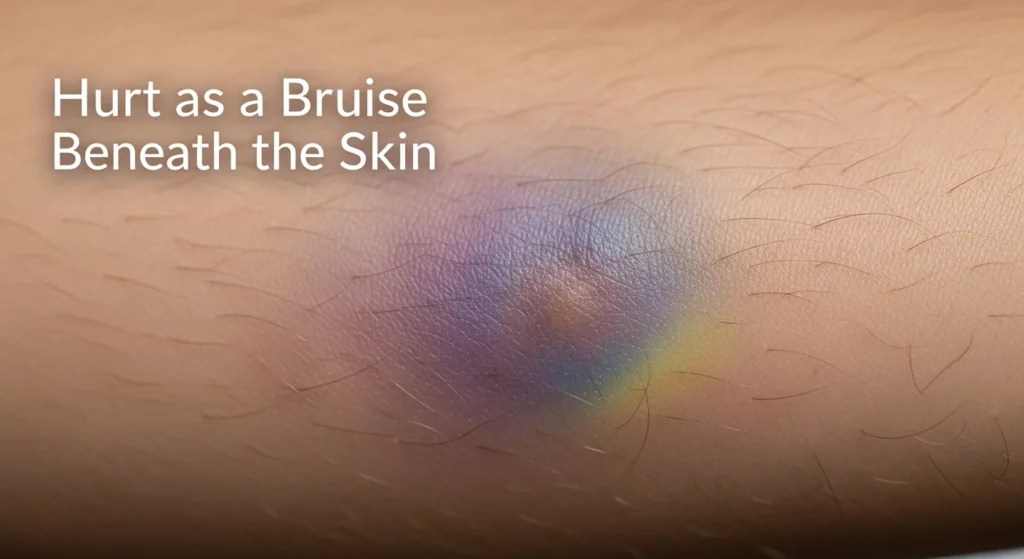
Hurt as a Bruise Beneath the Skin
Meaning & Explanation
This metaphor compares emotional pain to a bruise—something unseen but tender, sore, and real.
Bruises remind us: hurt lingers. Even when the world can’t see it, you feel it with every touch.
Example Sentence
“Her words left a bruise on my spirit, tender in places no one knew to press.”
Alternative Ways to Express It
- “A sore spot in my chest”
- “An ache that blooms under the surface”
- “A hidden injury of the heart”
Sensory & Emotional Detail
Bruises change color over time—purple, green, yellow—like grief transforming slowly, unwillingly, into something survivable.
Mini Storytelling Touch
Think of old heartbreak like an old bruise: you don’t notice it until something bumps against it, and suddenly you’re back in that moment.
How to Use Bruise Metaphors in Daily Life
Bruise metaphors work beautifully in captions, journaling, and honest conversations.
Try:
- “Still tender from what happened.”
- “Some pain doesn’t show, but it stays.”
- “Healing isn’t instant—it fades like a bruise.”
Bonus tip: Pair bruise imagery with softness—bandages, time, gentleness—to create emotional contrast.
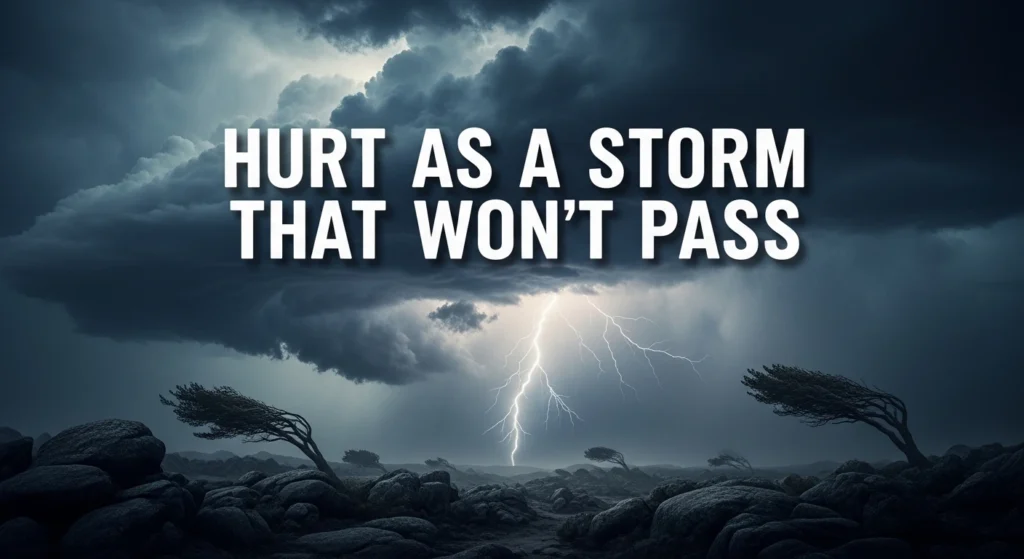
Hurt as a Storm That Won’t Pass
Meaning & Explanation
This metaphor frames pain as weather—unpredictable, overwhelming, sometimes consuming the whole sky.
Storm metaphors capture emotional chaos: the way sadness or anger can feel bigger than you.
Example Sentence
“Grief rolled through me like thunder, shaking everything I thought was steady.”
Alternative Ways to Express It
- “A hurricane in my chest”
- “Rain I couldn’t outrun”
- “Clouds that refused to lift”
Sensory & Emotional Detail
Storms have sound: roaring wind, relentless rain. Hurt can feel loud like that—unavoidable.
Literary Reference
Shakespeare often used storms as emotional mirrors. In King Lear, the raging weather reflects inner collapse. Nature becomes metaphor because pain is elemental.
Write Your Emotional Weather Report
Exercise: Describe your current emotional state as weather.
Ask yourself:
- Is it foggy confusion?
- A bright but brittle winter sun?
- A storm with flashes of hope?
Write one paragraph beginning with: “Today, my heart feels like…”
This is a powerful way to externalize emotion without drowning in it.
Hurt as Carrying a Stone in Your Pocket
Meaning & Explanation
This metaphor compares pain to a weight you carry—small enough to hide, heavy enough to tire you.
It’s perfect for long-term hurt: heartbreak, regret, quiet loss.
Example Sentence
“I moved through life with sorrow in my pocket, a stone I kept rubbing without realizing.”
Alternative Ways to Express It
- “A weight behind my ribs”
- “A burden I learned to hold”
- “A quiet heaviness I never set down”
Sensory & Emotional Detail
Stones are cold. Solid. Persistent. Hurt can feel like that—unchanging, patient.
Real-Life Resonance
People often function while hurting. They laugh, work, show up. But inside, they carry something dense and private.
Tips for Writing Fresh Metaphors for Hurt Without Clichés
To avoid overused phrases, try these strategies:
- Zoom into specificity Instead of “broken,” describe how it breaks: splintering, cracking, shattering.
- Use unexpected objects Hurt doesn’t have to be knives and storms. It can be:
- An unplugged lamp
- A song skipping
- A door that won’t close
- Blend senses Mix touch, sound, taste:
“Bitterness sat on my tongue like old coffee.”
Metaphors for Hurt in Relationships and Heartbreak
Heartbreak metaphors often revolve around absence:
- “A house with missing furniture”
- “A song without its chorus”
- “A phone that never rings”
Romantic hurt is uniquely haunting because love leaves echoes.
Mini scenario: You reach for someone in bed, half-asleep, and remember they’re gone. That absence becomes its own metaphor: an empty space shaped like them.
Metaphors for Hurt in Grief and Loss

Grief metaphors tend to be vast:
- “An ocean you learn to swim”
- “A shadow that follows”
- “A season that lasts too long”
Grief isn’t a single wound. It’s a landscape.
Writers like Joan Didion described grief as disorientation—life suddenly rearranged, familiar rooms feeling foreign.
Build Your Own Metaphor for Pain
Try this simple formula:
Emotion + Object + Sensory Detail
Example: “Loneliness is a hallway light buzzing at midnight.”
Now you try:
- Hurt is like __________
- Because it feels __________
- And it reminds me of __________
Write three versions. One will surprise you.
Metaphors for Hurt in Poetry, Stories, and Captions
Here are a few ready-to-use metaphor seeds:
- Hurt is a cracked mirror: you see yourself differently.
- Pain is an unfinished letter: words trapped inside.
- Heartache is a slow leak: not dramatic, but constant.
For social media, keep it short and sharp:
- “Some wounds don’t bleed. They echo.”
- “I’m healing, but still tender.”
- “Pain has a long memory.”
How to Use Metaphors for Hurt for Comfort and Connection
Metaphors aren’t just for art. They help in real conversations:
Instead of saying, “I’m fine,” you might say:
- “I feel a little bruised today.”
- “It’s been stormy inside.”
- “I’m carrying something heavy.”
These images invite gentleness. They allow others to meet you where you are.
Metaphors for Hurt Across Cultures and Literature
Across cultures, pain becomes symbol:
- In Japanese poetry, sadness is often autumn leaves falling.
- In Greek tragedy, suffering is fate’s thread tightening.
- In modern music, heartbreak becomes burning cities, empty highways, fading stars.
Hurt is universal. Metaphor is the shared language we use to survive it.
Conclusion
Hurt is part of life. Everyone feels it in different ways. However, when you use metaphors, you give your pain a voice.
You turn silent feelings into clear images. You make your emotions easier to share. Most importantly, you remind yourself that pain can be understood, shaped, and even softened through words.
So next time you feel hurt, do not hide it inside. Instead, describe it. Let it flow into words like rain, fire, or glass. You may find that your pain becomes lighter when you express it.
FAQs
1. Why do metaphors help express emotional pain?
Because pain is often abstract, and metaphors turn it into something sensory and relatable, making it easier to communicate.
2. What are some unique metaphors for hurt beyond “broken heart”?
Try images like bruises, storms, stones in pockets, cracked mirrors, unfinished letters, or empty rooms.
3. How can I create my own metaphors for hurt?
Start with what the pain feels like physically—sharp, heavy, cold—and connect it to an object or experience.
4. Are metaphors useful for healing, not just writing?
Yes. Metaphors help people name and process emotions, which can be an important step toward understanding and healing.
5. How can I use metaphaphors for hurt in social media or daily conversation?
Keep them simple and personal: “I’m feeling tender today,” or “It’s been stormy inside,” can express a lot with few words.