Many English learners feel confused about one vs won because both words sound exactly the same. When two words have the same sound but different meanings, they are called homophones.
Because of this, students often mix them in writing. However, their meanings are completely different. One word talks about number, and the other word talks about winning. Therefore, it is very important to understand the difference clearly. In this article, you will learn the meaning, grammar, and correct usage of one and won in very simple language. You will also see clear examples and easy rules. By the end, you will never confuse one vs won again.
The Basic Difference Between One and Won
The difference is simple.
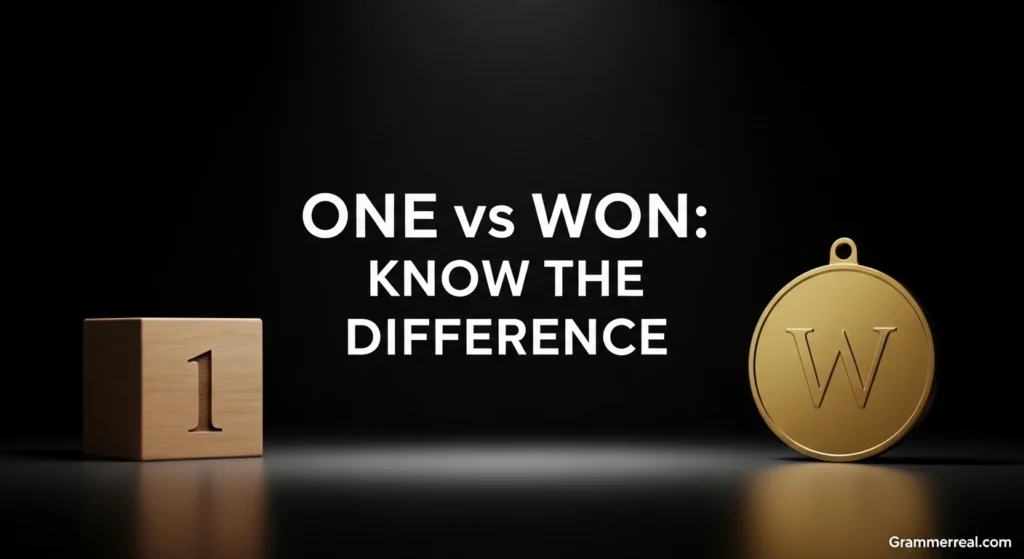
One is a number. Won is the past tense of win.
Although both words sound the same, their spelling and meaning are different.
Meaning of One
The word one is a number. It means a single person or thing. It is the first counting number.
Examples:
I have one book. She ate one apple. There is one cat outside.
In each sentence, one shows quantity. It tells us how many.
Uses of One
One can be used in different ways.
- As a number I need one pen.
- To replace a noun I like the red shirt, but I will buy the blue one.
- In expressions One day, I will travel the world.
In all these cases, one relates to number or quantity.
Meaning of Won
The word won is the past tense of the verb win. The verb win means to achieve victory in a game, competition, or contest.
Present: win Past: won Past participle: won
Examples:
She won the race. They won the match. He won a prize.
In each sentence, won shows past action.
Easy Comparison Examples
Let us compare both words in simple sentences.
Correct use of one: I bought one ticket. She has one brother.
Correct use of won: He won the game. They won the competition.
Now look at common mistakes.
Incorrect: He one the match. Correct: He won the match.
Incorrect: I have won pencil. Correct: I have one pencil.
These examples show how spelling changes the meaning.
Grammar Difference
One is usually used as a noun or pronoun. It talks about number or replaces a noun.
Won is always a verb. It shows past action of winning.
So if your sentence needs a number, use one. If your sentence talks about victory in the past, use won.
Sentence Structure Help
Look at the sentence carefully. Ask yourself a simple question.
Is the sentence about counting? If yes, use one.
Is the sentence about winning? If yes, use won.
This question helps you choose the correct word.
More Practice Sentences
Here are more examples for practice.
She has one idea. Only one student came today. I need one minute.
He won the prize yesterday. Our team won the final match. She won first place in the race.
Reading and writing these sentences helps you remember the rule.
Short Practice Story
Let us read a short story to understand better.
Ali bought one ticket for the football match. He sat in the stadium and watched the game. His favorite team played very well. In the end, his team won the match. Ali felt very happy because he bought one ticket and watched his team win.
In this story, one talks about number, and won talks about victory.
Why Students Confuse One and Won
Students confuse these words because they sound the same. In speaking, you cannot hear the spelling difference. However, in writing, spelling matters a lot. Therefore, you must think about meaning before you write.
Practice helps reduce mistakes.
Easy Memory Trick
Here is a simple trick to remember.
One starts with the letter O. You can think of O as a small circle that looks like the number zero. Numbers remind you of counting.
Won starts with the letter W. W can remind you of the word win. Both words start with W.
This small trick makes remembering easier.
Common Errors in Exams
Teachers often see mistakes like these:
Wrong: She one the race. Right: She won the race.
Wrong: I have won sister. Right: I have one sister.
Such mistakes are simple but can reduce marks. Therefore, always check the meaning before writing.
Quick Summary
One = number Won = past tense of win
If you talk about quantity, use one. If you talk about victory in the past, use won.
The pronunciation is the same, but the meaning is different.
Conclusion
In conclusion, the difference between one vs won is very clear when you understand their meaning. One is a number that shows quantity. Won is the past tense of win and shows victory. Even though both words sound the same, their spelling and usage are different. If you focus on the meaning of your sentence, you will easily choose the correct word. With practice and careful writing, you will not confuse one and won again.
FAQs
1. What is the main difference between one and won?
One is a number, while won is the past tense of win.
2. Do one and won sound the same?
Yes, they sound the same, but they have different meanings.
3. Is one a verb?
No, one is a number or pronoun.
4. Is won a verb?
Yes, won is a verb and the past tense of win.
5. Can I say “He one the game”?
No, the correct sentence is “He won the game.”
6. Can I say “I have won brother”?
No, the correct sentence is “I have one brother.”
7. Why do students confuse one and won?
Students confuse them because both words have the same pronunciation.
8. How can I remember the difference easily?
Remember that W in won stands for win.
9. Is one used for counting?
Yes, one is used to show number or quantity.
10. Is won used for past victory?
Yes, won shows that someone achieved victory in the past.