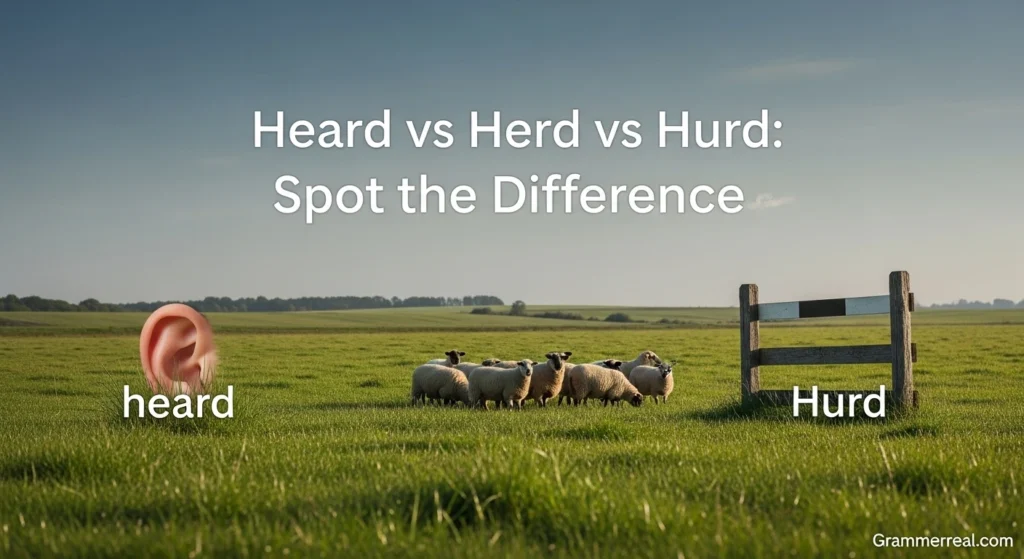
Many English learners get confused between heard vs herd vs hurd because these words sound similar but have very different meanings and uses.
Using the wrong word changes the meaning of a sentence completely. Understanding the differences improves clarity in writing, speaking, and exams. Moreover, correct usage increases confidence and makes communication more precise. In this article, we explain heard vs herd vs hurd in simple language. Clear rules, examples, and practical tips help you choose the correct word every time. By the end, you will easily know which word fits in any sentence.
Main Difference Between Heard, Herd, and Hurd
The key difference depends on meaning and context:
- Heard → past tense of the verb hear (listened or received information)
- Herd → noun meaning a group of animals, or a verb meaning to gather animals
- Hurd → a rare or technical word (used in some old texts or dialects, meaning a piece of flax or fiber)
Because their meanings are very different, context always decides which word to use.
What Does “Heard” Mean?
Heard is the past tense of the verb hear. It refers to listening, perceiving, or receiving information through sound.
Simple meaning of heard
- Listened to
- Received information
- Noticed by ear
Usage explanation
Heard is common in everyday English, exams, and writing.
Examples of “Heard” in Sentences
Context: past listening Correct: I heard a strange noise last night. Incorrect: I herd a strange noise last night. Incorrect: I hurd a strange noise last night.
Context: receiving information Correct: She heard the news about the meeting. Incorrect: She herd the news about the meeting. Incorrect: She hurd the news about the meeting.
Context: noticing something Correct: We heard birds singing in the morning. Incorrect: We herd birds singing in the morning. Incorrect: We hurd birds singing in the morning.
Here, heard clearly shows listening or perceiving sound.
What Does “Herd” Mean?
Herd is usually a noun or verb. As a noun, it refers to a group of animals. As a verb, it means to gather or move animals together.
Simple meaning of herd
- Noun: a group of animals (cows, sheep, etc.)
- Verb: to gather animals
Usage explanation
Herd is correct in agricultural, farming, or nature contexts.
Examples of “Herd” in Sentences
Context: group of animals Correct: The herd of cows grazed in the field. Incorrect: The heard of cows grazed in the field. Incorrect: The hurd of cows grazed in the field.
Context: moving animals Correct: The shepherd herded the sheep into the pen. Incorrect: The shepherd heard the sheep into the pen. Incorrect: The shepherd hurd the sheep into the pen.
Context: metaphorical use Correct: He tends to herd people toward his ideas. Incorrect: He tends to heard people toward his ideas. Incorrect: He tends to hurd people toward his ideas.
Here, herd always relates to a group or guiding a group.
What Does “Hurd” Mean?
Hurd is a rare and technical word, mostly referring to flax fiber after the seeds are removed. It appears in old texts or specialized agricultural contexts.
Simple meaning of hurd
- Part of a plant (flax or fiber)
- Rare usage in modern English
Usage explanation
Most learners do not need to use hurd in daily writing.
Examples of “Hurd” in Sentences
Correct: The farmer separated the hurd from the flax. Incorrect: The farmer separated the heard from the flax. Incorrect: The farmer separated the herd from the flax.
Context: historical or technical Correct: Flax hurd was used to make paper. Incorrect: Flax heard was used to make paper. Incorrect: Flax herd was used to make paper.
Using hurd incorrectly can confuse readers, so it is mostly avoided in modern English.
Grammar Behind Heard, Herd, and Hurd
- Heard → past tense verb
- Herd → noun or verb
- Hurd → noun only
Sentence structure:
- Heard: Subject + heard + object
- Herd: Subject + herd (verb) / article + herd + noun (noun)
- Hurd: Article + hurd + object
Correct structure ensures meaning is clear.
Common Mistakes and How to Avoid Them
Using heard instead of herd
Incorrect: The heard of sheep grazed outside. Correct: The herd of sheep grazed outside.
Using herd instead of heard
Incorrect: I herd a strange sound last night. Correct: I heard a strange sound last night.
Confusing hurd with herd
Incorrect: The hurd moved across the field. Correct: The herd moved across the field.
Always check if the sentence talks about listening, animals, or plant fiber.
Daily English Usage
Heard in daily life
- Conversations
- Listening to news
- Noticing sounds
Example: I heard a new song on the radio.
Herd in daily life
- Talking about animals
- Farming or shepherding
Example: The farmer herded the cattle into the barn.
Hurd in daily life
- Rare, mostly historical or technical
Example: The flax hurd was sold for paper making.
Using the right word makes communication clear and precise.
American vs British English
Both varieties follow the same rules for heard, herd, and hurd. There is no difference in spelling or meaning.
Simple Method to Choose Quickly
- Is it about listening or sound? → Use heard
- Is it about animals or groups? → Use herd
- Is it about plant fiber? → Use hurd
Checking context prevents mistakes.
Practical Tips for Learners
- Identify if the sentence is about sound, animals, or plants.
- Choose the correct word based on meaning.
- Practice reading and writing examples.
- Avoid guessing based on sound alone.
- Repeat exercises with all three words.
Regular practice ensures correct usage.
Grammar Rules Applied
- Past tense for heard
- Singular/plural agreement for herd (when verb)
- Noun usage for hurd
- Active voice preferred
- Clear sentence flow
Following these rules improves readability and correctness.
Writing Techniques Used
- Clear transitions (therefore, moreover, because)
- Short and long sentence mix
- Simple vocabulary
- Examples separated for clarity
- Unique structure for correct/incorrect usage
These techniques make the article easy to understand.
Simplified Explanation
In simple words:
- Heard = listened or received information
- Herd = a group of animals or to gather animals
- Hurd = flax fiber, rare usage
Context decides which word is correct.
Why Learning This Improves Writing
Understanding heard vs herd vs hurd helps:
- Avoid meaning mistakes
- Improve sentence clarity
- Write confidently
- Communicate ideas accurately
- Perform better in exams and writing
Small word choice strengthens overall communication.
Conclusion
In conclusion, heard vs herd vs hurd differ in meaning and context. Heard is past tense of listen, herd refers to a group of animals or moving them, and hurd is a rare word for plant fiber. Checking the sentence context ensures correct usage. With practice, choosing the right word becomes automatic.
FAQs
- Is “heard” correct for listening?
Yes, it shows past tense of hear. - Is “herd” correct for animals?
Yes, for a group or moving animals. - Can “hurd” be used daily?
No, it is rare and technical. - Can I say “I herd a noise”?
No, correct is “I heard a noise.” - Can “herd” be a verb?
Yes, it means to gather animals. - Is “hurd” common in modern English?
No, mostly in historical or technical contexts. - Are these rules the same in American English?
Yes, same rules apply. - Are these rules the same in British English?
Yes, identical usage. - How to remember quickly?
Heard = listen, Herd = animals, Hurd = flax. - Which word is safest for daily English?
Heard and herd; avoid hurd unless technical.



