Many English learners get confused between sizable vs sizeable because both words look almost the same and share the same meaning. This confusion often appears in exams, formal writing, and everyday English.
Since English spelling changes slightly between regions, learners sometimes think one form is wrong. However, both words are correct, and context decides which one fits better. Understanding sizable vs sizeable helps improve spelling accuracy and overall writing confidence. In this article, we explain the difference using very simple language and clear grammar rules. Easy examples and practical tips support understanding throughout. By the end, you will know when to use sizable and when to use sizeable without hesitation.
Main Difference Between Sizable and Sizeable
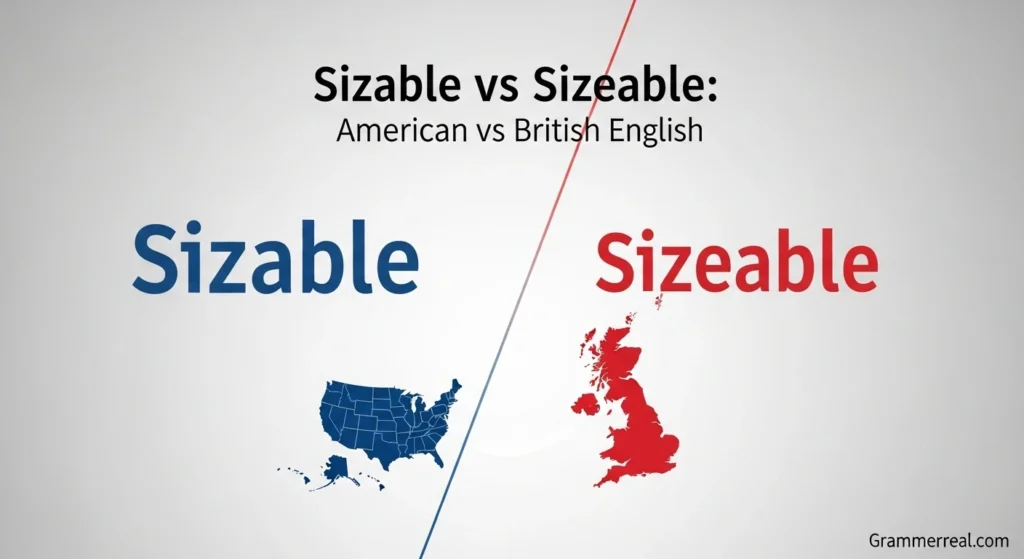
The difference between sizable vs sizeable is not about meaning. Instead, it is about regional spelling preference.
- Sizable is preferred in American English.
- Sizeable is preferred in British English.
Both words mean the same thing and function in the same way. Therefore, choosing the correct form depends on the variety of English you are using.
What Does “Sizable” Mean?
The word sizable means fairly large in size, amount, or degree. Writers mostly use it as an adjective.
Simple meaning of sizable
- Fairly large
- Considerable in size or amount
Examples of sizable in sentences
Correct: He received a sizable bonus at work.
Correct: The company made a sizable profit this year.
Incorrect: He received a sizeable bonus in American academic writing.
In American English contexts, sizable is the preferred spelling.
What Does “Sizeable” Mean?
The word sizeable has the same meaning as sizable. It also describes something that is fairly large or considerable.
Simple meaning of sizeable
- Fairly large
- Quite big in amount or size
Examples of sizeable in sentences
Correct: The project requires a sizeable investment.
Correct: The crowd was sizeable despite the rain.
Incorrect: The project requires a sizable investment in British formal writing.
In British English contexts, sizeable is the preferred spelling.
Grammar Role of Sizable and Sizeable
Both sizable and sizeable function as adjectives. They describe nouns and usually come before the noun they modify.
Sentence structure
Adjective + noun
Examples
Correct: A sizable donation helped the school. Correct: A sizeable garden surrounds the house.
The adjective form does not change based on tense because adjectives do not carry tense.
Why Two Spellings Exist
English spelling developed differently across regions over time. American English often prefers shorter spellings, while British English keeps older or longer forms.
- American English removes some extra letters.
- British English often keeps traditional spellings.
Therefore, sizable vs sizeable exists because of spelling conventions, not grammar rules.
Contextual Usage of Sizable vs Sizeable
Context helps you decide which spelling to use.
Academic and Formal Writing
- American context: Use sizable.
- British context: Use sizeable.
General Writing
If the audience is international, either spelling works. However, consistency matters.
Examples
Correct: The report shows a sizable increase in revenue. Correct: The report shows a sizeable increase in revenue.
Both sentences are grammatically correct.
Common Mistakes and How to Avoid Them
Mixing spellings in one document
Incorrect: The company earned a sizable profit and made sizeable investments. Correct: The company earned a sizable profit and made sizable investments.
Thinking one spelling is wrong
Incorrect: Sizeable is incorrect English. Correct: Sizeable is correct in British English.
Ignoring audience preference
Incorrect: Using random spelling without checking region. Correct: Choosing spelling based on audience.
Consistency always improves clarity.
Sizable and Sizeable in Daily English
Both words appear in daily communication, news articles, and reports.
Examples
Correct: The business suffered a sizable loss. Correct: The business suffered a sizeable loss.
Meaning stays the same in both sentences.
American vs British English Usage
This difference is mainly regional.
- American English prefers sizable.
- British English prefers sizeable.
Other grammar rules remain the same in both varieties. Learners should focus on audience and region while choosing spelling.
Idiomatic and Natural Usage
These adjectives commonly appear with abstract nouns.
Common pairings:
- Sizable increase
- Sizable amount
- Sizeable crowd
- Sizeable investment
Examples
Correct: The policy caused a sizable change in spending. Correct: A sizeable number of people attended the event.
Such pairings sound natural and clear.
Choosing the Right Spelling Easily
Ask yourself one simple question.
Which English style am I using?
- American style → use sizable
- British style → use sizeable
This rule works in almost all cases.
Practical Tips to Avoid Confusion
- Decide the English variety before writing.
- Stay consistent throughout the text.
- Do not mix spellings in one document.
- Proofread carefully for spelling.
- Practice reading both forms to recognize them easily.
Regular exposure builds confidence.
Active Usage in Sentences
- The firm earned a sizable profit; therefore, it expanded quickly.
- A sizeable group attended the meeting; however, many left early.
- The project needs a sizable budget, so planning matters.
- A sizeable improvement appeared after the changes; moreover, results stayed stable.
Active sentence structure keeps meaning direct and clear.
Grammar Rules Applied
- Correct adjective usage
- Proper noun modification
- Consistent spelling
- Clear sentence structure
- Mostly active voice for clarity
These rules support accurate writing.
Writing Techniques Used
This article applies:
- Simple vocabulary
- Clear topic sentences
- Varied sentence openings
- Transition words for flow
- No unnecessary wording
These techniques improve readability and understanding.
Rewritten and Polished Explanation
In simple terms, sizable and sizeable mean the same thing. The only difference lies in spelling preference. American English favors sizable, while British English favors sizeable. Meaning, grammar role, and usage remain the same. Choosing the correct form depends on audience and consistency. Once this rule is clear, confusion disappears.
How This Practice Improves Writing
Learning sizable vs sizeable helps writers:
- Avoid spelling inconsistency
- Understand regional English differences
- Improve formal writing accuracy
- Build exam confidence
- Write more professionally
Small spelling choices create strong impressions.
Conclusion
In conclusion, sizable vs sizeable differs only in spelling, not in meaning. Sizable follows American English conventions, while sizeable follows British English conventions. Both describe something fairly large or considerable. Writers should choose one form based on audience and remain consistent throughout the text. With careful practice, using the correct spelling becomes easy and natural.
FAQs
- Are sizable and sizeable the same in meaning?
Yes, both words have the same meaning. - Which spelling is used in American English?
American English uses sizable. - Which spelling is used in British English?
British English uses sizeable. - Can I use both in one article?
No, consistency is important. - Are both spellings grammatically correct?
Yes, both are correct. - Is one spelling older than the other?
Yes, sizeable follows older British spelling patterns. - Which spelling is safer in exams?
Use the spelling taught in your syllabus. - Do these words change form with tense?
No, adjectives do not change with tense. - Can sizable describe abstract things?
Yes, it can describe abstract ideas like change or growth. - Does pronunciation change with spelling?
No, pronunciation remains the same.