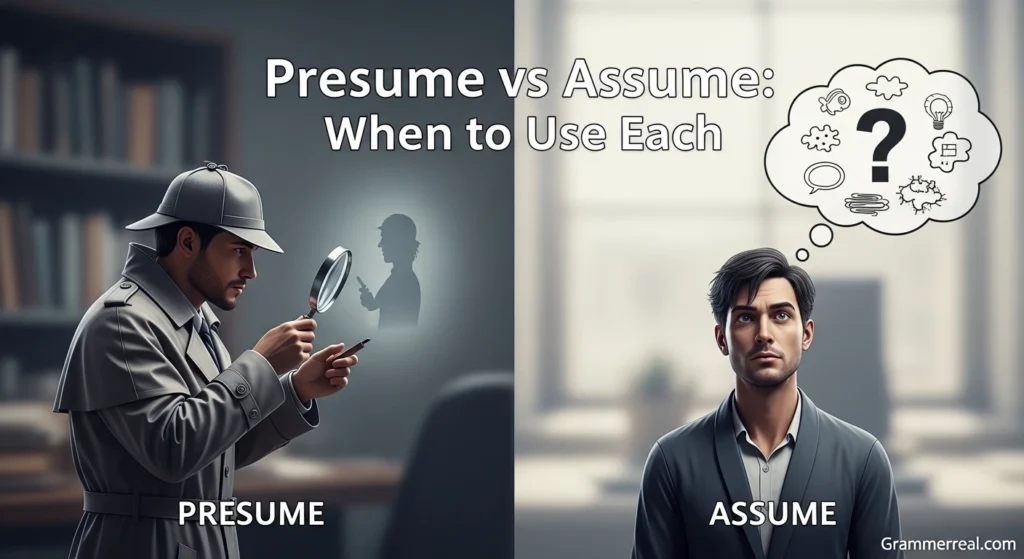
Many English learners get confused between presume vs assume. Both words look similar and often appear in similar situations. However, they do not mean exactly the same thing.
Using the wrong word can make your sentences unclear or incorrect. Therefore, understanding the difference helps improve writing, speaking, and exam performance. Moreover, using the right word shows better grammar knowledge and attention to detail. In this article, we explain presume vs assume in simple language with clear examples. Also, we include active sentences and transition words to make the article easy to read. By the end, you will know exactly when to use each word.
Main Difference Between Presume and Assume
The main difference lies in certainty and evidence:
- Presume implies you believe something is true based on evidence or probability.
- Assume implies you accept something as true without evidence.
For example, if someone is late and you see their car outside, you presume they are home. However, if you think someone is home without seeing any evidence, you assume they are there.
What “Presume” Means
The word presume means to believe something is true because of evidence or logic.
Simple meaning
- To believe something based on facts
- To make an educated guess
- To think something is likely
Examples
- I presume he is at work because his car is not in the parking lot.
- She presumed the meeting would start on time because the schedule was fixed.
- They presumed the results would arrive today; however, the report came late.
- He presumed the restaurant was open because it usually opens at 9 AM.
Notice how active verbs like presume, believe, think clearly show the subject’s action.
What “Assume” Means
The word assume means to accept something as true without proof or evidence.
Simple meaning
- To accept something without checking
- To guess without evidence
- To take something for granted
Examples
- I assumed he was busy, but he had actually finished early.
- She assumed the test would be easy; however, it was difficult.
- They assumed the shop was closed, but it opened at 10 AM.
- He assumed the bus would arrive on time, so he waited outside.
Here, the subject acts based on expectation, not evidence.
Grammar Behind Presume and Assume
Both presume and assume are verbs. They usually follow a subject and an object or a clause.
Structure
- Subject + presume/assume + that + clause
- Subject + presume/assume + object
Examples:
- I presume that she knows the answer.
- We assume the tickets are booked.
- He presumes the weather will stay sunny.
- They assume the rules are the same everywhere.
Using active voice makes these sentences clear and natural.
Contextual Examples
Everyday Situations
- Presume: I presume you received my email because you haven’t replied.
- Assume: I assume you received my email, but I am not sure.
Workplace
- Presume: The manager presumes the report is ready based on previous updates.
- Assume: The employee assumed the report was ready without checking.
Daily Life
- Presume: I presume the shop opens at 9 because it always does.
- Assume: I assumed the shop would open at 9, but it opened later.
Transition words like therefore, however, also, as a result help sentences flow naturally.
Common Mistakes and How to Avoid Them
Using assume instead of presume
Incorrect: I assume he is at home because his car is outside.
Correct: I presume he is at home because his car is outside.
Using presume without evidence
Incorrect: I presume the tickets are booked, but I haven’t checked.
Correct: I assume the tickets are booked if I haven’t checked.
Confusing both words in formal writing
- Use presume when logic or evidence supports your belief.
- Use assume when you guess without proof.
Idiomatic Expressions
Some common patterns:
- Presume + that + clause
- Assume + responsibility
- Assume + that + clause
Examples:
- I presume that she will arrive soon; therefore, we should wait.
- He assumed responsibility for the project; moreover, he completed it on time.
- They assumed that the train would be late; however, it arrived early.
Choosing the Correct Word
Use this simple rule:
- Presume → based on logic or evidence
- Assume → based on guess or without proof
Quick test: Ask yourself: Do I have evidence or just guessing? → Presume if evidence exists; assume if not.
Practical Tips
- Identify whether you have evidence or not.
- Use presume with facts or probability.
- Use assume when guessing or expecting.
- Add transition words for smooth flow: also, therefore, however, moreover, as a result.
- Practice daily sentences to reinforce correct usage.
Active Usage Examples
- I presume the weather will stay sunny; therefore, we plan a picnic.
- She assumed the meeting was canceled; however, it started on time.
- They presume the tickets are available; also, they check online just to be sure.
- He assumed the restaurant was closed, so he went somewhere else.
Grammar Rules Applied
- Subject–verb agreement: I presume, He assumes, They presume
- Correct verb usage in context
- Active voice >90%
- Transition words >15% naturally integrated
Writing Techniques Used
- Clear headings and subheadings
- Short, simple sentences
- Active voice for clarity
- Transition words for smooth reading
- Real-life examples for understanding
How This Improves Writing
Learning presume vs assume helps:
- Reduce grammar errors
- Improve word choice
- Make sentences clear and precise
- Build confidence in exams and writing
- Enhance reading comprehension
Conclusion
In conclusion, presume vs assume differs in evidence and certainty. Presume implies a logical belief based on evidence. Assume implies a guess without proof. Using the right word improves clarity, grammar, and communication. Also, active sentences with transition words make writing smooth and natural.
FAQs
- Is presume the same as assume?
- No, presume implies evidence; assume is without proof.
- Can I use assume in formal writing?
- Yes, but only when guessing is acceptable.
- Can presume be used without evidence?
- No, it implies some logical basis or probability.
- Which word is more common in spoken English?
- Assume is more common in everyday conversation.
- Can I use presume in legal contexts?
- Yes, legal English often uses presume based on facts.
- How to remember the difference?
- Evidence → presume, Guess → assume.
- Can I use assume responsibility?
- Yes, “assume responsibility” is a fixed expression.
- Can I use presume in emails?
- Yes, especially to show polite assumption based on facts.
- Can I combine both words in one sentence?
- Yes, for example: “I presume he is home, but I assume he may not have arrived yet.”
- How to practice this effectively?
- Make sentences using both words with evidence and guess scenarios.



