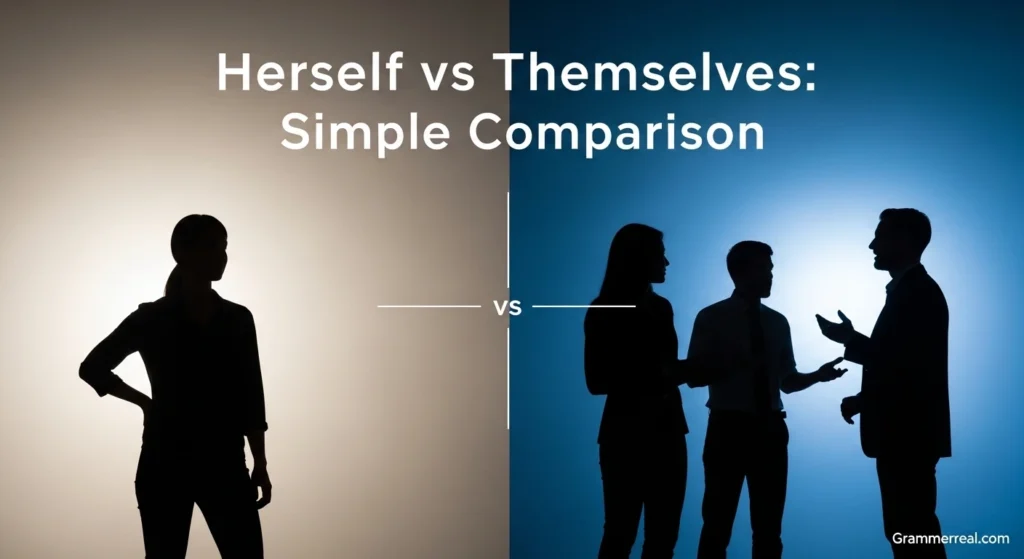
English learners often pause when they see herself vs themselves in a sentence. Both words act as reflexive pronouns, yet they do not work in the same way.
Because they look similar in function, writers sometimes mix them up. However, grammar rules clearly separate their usage. This difference becomes important in exams, formal writing, and clear communication. Moreover, modern English adds more confusion because of gender-neutral language. As a result, many learners feel unsure about the correct choice. This article explains herself vs themselves in very simple language. It focuses on meaning, grammar, and correct sentence use. By the end, you will know which word fits your sentence and why.
Understanding the Basic Difference
The main difference between herself vs themselves depends on number and reference.
- Herself refers to one female person.
- Themselves refers to more than one person or is used as a gender-neutral option.
Because of this, subject reference decides which word you should use.
What Does “Herself” Mean?
The word herself is a reflexive pronoun. It refers back to a singular female subject.
Simple meaning of herself
- referring back to one female
- showing the subject and object are the same
- used for emphasis or reflection
Examples of “herself” in sentences
- She prepared the meal herself.
- She blamed herself for the mistake.
- The girl taught herself to read.
- She looked at herself in the mirror.
In these examples, the subject is female and singular.
What Does “Themselves” Mean?
The word themselves is also a reflexive pronoun. It usually refers to plural subjects. However, modern English also uses it as a gender-neutral singular form.
Simple meaning of themselves
- referring back to more than one person
- referring to a person without gender focus
- showing self-action
Examples of “themselves” in sentences
- They prepared themselves for the test.
- The children enjoyed themselves.
- Someone hurt themselves on the stairs.
In the last example, themselves refers to one person, but gender stays unknown.
Grammar Structure of Herself vs Themselves
Grammar explains the difference clearly.
Structure of “herself”
- Pronoun type: reflexive
- Number: singular
- Gender: female
Structure of “themselves”
- Pronoun type: reflexive
- Number: plural or neutral singular
- Gender: neutral
Correct grammar depends on subject agreement.
Subject–Pronoun Agreement
Agreement is very important in herself vs themselves.
- She → herself
- They → themselves
- Someone / a person → themselves (modern usage)
Incorrect agreement causes grammar errors.
Contextual Examples of Herself vs Themselves
Context always decides the correct word.
- She reminded herself about the meeting.
- They reminded themselves about the meeting.
- Everyone reminded themselves about the rules.
The subject controls the pronoun choice.
Usage in Daily Life
Both words appear often in daily English.
Common uses of herself
- personal responsibility
- self-reflection
- emphasis
Examples:
- She completed the project herself.
- She apologized to herself.
Common uses of themselves
- group actions
- general statements
- neutral references
Examples:
- They found themselves in trouble.
- Someone should take care of themselves.
Emphatic Use of Herself and Themselves
Sometimes these pronouns add emphasis.
- She herself solved the problem.
- They themselves admitted the mistake.
This usage highlights the subject.
Common Mistakes With Herself vs Themselves
Many learners repeat the same errors.
Using herself for plural subjects
Incorrect: They prepared herself. Correct: They prepared themselves.
Using themselves for a known female
Incorrect: She blamed themselves. Correct: She blamed herself.
Ignoring modern neutral usage
Incorrect: Someone hurt himself or herself. Better: Someone hurt themselves.
Formal and Informal Writing
Both pronouns appear in formal and informal writing.
- Formal writing prefers clear agreement.
- Neutral writing often uses themselves for inclusivity.
Clarity remains the main goal.
American vs British English Usage
American and British English follow the same rules.
- Both accept neutral singular themselves
- Both use herself for female subjects
- Meaning stays the same
No major difference exists.
Idiomatic and Natural Expressions
Some expressions use these pronouns naturally.
- be beside oneself
- keep to oneself
However, most idioms avoid gender focus.
Sentence Placement and Grammar Role
Both words act as objects in sentences.
Examples:
- She taught herself Spanish.
- They introduced themselves politely.
Correct placement improves sentence flow.
Choosing the Right Word Easily
Ask yourself two questions:
- Is the subject female and singular? → use herself
- Is the subject plural or gender-neutral? → use themselves
This rule works in most cases.
Practical Tips to Avoid Errors
Here are simple tips:
- Identify the subject first
- Check number and gender
- Read the sentence aloud
- Avoid guessing
- Practice agreement rules
Practice builds confidence.
Grammar Rules Applied in This Article
This article follows clear grammar rules.
- Correct subject-pronoun agreement
- Accurate verb tense
- Clear modifiers
- Proper sentence structure
- Balanced voice use
These rules improve clarity.
Writing Techniques Used
Several techniques improve readability.
- Simple vocabulary
- Short sentences
- Clear examples
- Logical flow
- Natural transitions
As a result, understanding becomes easier.
How This Practice Improves Writing
Learning herself vs themselves improves writing skills.
- It improves accuracy
- It supports inclusive language
- It reduces confusion
- It strengthens grammar control
- It builds confidence
Small grammar choices matter.
Rewritten and Polished Explanation
In simple words, herself refers to one female person, while themselves refers to many people or one person without gender focus. Both words are reflexive pronouns. However, subject agreement decides correct usage. Choosing the right pronoun improves clarity and correctness.
Conclusion
In conclusion, the difference between herself vs themselves depends on subject, number, and gender reference. Herself matches a singular female subject. Themselves matches plural subjects or works as a neutral option. Both forms are correct when used properly. With practice and attention, this difference becomes easy to understand and apply.
FAQs
1. Are herself and themselves the same?
No, they refer to different subjects.
2. Can themselves be singular?
Yes, in gender-neutral usage.
3. Is herself only for females?
Yes, for singular female subjects.
4. Can I use themselves for everyone?
Only when gender is unknown or neutral.
5. Are both reflexive pronouns?
Yes, both are reflexive pronouns.
6. Is singular themselves grammatically correct?
Yes, modern English accepts it.
7. Can these words add emphasis?
Yes, both can emphasize the subject.
8. Is there a difference in British English?
No major difference exists.
9. Can they appear after verbs?
Yes, they often follow verbs.
10. What is the easiest way to remember the difference?
Check the subject’s number and gender.



