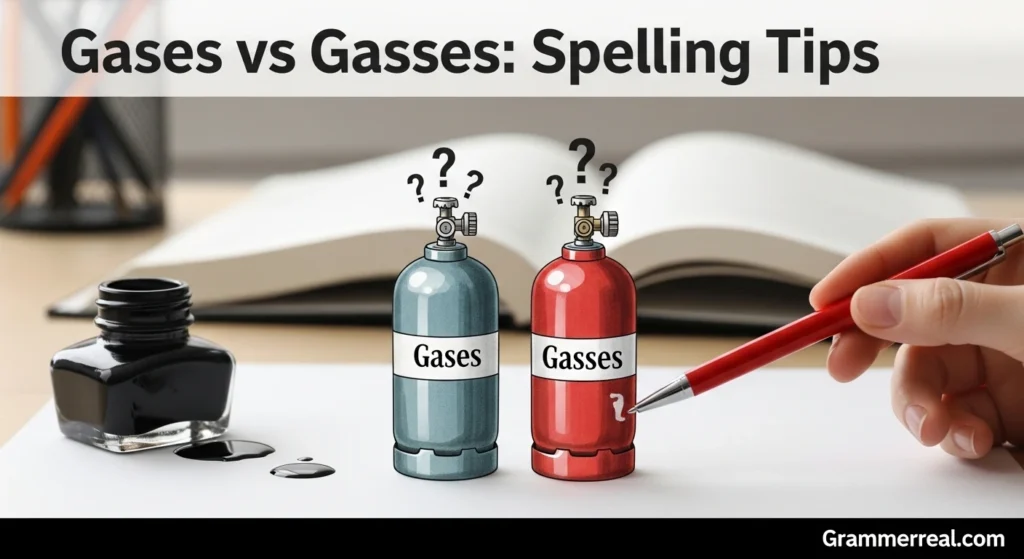
Many English learners feel confused about gases vs gasses because both spellings appear in writing. At first glance, they look very similar, which makes the confusion stronger.
The problem usually comes from verb forms and spelling rules in English. Some learners think one spelling is American and the other is British, but that idea is not fully correct. Others believe both forms can always be used in the same way. Understanding gases vs gasses helps improve spelling, grammar, and sentence accuracy. This topic often appears in science texts, school exams, and everyday writing. It is also common in discussions about chemistry and health. The good news is that the rule is simple once explained clearly. This article explains the difference using very easy language, clear examples, and practical tips.
Understanding the Basic Difference Between Gases vs Gasses
The main difference between gases vs gasses depends on grammar and spelling rules. Both words come from the base word gas. However, they are not always interchangeable.
Gases is the plural noun form of gas. Gasses is a verb form of gas.
This simple distinction explains most cases.
What Does “Gas” Mean?
Before understanding gases vs gasses, it is important to understand the base word.
Gas can be:
- A noun
- A verb
As a noun, gas refers to a substance like air, oxygen, or steam. As a verb, gas means to release gas or to attack using gas.
The form changes based on usage.
What Does “Gases” Mean?
The word gases is the plural noun form of gas. It refers to more than one gas.
Uses of “gases”
- Talking about different types of gas
- Scientific writing
- General descriptions
Examples of “gases”
Oxygen and nitrogen are gases. Many gases exist in the atmosphere. The experiment studied harmful gases.
In all these examples, gases refers to substances, not actions.
Grammar note for “gases”
Gas → singular noun Gases → plural noun
This follows normal plural noun rules.
What Does “Gasses” Mean?
The word gasses is a verb form. It is the third-person singular present tense of the verb gas.
Uses of “gasses”
- Talking about an action
- Describing someone releasing gas
- Describing chemical attacks
Examples of “gasses”
The machine gasses the chamber. The vehicle gasses the area with fumes. The system gasses automatically.
Here, gasses shows an action, not a thing.
Verb forms of “gas”
Gas – base form Gasses – present tense Gassed – past tense Gassing – continuous form
Gases vs Gasses: Simple Rule to Remember
A very easy rule can help.
If you are talking about things, use gases. If you are talking about an action, use gasses.
This rule works in most sentences.
Gases vs Gasses in Scientific Writing
Scientific writing often uses the word gases.
Examples
The lab studies toxic gases. Several gases react under heat.
Using gasses here would be incorrect because science usually talks about substances.
Gases vs Gasses in Daily Language
In daily language, both forms can appear.
Examples:
The air contains many gases. The engine gasses too much fuel.
The meaning depends on whether the word is a noun or a verb.
Sentence Structure With Gases vs Gasses
Sentence structure affects clarity.
With gases (noun)
These gases are dangerous. Cold gases expand quickly.
With gasses (verb)
The device gasses the container. The car gasses the environment.
The position in the sentence helps identify the form.
Common Mistakes With Gases vs Gasses
Many learners make similar mistakes.
Using “gasses” as a plural noun
Incorrect: These gasses are harmful.
Correct: These gases are harmful.
Using “gases” as a verb
Incorrect: The machine gases the room.
Correct: The machine gasses the room.
Confusing spelling rules
Some learners think adding -es always makes a plural. That is not true for verbs.
Gases vs Gasses in Questions
Questions follow the same rules.
Examples:
What gases are present here? Does the system gasses the chamber?
The verb or noun role stays the same.
Negative Sentences With Gases vs Gasses
Negatives do not change the form.
Examples:
These gases are not safe. The machine does not gas the room.
Do not use gasses after does not.
Active and Passive Voice Examples
Both voices are correct.
Active voice
The lab tests harmful gases. The machine gasses the container.
Passive voice
Harmful gases are released. The area is gassed during cleaning.
Both forms are grammatically correct.
Gases vs Gasses in American and British English
There is no major difference between American and British English for gases vs gasses.
Shared usage:
- Gases as plural noun
- Gasses as verb
Both varieties follow the same rules.
Idiomatic and Natural Expressions
The word gas appears in expressions.
Common expressions with “gas”
Gas leak Gas chamber Gas attack
Verb-based expressions
He gassed out quickly. The engine gasses badly.
Meaning depends on context.
Gases vs Gasses in Formal and Informal Writing
Both forms appear in all writing types.
Formal writing: The study examined toxic gases.
Informal writing: The engine gasses too much.
Correct usage matters in both cases.
Grammar Rules Applied
Understanding grammar helps usage.
Nouns
Plural nouns often add -es. Gas → gases
Verbs
Verbs change with tense and subject. He gasses They gas
Subject-verb agreement
Singular subject uses gasses. Plural subject uses gas.
Writing Techniques Used
Clear writing improves understanding.
Short sentences explain rules. Lists show patterns. Examples clarify meaning. Simple words reduce confusion.
These techniques support learning.
Practical Tips to Remember Gases vs Gasses
Here are easy tips.
Ask if it is a thing or an action. Use gases for substances. Use gasses for actions. Check the sentence subject. Read the sentence aloud. Practice with simple examples.
Practice makes correct usage natural.
Rewritten and Polished Explanation (Clear and Simple)
To explain again in the simplest way, gases vs gasses depend on grammar role. Gases is a plural noun. It names substances like oxygen and carbon dioxide. Gasses is a verb. It shows an action related to releasing gas. The spelling difference matches the word function. Using the correct form makes sentences clear and correct. With regular practice, this rule becomes easy to remember.
Conclusion
In conclusion, understanding gases vs gasses is simple when grammar rules are clear. Use gases as the plural noun form of gas. Use gasses as a verb form showing action. The meaning depends on sentence role, not preference. Both forms are correct when used properly. Paying attention to grammar improves clarity and accuracy. With practice, correct usage becomes natural in writing and speaking.
FAQs
- Should I write “toxic gases” or “toxic gasses”?
Use toxic gases. - Is “gasses” a real word?
Yes, it is a verb form. - Can “gases” be used as a verb?
No, it is a noun. - Is there a difference between British and American English?
No, the rule is the same. - What is the singular form of gases?
Gas. - What tense is “gasses”?
Present tense. - Can I say “the room was gasses”?
No, use “was gassed.” - Is “gassed” past tense?
Yes, it is the past tense and past participle. - Why do learners confuse these words?
Because they look very similar. - What is the easiest way to remember the rule?
Remember: gases are things, gasses are actions.



