Many English learners feel confused about the phrases born in and born on. Both phrases are used to talk about birth, but they are not used in the same way.
The confusion usually comes from prepositions, which are small words but very important in English. Using the wrong preposition can make a sentence sound incorrect or unclear. Understanding born in or born on helps you speak and write English more accurately. This topic appears often in school writing, exams, biographies, and everyday conversations. The good news is that the rule is simple once you understand it. This article explains the difference in very clear and easy language. It uses examples, common mistakes, and practical tips. By the end, you will know exactly when to use born in and when to use born on with confidence.
Understanding the Basic Difference Between Born In or Born On
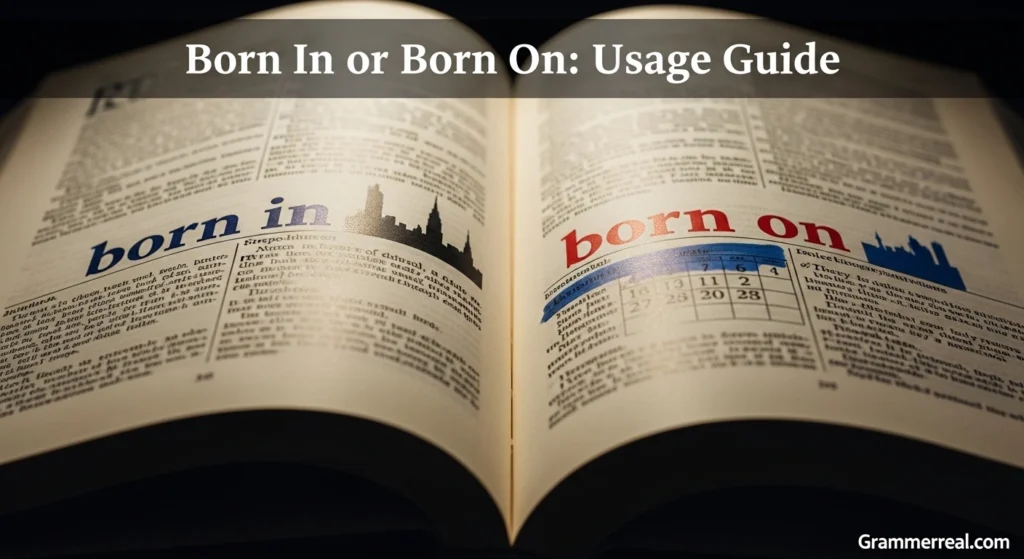
The main difference between born in or born on depends on what information comes after the phrase. English uses different prepositions for time and place.
- Born in is used with places and longer periods of time.
- Born on is used with specific dates and days.
This simple rule solves most confusion.
What Does “Born In” Mean?
The phrase born in is used to talk about place or a general time period. It does not point to a specific day. Instead, it gives broader information.
Uses of “born in”
- Cities
- Countries
- States
- Months
- Years
Examples of “born in” (place)
- She was born in Canada.
- He was born in New York.
- They were born in a small village.
Examples of “born in” (time)
- I was born in 2001.
- She was born in July.
- He was born in the 1990s.
In all these cases, the information is general, not exact.
What Does “Born On” Mean?
The phrase born on is used with specific dates or days. It gives exact information about when someone was born.
Uses of “born on”
- Specific dates
- Days of the week
- Special named days
Examples of “born on”
- She was born on March 5.
- He was born on Monday.
- They were born on Christmas Day.
Here, the time is exact, so on is the correct preposition.
Born In or Born On: Simple Rule to Remember
A very easy rule can help you choose correctly:
- If the time or place is general, use born in.
- If the time is specific, use born on.
This rule works in almost every sentence.
Born In or Born On With Dates and Time
Time expressions are a common source of confusion.
Correct usage
- Born in 1998
- Born in August
- Born on August 12
- Born on Friday
Incorrect usage
- Born on 1998
- Born in Friday
Always match the preposition with the level of detail.
Born In or Born On With Places
Place expressions are simpler.
Use “born in” for places
- born in a country
- born in a city
- born in a town
Examples:
- She was born in India.
- He was born in London.
Do not use “born on” for places
- born on Paris
- born on America
These forms are incorrect.
Sentence Structure With Born In or Born On
Sentence structure affects clarity but not the basic rule.
Active voice
- She was born in Spain.
- He was born on June 10.
Passive voice
- A famous writer was born in this town.
- The child was born on a rainy day.
Both voices are correct when grammar is clear.
Contextual Examples of Born In or Born On
Seeing both phrases in context helps understanding.
- She was born in 1995 and born on May 14.
- He was born in France but born on a Sunday.
- The artist was born in a small town and born on a cold morning.
Each phrase gives different information.
Common Mistakes With Born In or Born On
Many learners make similar mistakes.
Using “born on” with years
- Incorrect: I was born on 2000.
- Correct: I was born in 2000.
Years are general time periods.
Using “born in” with exact dates
- Incorrect: She was born in March 3.
- Correct: She was born on March 3.
Exact dates need on.
Mixing place and time incorrectly
- Incorrect: He was born on London.
- Correct: He was born in London.
Places always use in.
Born In or Born On in Questions
Questions follow the same rules.
Incorrect:
- Where were you born in?
Correct:
- Where were you born?
- Were you born in 1999?
- Were you born on July 7?
The preposition depends on the answer.
Born In or Born On in Formal and Informal Writing
Both phrases are used in all types of writing.
Formal writing
- The author was born in 1920.
- She was born on April 18.
Informal writing
- I was born in May.
- He was born on Sunday.
Correct usage matters in both styles.
American vs British English Usage
There is no difference between American and British English for born in or born on.
Shared rules
- Born in for places and general time
- Born on for specific dates
The rules stay the same in both varieties.
Idiomatic and Natural Expressions
Some natural expressions use these phrases.
Common expressions with “born in”
- born in poverty
- born in freedom
- born in the modern age
These expressions focus on conditions or periods.
Common expressions with “born on”
- born on a holiday
- born on a special day
These expressions focus on exact days.
Practical Tips to Remember Born In or Born On
Here are simple tips to avoid mistakes.
- Ask: Is the time exact or general?
- Use in for years, months, and places.
- Use on for dates and days.
- Practice with personal examples.
- Read sentences aloud to check flow.
Practice makes the rule automatic.
Grammar Rules Applied
Understanding grammar makes usage easier.
Prepositions
- In is used for larger units of time and space.
- On is used for specific points in time.
Verb tense
- Past tense is used with birth: was born.
- Subject-verb agreement stays consistent.
Examples:
- She was born in 1990.
- They were born on the same day.
Sentence Flow and Clarity
Good sentence flow improves understanding.
- Short sentences explain rules clearly.
- Longer sentences show context.
- Active voice sounds direct.
- Passive voice is natural with birth statements.
Clear structure supports meaning.
Rewritten and Polished Explanation (Clear and Simple)
To explain again in the simplest way, born in is used for places and general time periods, while born on is used for specific dates and days. The difference depends on how detailed the information is. Using the correct preposition makes sentences sound natural and correct. With practice, this rule becomes easy to remember and use.
Why This Practice Improves Writing
Learning born in or born on improves writing skills.
- It strengthens grammar accuracy
- It reduces common errors
- It improves sentence clarity
- It builds confidence
- It supports correct preposition use
Small grammar rules make writing stronger.
Conclusion
In conclusion, understanding born in or born on is simple once the basic rule is clear. Use born in for places and general time like years and months. Use born on for specific dates and days. Both phrases are correct when used properly. Paying attention to detail improves clarity and accuracy. With regular practice, correct usage becomes natural and easy in both writing and speaking.
FAQs
1. Should I say “born in 2005” or “born on 2005”?
Use born in 2005.
2. Is “born on Monday” correct?
Yes, it is correct.
3. Can I say “born in July 10”?
No, use born on July 10.
4. Do places ever use “born on”?
No, places always use born in.
5. Is there a difference in British and American English?
No, the rule is the same.
6. Can I say “born in the morning”?
Yes, it is correct.
7. Can I say “born on the morning”?
No, use born in the morning.
8. Why do we say “was born” and not “is born”?
Because birth is a past event.
9. Is “born on Christmas” correct?
Yes, because it is a specific day.
10. What is the easiest way to remember the rule?
Remember: in for general, on for specific.