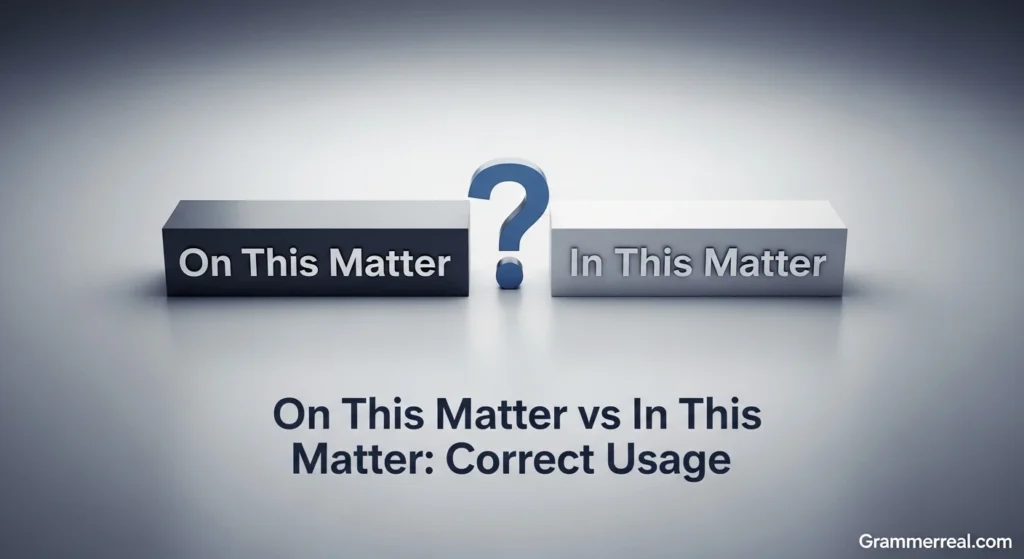
Clear communication depends on choosing the right words and phrases. One common question in English writing is whether to use “on this matter” or “in this matter.” Although these two expressions look very similar, they have slightly different meanings and are used in different situations.
Understanding the difference helps writers sound more natural and precise. In everyday conversations, emails, academic writing, and official documents, both phrases appear frequently. However, many learners feel unsure about which one is correct in a particular sentence. This confusion often happens because both expressions refer to a topic, issue, or situation. When used correctly, “on this matter or in this matter” can help clarify whether someone is giving an opinion about a topic or describing involvement within a situation. Therefore, learning the difference between these phrases improves grammar, clarity, and overall writing quality. In this article, we will explain the meaning, usage, examples, and common mistakes related to “on this matter or in this matter.”
What Does “On This Matter” Mean
The phrase “on this matter” is used when talking about a topic, issue, or subject. It focuses on discussion, opinions, decisions, or actions related to a matter.
Simply put, “on this matter” means “about this issue.”
Examples of “on this matter”
- I would like to speak on this matter.
- She gave her opinion on this matter.
- The manager made a decision on this matter.
- We will update you on this matter soon.
In all these examples, the phrase refers to talking, deciding, or giving information about something.
What Does “In This Matter” Mean
The phrase “in this matter” is used when someone is involved in a situation, case, or issue. It often appears in legal, official, or formal contexts.
Simply put, “in this matter” means “within this situation or case.”
Examples of “in this matter”
- He is involved in this matter.
- She acted as a lawyer in this matter.
- We cannot comment further in this matter.
- The court will decide in this matter.
Here, the phrase refers to participation or involvement inside a specific situation.
Key Difference Between On This Matter or In This Matter
The main difference between on this matter or in this matter is very simple
- On this matter → talking about the issue
- In this matter → being involved in the issue
Easy way to remember
- On = about
- In = inside or involved
If you are giving information, opinions, or decisions, use on this matter. If you are part of the situation or case, use in this matter.
On This Matter in Daily and Professional Use

The phrase “on this matter” is very common in emails, meetings, reports, and discussions.
Common uses
- sharing opinions
- giving updates
- making decisions
- explaining actions
Examples
- Please advise me on this matter.
- We need more information on this matter.
- The committee agreed on this matter.
- I will contact you later on this matter.
This phrase sounds natural when discussing topics or issues.
In This Matter in Formal and Legal Use
The phrase “in this matter” is more formal. It is often used in legal writing, official statements, and serious discussions.
Common uses
- legal cases
- investigations
- official involvement
- formal responsibility
Examples
- She represents the client in this matter.
- We are waiting for instructions in this matter.
- He has no role in this matter.
- The judge will rule in this matter.
This phrase fits situations where someone is directly connected to an issue.
Contextual Examples Showing Both Phrases
Seeing both phrases together makes the difference clearer.
- I cannot comment on this matter because I am not involved in this matter.
- She shared her views on this matter, but she played no role in this matter.
- The report focuses on this matter, while the lawyer works in this matter.
These examples show how each phrase serves a different purpose.
Common Mistakes With On This Matter or In This Matter
Many learners make the same mistakes with these phrases.
Using “in this matter” when meaning “about”
- Incorrect: I want to speak in this matter.
- Correct: I want to speak on this matter.
Speaking is about a topic, not inside it.
Using “on this matter” for legal involvement
- Incorrect: He is representing us on this matter.
- Correct: He is representing us in this matter.
Representation means involvement, so in is correct.
Mixing both in the same meaning
Using the wrong preposition can confuse the reader. Always check whether you mean discussion or involvement.
Grammar Focus: Why Prepositions Matter
Prepositions like on and in change meaning. In on this matter or in this matter, the preposition is the key difference.
- On connects ideas, opinions, and topics
- In connects people and actions inside a situation
Correct preposition use improves sentence accuracy and clarity.
On This Matter vs In This Matter in Emails
In professional emails, choosing the correct phrase is important.
Email examples
- I am writing on this matter to request clarification.
- Please let me know your decision on this matter.
- I am assisting the team in this matter.
- We are directly involved in this matter.
Using the right phrase makes emails sound professional and clear.
American vs British English Usage
There is no major difference between American and British English when using on this matter or in this matter.
Both varieties:
- use on this matter for discussion
- use in this matter for involvement
The meaning and usage stay the same in both forms of English.
Formal Tone and Register
Both phrases are formal, but “in this matter” sounds more serious and official.
- On this matter → formal but common
- In this matter → formal and legal
Choose based on tone and context.
Idiomatic and Fixed Expressions

These phrases often appear in fixed patterns.
Common patterns with “on this matter”
- decision on this matter
- opinion on this matter
- update on this matter
Common patterns with “in this matter”
- involved in this matter
- acting in this matter
- ruling in this matter
These patterns help you remember correct usage.
Practical Tips to Choose the Right Phrase
Here are easy tips to avoid confusion:
- Ask if you are talking about or inside the issue.
- Use on for opinions, updates, and decisions.
- Use in for roles, involvement, and cases.
- Replace the phrase with “about” or “involved” to test it.
- Read the sentence aloud and check if it sounds natural.
Sentence Structure and Clarity
Short and clear sentences work best with these phrases. Avoid long or confusing structures.
Example
- Clear: Please advise me on this matter.
- Clear: He is not involved in this matter.
Good structure supports correct meaning.
Why Correct Usage Matters
Using on this matter or in this matter correctly
- improves clarity
- avoids confusion
- shows strong grammar skills
- builds professional trust
Small details like prepositions make a big difference in writing quality.
Reflection on Grammar and Writing Practice
This article follows clear grammar rules, correct verb tense, and proper subject-verb agreement. Articles and prepositions are used carefully to avoid mistakes. Sentence length varies to keep the text smooth and readable. Simple words are chosen to support easy understanding. Practicing small differences like on this matter or in this matter improves overall writing accuracy. It also builds confidence and helps writers communicate ideas clearly and correctly.
Conclusion
The phrases “on this matter” and “in this matter” may look similar, but they serve different purposes in English. “On this matter” is used when discussing, explaining, or giving opinions about a topic. In contrast, “in this matter” is used when someone is involved in a situation, process, or legal case. Understanding this difference helps writers communicate clearly and accurately. By practicing with examples, paying attention to context, and thinking about the role of the speaker, learners can choose the correct phrase with confidence. Over time, this small grammar distinction becomes natural, leading to stronger writing and clearer communication.
FAQs
1. Are “on this matter” and “in this matter” interchangeable?
No, they have different meanings.
2. Which phrase is more formal?
“In this matter” is more formal.
3. Can I use “on this matter” in emails?
Yes, it is very common in emails.
4. Is “in this matter” mainly legal?
Yes, it is often used in legal or official contexts.
5. Does American English use these phrases differently?
No, usage is the same.