Music has a special way of bringing people together. Many people enjoy singing in groups, whether for fun, worship, or performance. When learning about group singing, you might notice the terms choir and chorus being used.
While they are often treated as similar, there are subtle differences between the two. Understanding choir vs chorus can help you communicate clearly, join the right group, and enjoy music more fully. Choirs and choruses both involve multiple singers performing together, but the setting, style, and context may vary. This article will explore the distinctions, provide examples, and guide you through the common mistakes people make when using these terms. By the end, you will know exactly when to use “choir” and when “chorus” fits better. Let’s dive into the world of group singing and clarify these important terms.
What is a Choir?
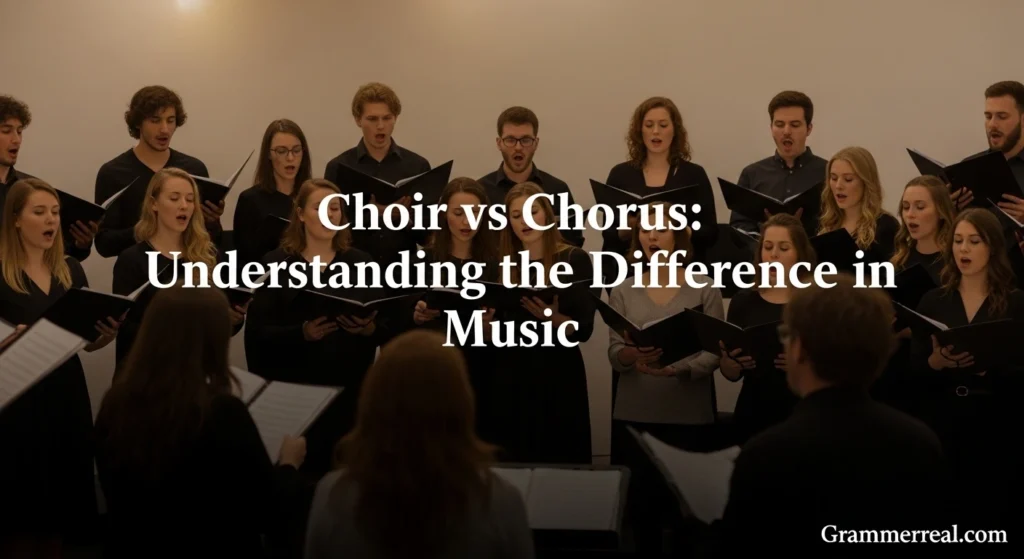
A choir is a group of singers who usually perform together regularly. Choirs are often associated with religious settings, schools, or professional organizations. They can include different voice parts, such as soprano, alto, tenor, and bass. Choirs tend to focus on harmony, blending voices, and following a conductor. They often perform sacred music, classical pieces, or other structured songs. In schools, choirs are often part of the music curriculum, providing both practice and performance opportunities. In churches, a choir may lead hymns or perform during special ceremonies. Choir members usually meet frequently to rehearse and develop a unified sound.
What is a Chorus?
A chorus is also a group of singers, but it can be slightly more flexible in purpose and style. Choruses are often associated with theatrical performances, musicals, and community events. While a choir may focus on traditional or formal music, a chorus can perform a wider variety of songs, including pop, folk, or contemporary pieces. Choruses might not meet as often as choirs, and the group size can be larger or smaller depending on the performance. A chorus often sings in a section of a musical or a stage show, supporting the main performers. While both choirs and choruses involve multiple singers, a chorus emphasizes performance in entertainment settings more than religious or formal contexts.
Key Differences Between Choir and Chorus
Although the terms are sometimes used interchangeably, there are several differences:
- Purpose: Choirs often focus on worship, school music, or formal concerts, while choruses are frequently part of theater or entertainment performances.
- Style: Choirs typically sing classical, sacred, or structured music; choruses perform more diverse genres.
- Setting: Choirs are common in churches, schools, or professional ensembles; choruses appear in musicals, plays, and community events.
- Leadership: Choirs usually have a conductor who guides vocal harmony and technique; choruses may also have a conductor, but sometimes focus more on stage direction.
- Frequency: Choirs often meet regularly, rehearsing multiple times a week; choruses may rehearse depending on performance schedules.
Understanding these differences can help you use the words correctly and avoid common mistakes.
Contextual Examples
Here are a few examples showing proper use of choir and chorus:
- Choir: “The church choir sang beautifully during Sunday service.”
- Chorus: “The chorus in the school musical received a standing ovation.”
- Choir: “She joined the college choir to improve her vocal technique.”
- Chorus: “During the play, the chorus provided background vocals and support for the lead actors.”
These examples show how context and setting guide which word to use.
Common Mistakes
Many people confuse choir and chorus, using them interchangeably. Some frequent mistakes include:
- Saying “school chorus” when referring to a traditional music class that focuses on classical songs (a choir is more accurate).
- Calling the chorus section of a pop song a choir, which is incorrect; in music terminology, the repeated part of a song is called the chorus, not a choir.
- Assuming all group singing is a choir, ignoring theatrical or performance-based contexts.
Remember: the context matters more than just the number of singers.
American vs British English Differences
In both American and British English, choir and chorus are used similarly, but there are minor distinctions:
- American English: The word “chorus” is often used for theatrical or musical theater groups, while “choir” is commonly associated with churches or school music programs.
- British English: “Choir” is widely used for formal singing groups, while “chorus” may refer to community groups or the section of a musical.
Understanding these regional nuances can improve communication, especially in writing and academic contexts.
Idiomatic Expressions Involving Choir and Chorus
Both words appear in idioms or expressions:
- “Sing in the choir”: To participate in a formal singing group.
- “Raise your voice in chorus”: To speak or act together in agreement.
- “Chorus of voices”: Multiple people expressing the same opinion.
These expressions show how the words extend beyond literal singing into figurative language.
Practical Tips for Choosing the Right Word
- Consider the setting: Religious or formal → choir; theatrical or entertainment → chorus.
- Check the style of music: Classical or structured → choir; diverse or pop → chorus.
- Think about purpose: Practice and rehearsal focus → choir; performance support → chorus.
- Observe frequency: Regular rehearsals → choir; occasional rehearsals → chorus.
- Look for idiomatic usage: Expressions like “in chorus” or “chorus of voices” indicate figurative use.
By following these tips, you can confidently use the correct term.
Conclusion
Understanding choir vs chorus helps you communicate clearly, appreciate music more, and avoid common mistakes. Choirs are usually formal, structured, and linked to worship or school programs, while choruses are more flexible, theatrical, and entertainment-focused. Paying attention to context, music style, and purpose ensures you use the right word. Both groups bring people together, create harmony, and enhance the joy of singing. With this knowledge, you can describe musical groups accurately and use idiomatic expressions correctly.
FAQs
1. Can “choir” and “chorus” be used interchangeably?
Yes, sometimes, but the context often dictates the correct choice. Choirs are formal; choruses often perform in entertainment.
2. What is the difference in music style?
Choirs sing classical or sacred music; choruses sing diverse or theatrical songs.
3. Do choirs meet more frequently than choruses?
Typically, yes. Choirs often rehearse regularly, while choruses may meet depending on performances.
4. Is “chorus” used in songs differently than in singing groups?
Yes. In songs, the chorus is the repeated section, not the group of singers.
5. Are choirs only in churches?
No. Choirs exist in schools, colleges, and professional ensembles too.
6. Can a chorus perform in a church?
Yes, but traditionally, formal singing groups in churches are called choirs.
7. Which word is more common in British English?
Both are used, but “choir” is preferred for formal singing groups.
8. What is a “chorus of voices”?
It is an expression meaning multiple people speaking or singing together.
9. Can a choir perform pop songs?
Yes, choirs can perform any style, but they usually focus on classical or structured music.
10. How do I know which term to use in writing?
Consider context, music style, setting, and purpose to choose the correct word.