The words specter vs spectre often confuse English learners and even native speakers because they look almost identical and share the same meaning. Both words describe a ghost, spirit, or something frightening that seems to appear suddenly.
The main difference between specter and spectre is not meaning but spelling, which depends on regional English usage. Many readers wonder which form is correct and whether using the “wrong” one counts as a mistake. Understanding specter vs spectre helps improve spelling, clarity, and consistency in writing. These words appear in literature, news writing, academic texts, and everyday conversation. Writers often hesitate when choosing between them, especially when switching between American and British English. By learning how specter vs spectre works, you can write with more confidence. This article explains the difference clearly, with simple language and practical examples, so you can always choose the right spelling.
Meaning of specter and spectre
Both specter and spectre have the same meaning. They refer to a ghost, spirit, or frightening image, either real or imagined. The word can describe something supernatural, like a ghost in a story, or something abstract, like a fear that haunts someone’s mind.
For example, a ghost in a haunted house can be called a specter or a spectre. In a non-literal sense, fear, poverty, or war can be described as a specter that hangs over people’s lives. In both cases, the meaning does not change with spelling.
The word comes from Latin spectrum, meaning “appearance” or “image.” Over time, English adopted two spelling forms, which is why specter vs spectre exists today.
Specter vs spectre: the key difference
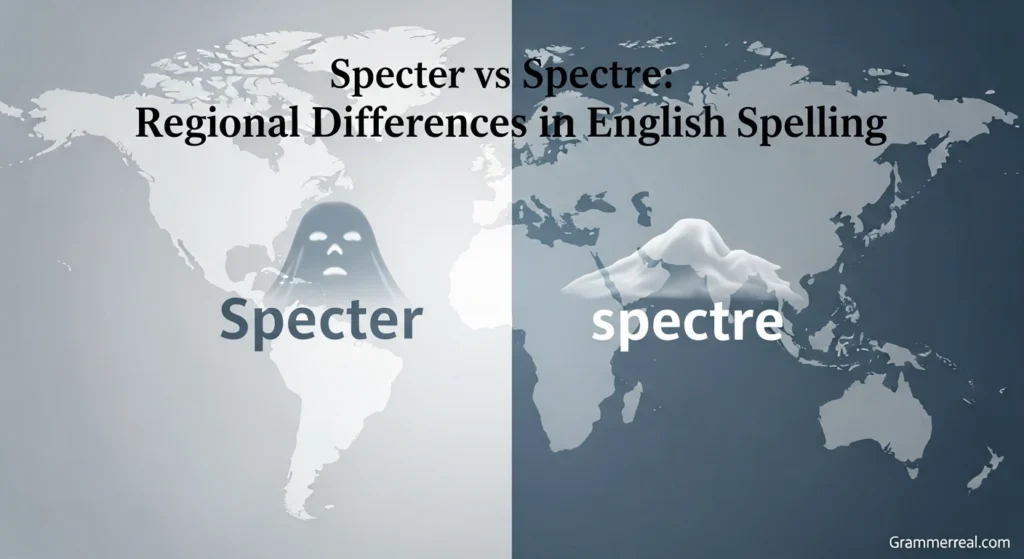
The real difference between specter vs spectre is regional usage.
- Specter is the preferred spelling in American English.
- Spectre is the preferred spelling in British English.
This pattern is common in English. American English often drops the “-re” ending and replaces it with “-er,” while British English keeps “-re.”
Examples of similar pairs include:
- Center vs centre
- Theater vs theatre
- Meter vs metre
So, specter vs spectre follows a familiar spelling pattern rather than a difference in meaning.
American English usage of specter
In American English, specter is the standard and accepted spelling. It appears in American books, newspapers, academic writing, and everyday communication.
Examples:
- The specter of war worried the entire nation.
- A pale specter appeared at the end of the hallway.
- Fear became a specter that followed him everywhere.
American style guides and dictionaries list specter as the correct form. Using spectre in American writing is not technically wrong, but it may look unusual or inconsistent.
British English usage of spectre
In British English, spectre is the standard spelling. It appears in British literature, journalism, and formal writing.
Examples:
- The spectre of unemployment haunted the community.
- A ghostly spectre stood near the old castle.
- History still carries the spectre of past conflicts.
British readers expect this spelling, and it matches other British word forms ending in “-re.” Using specter in British English may seem foreign or out of place.
Use of specter and spectre in literature
Both spellings appear widely in literature, depending on the author’s background.
American writers like Edgar Allan Poe often used specter in their works. British writers, including classic authors, preferred spectre. Modern writers usually follow the spelling rules of their target audience.
In fantasy and horror stories, these words help create mood and tension. Whether spelled specter or spectre, the word often suggests fear, mystery, or something unknown.
Figurative meaning of specter and spectre
The words are often used in a figurative way, not just for ghosts.
Examples:
- The specter of failure stopped her from trying.
- The spectre of hunger threatened the region.
- A past mistake became a specter in his memory.
In these cases, the word represents fear, worry, or a looming problem. This figurative use is common in news writing, essays, and speeches.
Pronunciation of specter vs spectre
Despite the spelling difference, specter vs spectre is pronounced the same way.
Pronunciation: /ˈspɛk.tər/
The ending sound is soft and unstressed, which is why spelling causes confusion. There is no pronunciation clue to help you choose the correct form, so regional rules matter most.
Common mistakes with specter and spectre
One common mistake is mixing spellings within the same text. For example, using specter in one paragraph and spectre in another can confuse readers.
Another mistake is assuming one spelling is more formal than the other. Neither spelling is more formal. The difference is regional, not about tone or level.
Some writers also confuse these words with similar-looking terms like “scepter” or “sceptre,” which have a different meaning related to royal authority.
Specter vs spectre vs scepter vs sceptre
This confusion is very common.
- Specter / spectre = a ghost or haunting fear
- Scepter / sceptre = a staff carried by a king or queen
Like specter vs spectre, scepter is American spelling, and sceptre is British spelling. The meanings, however, are completely different.
Example:
- The king held a golden sceptre.
- The spectre of rebellion worried the ruler.
Mixing these words can change the meaning of a sentence entirely.
Idiomatic expressions using specter and spectre
These words appear in many common expressions.
Examples:
- The specter of death
- The spectre of war
- A haunting specter
These expressions are often used in serious or dramatic contexts. The spelling depends on the variety of English being used.
Choosing the correct spelling in your writing
To choose correctly between specter vs spectre, ask one simple question: Who is your audience?
- If your audience is American, use specter.
- If your audience is British or follows British standards, use spectre.
If you are writing for an international audience, choose one spelling and stay consistent throughout the text.
Specter vs spectre in academic and professional writing
In academic writing, consistency is very important. Most institutions follow either American or British standards.
If you are submitting work to an American university or publication, specter is the safer choice. For British institutions, spectre is preferred.
Always check the style guide you are following and match your spelling to it.
Why English has specter and spectre
English developed from many languages, including Latin, French, and German. Over time, spelling standards changed differently in different regions.
American English simplified many spellings, while British English kept older forms. This history explains why pairs like specter vs spectre still exist today.
Practical tips to remember the difference
Here are a few simple tips:
- Think “America = ER” → specter
- Think “Britain = RE” → spectre
- Match the spelling with center/centre
- Be consistent in one document
These simple rules can help avoid mistakes.
Benefits of understanding specter vs spectre
Knowing the difference improves spelling accuracy, reader trust, and writing clarity. It also shows attention to detail and respect for language standards.
This knowledge helps students, writers, editors, and professionals write more confidently.
Reflection on grammar and writing techniques used
This article applies basic grammar rules carefully. Verbs match their subjects, articles are used correctly, and prepositions fit their context. Sentences vary in length to keep the flow smooth and readable. Both active and passive voice appear where they sound natural. Clear transitions connect ideas, and repetition is avoided. Simple vocabulary makes the content easy to understand. Careful word choice and consistent spelling improve clarity. Practicing this type of writing strengthens language skills and helps writers use important words naturally and correctly.
Conclusion
The difference between specter vs spectre is simple once you understand it. Both words mean the same thing and describe a ghost or a haunting fear. The only real difference lies in regional spelling. Specter belongs to American English, while spectre belongs to British English. Pronunciation does not change, and neither form is more formal than the other. Choosing the right spelling depends on your audience and writing style. By staying consistent and following regional rules, you can avoid confusion. Understanding this pair improves accuracy, clarity, and confidence in English writing.
FAQs
1. What is the difference between specter and spectre?
The difference is spelling. Specter is American English, and spectre is British English.
2. Do specter and spectre mean different things?
No, they have the same meaning.
3. Which spelling is correct?
Both are correct, depending on the type of English you use.
4. Is spectre more formal than specter?
No, neither spelling is more formal.
5. How do you pronounce specter and spectre?
They are pronounced the same way.
6. Can I use both spellings in one article?
It is better to use only one spelling for consistency.
7. Are specter and scepter the same word?
No, specter means a ghost, while scepter means a royal staff.
8. Which spelling should students use?
Students should follow the spelling rules of their school or country.
9. Is specter used in figurative language?
Yes, it often describes fear or a looming problem.
10. How can I remember the difference easily?
Remember “ER” for America and “RE” for Britain.