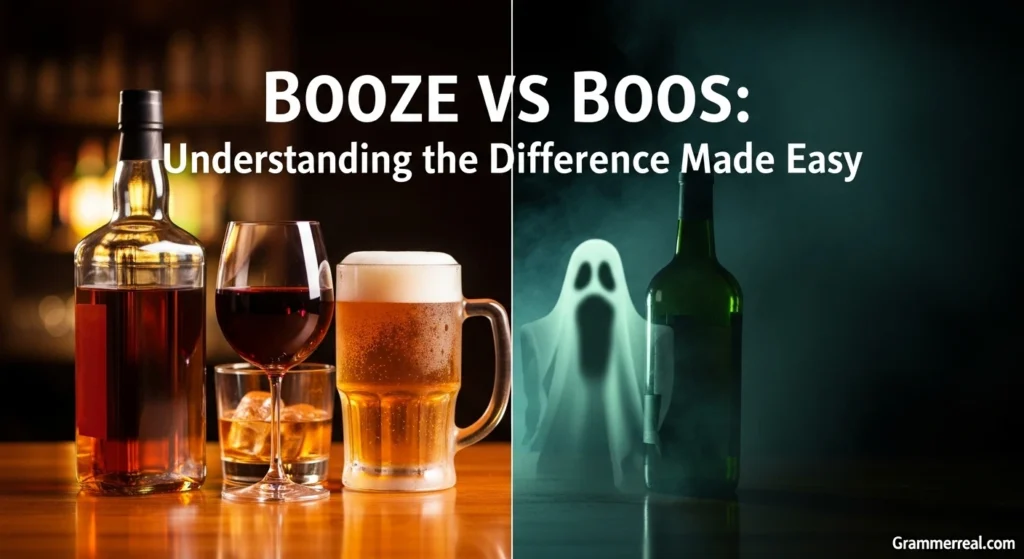
The words booze vs boos often confuse English learners because they sound almost the same, but their meanings are completely different. Many people hear these words in conversation or see them in writing and are unsure which one to use.
Understanding the difference between booze vs boos is important for clear communication. Both words can appear in casual and informal contexts, but using the wrong one can change the meaning of a sentence entirely. This article explains the difference between booze vs boos in very simple language. You will learn their definitions, how to use them in sentences, and the common mistakes to avoid. We will also discuss American vs British English usage, idiomatic expressions, and practical tips to remember them. By the end of this article, you will confidently use booze and boos correctly in speaking and writing.
Meaning of Booze vs Boos
Meaning of Booze
Booze is an informal word for alcoholic drinks, such as beer, wine, or spirits. It is often used in casual speech, party contexts, or informal writing. The word has a slightly playful or casual tone.
Examples:
- They brought plenty of booze to the party.
- He doesn’t drink much booze.
- College students often drink too much booze at celebrations.
In these examples, booze clearly refers to alcoholic beverages.
Meaning of Boos
Boos is the plural form of boo, which is a sound people make to show disapproval, disappointment, or dislike. You often hear boos in sports events, performances, or public gatherings when the audience disagrees with or dislikes something.
Examples:
- The audience gave loud boos after the singer missed a note.
- The referee faced boos from the fans.
- She ignored the boos and continued her speech.
In these examples, boos indicate negative reactions or sounds of disapproval.
Core Difference Between Booze vs Boos
The main difference is simple:
- Booze → alcoholic drinks
- Boos → sounds of disapproval
They are completely unrelated in meaning, even though they sound similar.
Grammar and Word Form
Both words have different grammar roles.
- Booze → noun (uncountable)
- Boos → plural noun (countable, plural of boo)
Examples:
- Booze: She bought some booze for the party.
- Boos: The actor heard boos from the crowd.
Using Booze in Sentences
Here are some clear ways to use booze in sentences.
- I don’t like to drink booze often.
- They stocked the fridge with beer and other booze.
- After the meeting, he suggested getting some booze.
Notice that booze is often uncountable. We usually say some booze, not “two boozes.”
Using Boos in Sentences
Here are examples using boos.
- The audience responded with boos when the team lost.
- Despite the boos, the speaker continued confidently.
- Boos can be louder than cheers in a stadium.
Boos is always plural and relates to negative sounds from people.
Booze vs Boos in Real-Life Contexts
Situation 1: Parties and Celebrations
- Booze is common at parties, festivals, and gatherings.
- Boos are unlikely unless someone is unhappy with something at the party.
Example:
- They served plenty of booze, but the performance got boos from some guests.
Situation 2: Sports and Public Events
- Boos are very common in sports games or performances.
- Booze may also be present in spectators’ hands, but it refers to drinks, not sounds.
Example:
- The fans waved their flags and shouted boos, while some enjoyed their booze in the stands.
Tone and Emotional Difference
- Booze → casual, fun, informal
- Boos → negative, disapproving, often public
Understanding the tone helps choose the correct word.
Common Mistakes With Booze vs Boos
Confusing the Words
Some learners write “boos” when they mean alcohol or “booze” when they mean disapproval.
Incorrect:
- The audience gave loud booze.
Correct:
- The audience gave loud boos.
Plural Confusion
- Booze is uncountable; don’t write “boozes.”
- Boos is always plural; don’t write “boo” when you mean multiple sounds.
Mispronunciation
Both words sound alike. Careful listening or reading helps avoid confusion.
American vs British English
Both words are used in American and British English similarly.
- Booze: informal, refers to alcohol in both varieties.
- Boos: same meaning and use in both American and British English.
There are no significant spelling or usage differences.
Idiomatic Expressions
Some expressions use booze or boos naturally.
Booze Idioms
- Booze it up → drink a lot
- Booze cruise → a party on a boat with alcohol
Boos Idioms
- Hear boos → receive disapproval
- Face the boos → confront negative reactions
Idiomatic usage shows natural context for each word.
Polite vs Informal Context
- Booze → informal, casual, often in social contexts
- Boos → neutral, describes audience reaction, can appear in formal writing about performances
Example:
- The theater review mentioned the boos but avoided talking about booze in the audience.
Passive and Active Voice
Both words can be used with active and passive structures.
Active Voice:
- Fans booed the referee.
- They drank booze at the party.
Passive Voice:
- The referee was booed by the fans.
- The booze was served at the party.
Both forms are clear and grammatical.
Using Booze vs Boos in Professional Writing
- Booze appears rarely in formal writing; mostly in reports about social studies or culture.
- Boos appears in news articles, reviews, and performance reports.
Example:
- The play received boos from critics, while some attendees brought their own booze.
Cultural Considerations
- Booze may be taboo in some cultures; use carefully.
- Boos is widely accepted as a neutral description of audience behavior.
Practical Tips to Remember Booze vs Boos
- Think about meaning: Alcohol → booze, Disapproval → boos.
- Check number: Booze is uncountable, Boos is plural.
- Listen carefully: Pronunciation is similar, so context matters.
- Practice with examples: Read sentences aloud to notice differences.
Practice Sentences
Correct:
- He enjoyed some booze at the party.
- The actor ignored the boos from the audience.
- They had plenty of booze but heard boos during the toast.
Incorrect:
- The audience gave loud booze.
- He bought a few boos from the store.
Reflection on Grammar and Writing
This topic uses basic grammar rules:
- Correct noun usage (countable vs uncountable)
- Clear subject–verb agreement
- Proper sentence structure
- Correct articles and prepositions
Following these rules ensures clarity when using confusing words like booze vs boos.
Summary of Booze vs Boos
- Booze → alcohol, informal, uncountable
- Boos → disapproval sounds, plural, can be public
- Both sound similar but have completely different meanings
- Context, tone, and number are keys to correct usage
Conclusion
In conclusion, booze vs boos is a simple yet important comparison in English. Both words sound alike but have entirely different meanings. Booze refers to alcoholic drinks and is casual and informal. Boos refers to sounds of disapproval and is often public or performance-related. Knowing the difference helps avoid embarrassing mistakes in speech and writing. By practicing sentences, observing context, and remembering their meanings, you can confidently use booze and boos correctly. Small differences like this make your English more precise and natural.
FAQs
- What is the meaning of booze?
Booze means alcoholic drinks. - What is the meaning of boos?
Boos are sounds of disapproval or dislike. - Can booze be plural?
No, it is uncountable. - Can boos be singular?
Yes, one boo is singular; multiple are boos. - Are both words used in British English?
Yes, they are used the same as in American English. - Which word is informal?
Booze is informal; boos can be neutral or formal. - Can booze appear in formal writing?
Rarely, mostly in cultural or social reports. - Can boos appear in news articles?
Yes, especially about sports or performances. - How can I remember the difference?
Alcohol → booze, Disapproval → boos. - Can someone say “I heard boos at the bar”?
Yes, if people disapproved of a performance there.



