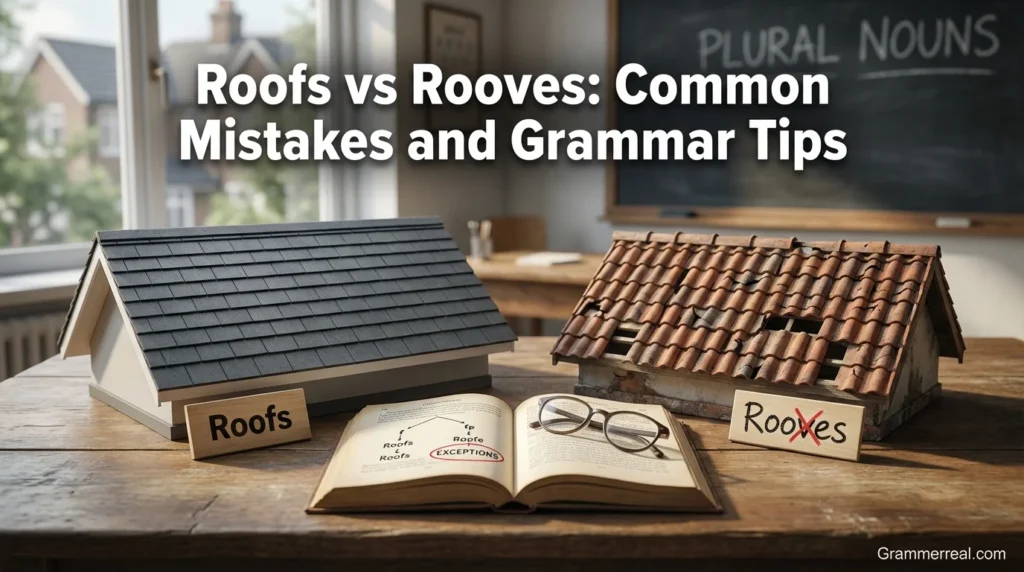
Understanding roofs vs rooves can feel confusing, even for confident English users. Both words appear to be plural forms of roof, yet only one is widely accepted in modern English.
This topic often causes doubt in writing, speaking, exams, and professional communication. Learners frequently wonder why some nouns change their endings while others do not. The confusion increases because older rules, regional differences, and historical usage all play a role. In everyday writing, choosing the wrong plural can make sentences sound unnatural or incorrect. At the same time, dictionaries and teachers sometimes give mixed explanations. This article clearly explains roofs vs rooves using simple language and clear examples. By the end, you will know which form to use, why it is correct, and how to avoid common mistakes with confidence.
What Does the Word “Roof” Mean?
A roof is the top covering of a building. It protects people and objects inside from rain, heat, cold, wind, and sunlight. Roofs can be flat or sloped, and they can be made of many materials such as tiles, metal, wood, or concrete. In daily life, the word roof is very common and easy to understand.
Examples:
- The roof of the house was damaged during the storm.
- Birds were sitting on the roof.
- The workers repaired the roof last week.
The problem starts when we want to talk about more than one roof.
Forming Plurals in English: A Simple Overview
Before focusing on roofs vs rooves, it helps to review how plurals usually work in English.
Most English nouns form their plural by adding -s or -es:
- book → books
- car → cars
- box → boxes
Some nouns change their spelling:
- man → men
- child → children
Some nouns ending in -f or -fe sometimes change f to v and add -es:
- leaf → leaves
- knife → knives
- wolf → wolves
Because of this pattern, many learners expect roof to follow the same rule. This expectation leads directly to the confusion between roofs and rooves.
Roofs vs rooves: The Core Difference
The correct plural of roof in modern English is roofs.
Correct: one roof → two roofs
Incorrect: one roof → two rooves (not standard)
The word rooves is considered incorrect or very rare in modern usage. While it may appear in old texts or poetry, it is not accepted in standard English today.
So, when choosing between roofs vs rooves, roofs is the correct and safe choice.
Why “Rooves” Sounds Logical but Is Wrong
Many learners think rooves should be correct because of similar words like leaf and knife. This is a reasonable thought, but English does not always follow strict patterns.
Here is the key point:
- Not all nouns ending in -f change to -ves in the plural.
Some words simply add -s:
- roof → roofs
- belief → beliefs
- chief → chiefs
- proof → proofs
These words kept the f sound instead of changing it to v. Over time, English speakers accepted these forms, and they became standard.
Historical Background of Roofs vs rooves
In older forms of English, rooves did exist. Several centuries ago, English plural rules were less fixed than they are now. During that time, rooves appeared in some writings.
However, language changes with usage. As English developed, roofs became the preferred and dominant form. Dictionaries, grammar guides, and style manuals now list roofs as the correct plural.
Today:
- rooves is outdated
- roofs is modern and correct
Using rooves now may confuse readers or make writing look incorrect.
American vs British English Differences
When discussing roofs vs rooves, learners often ask if British English uses rooves while American English uses roofs. This is a fair question, but the answer is simple.
Both American English and British English use roofs.
There is no standard regional difference here.
Examples:
- American English: The city has many tall buildings with flat roofs.
- British English: Old houses in the village have stone roofs.
In both varieties, roofs is correct, natural, and expected.
Common Mistakes with Roofs vs rooves
Many mistakes happen because of overthinking or guessing plural rules. Below are common errors and how to fix them.
Using “rooves” in formal writing
Incorrect: The houses have damaged rooves.
Correct: The houses have damaged roofs.
Mixing both forms
Incorrect: Some roofs were repaired, while other rooves were ignored.
Correct: Some roofs were repaired, while others were ignored.
Assuming all -f words follow the same rule
Incorrect: One roof, many rooves
Correct: One roof, many roofs
Being consistent and using the accepted form avoids confusion.
Contextual Examples in Simple Sentences
Using roofs correctly becomes easier with practice. Here are clear examples in different contexts.
Everyday speech
- The roofs of the houses were covered with snow.
- Birds often rest on roofs in the morning.
Academic or formal writing
- Flat roofs are common in modern architecture.
- The study focused on green roofs in urban areas.
Professional communication
- The company specializes in repairing industrial roofs.
- Safety equipment was installed on the factory roofs.
In all cases, roofs fits naturally.
Idiomatic and Figurative Uses of “Roof”
The word roof also appears in expressions and figurative language. Even in these cases, the plural remains roofs.
Examples:
- Prices went through the roof.
- The noise level raised the roofs of the stadium.
When plural meaning is intended, writers still use roofs.
Practical Tips to Remember the Correct Form
To avoid confusion with roofs vs rooves, follow these simple tips:
- Always use roofs in modern writing.
- Do not apply the leaf → leaves rule to roof.
- If unsure, check whether the word appears in daily conversation.
- Remember that both British and American English agree on roofs.
- Avoid old or poetic forms unless you are studying historical texts.
These steps make your writing clearer and more accurate.
Comparison Table in Words (Explained Simply)
Instead of a table, here is a clear explanation:
- Roof (singular): one top covering of a building
- Roofs (plural): more than one roof
- Rooves: outdated and not standard
This simple comparison helps fix the idea in memory.
Why Correct Plurals Matter in Writing
Correct word forms improve clarity and trust. When readers see mistakes like rooves, they may question the writer’s language skills. Even small errors can reduce confidence in the message.
Using roofs correctly:
- Improves clarity
- Sounds natural to native speakers
- Helps writing appear polished and careful
Strong writing depends on small details done well.
Related Words That Follow the Same Pattern
Several words behave like roof and keep the f in the plural.
Examples:
- belief → beliefs
- chief → chiefs
- proof → proofs
Knowing these examples makes the rule easier to remember.
Writing Style and Grammar Choices Explained
This article uses:
- Short and clear sentences
- Simple vocabulary
- Correct verb tense and agreement
- Smooth transitions between ideas
Active voice is used for clarity, while passive voice appears where focus on action is helpful. Sentence length varies to keep reading comfortable and natural.
How Learning Roofs vs rooves Improves Writing Skills
Understanding roofs vs rooves is more than learning one plural. It teaches you:
- Not to overgeneralize grammar rules
- To rely on accepted usage
- To value clarity over guesswork
This awareness improves overall writing accuracy and confidence.
Final Summary of Key Points
- The correct plural of roof is roofs.
- Rooves is outdated and not standard in modern English.
- Both American and British English use roofs.
- Many nouns ending in -f do not change to -ves.
- Using the correct form improves clarity and professionalism.
Conclusion
The confusion around roofs vs rooves comes from understandable assumptions about English plural rules. However, modern English clearly accepts roofs as the correct plural form. While rooves may appear logical or historical, it no longer fits standard usage. By learning this distinction, writers can avoid a common mistake and improve overall clarity. Simple rules, when applied carefully, make writing stronger and more natural. With practice, choosing roofs will feel automatic and confident. Clear language always supports better communication.
FAQs
1. Is “rooves” ever correct?
No, rooves is outdated and not accepted in modern standard English.
2. What is the correct plural of roof?
The correct plural is roofs.
3. Do British writers use “rooves”?
No, British English also uses roofs.
4. Why does roof not change to rooves like leaf to leaves?
English does not apply one rule to all words. Roof follows a different pattern.
5. Can I use rooves in poetry?
Only if you are intentionally using old or historical language.
6. Is roofs used in formal writing?
Yes, roofs is correct in all writing styles.
7. Are there other words like roof?
Yes, words like belief and chief also form plurals with -s.
8. Will using rooves affect my grades?
Yes, it may be marked as incorrect in exams or assignments.
9. How can I remember the correct form?
Remember that proof becomes proofs, and roof works the same way.
10. Does learning this help overall grammar?
Yes, it improves understanding of plural patterns and careful writing.



