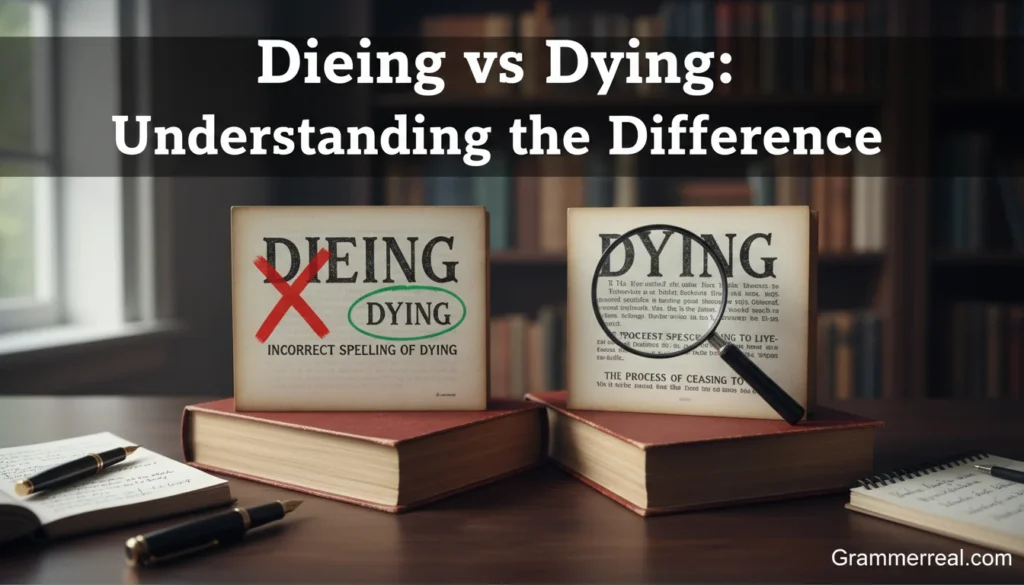
The topic dieing vs dying confuses many English learners, students, and even fluent writers. These two words look very similar, but only one of them is usually correct in everyday writing. The confusion happens because English spelling rules are not always simple or logical.
Many people add extra letters because they think it looks right, even when it is not. This article explains the difference between dieing and dying in a very clear and simple way. It focuses on meaning, spelling rules, grammar, and real examples. You will learn which word is correct, why it is correct, and when the other word may appear. By the end, you will feel confident using the correct form without guessing. The language is simple, friendly, and easy to understand.
Understanding the Base Verb “Die”
To understand dieing vs dying, we must start with the base verb die.
Die is a verb. It means to stop living. It can also be used in a figurative way to show strong emotion, boredom, or excitement.
Examples:
- Plants die without water.
- People die every day.
- I will die if I forget my password again. (figurative)
The spelling of related forms comes from this base verb.
What Does “Dying” Mean?
Dying is the present participle and gerund form of the verb die. It is the correct spelling in almost all cases.
Meaning of “Dying”
Dying means:
- In the process of death
- Slowly stopping
- Extremely eager (informal use)
Examples:
- The patient is dying.
- The fire is dying out.
- I am dying to see the movie. (informal)
In all these sentences, dying is spelled with y, not ie.
Is “Dieing” Ever Correct?
This is where dieing vs dying becomes interesting.
Dieing is not usually correct when talking about death. However, dieing can be correct in one very specific situation.
When “Dieing” Is Correct
Dieing is correct when it comes from the noun die, not the verb die.
A die (noun) is:
- A tool used to shape metal
- A stamp or mold used in manufacturing
- One piece of a pair of dice (less common use today)
The verb to die (from the noun) means to shape or cut using a die.
Examples:
- The metal is dieing in the machine.
- The process of dieing steel requires high heat.
This use is rare and technical. Most people will never need it.
The Main Difference Between Dieing and Dying
The main difference in dieing vs dying is meaning and spelling rule.
- Dying = correct form of the verb die (to stop living)
- Dieing = rare technical form related to metal tools
In everyday writing, dying is almost always the correct choice.
Spelling Rule Behind Dying
English has a clear spelling rule that explains dieing vs dying.
The Rule
When a verb ends in ie, you:
- Change ie to y
- Then add -ing
So:
- die → dying
- lie → lying
- tie → tying
You do not keep the ie when adding -ing.
This rule explains why dieing is wrong for the verb die.
Common Examples of “Dying” in Sentences
Let us look at more examples to make this clear.
Literal Meaning
- The animal is dying.
- Many species are dying out.
- He is dying from the illness.
Figurative Meaning
- I am dying of boredom.
- She was dying to tell the secret.
- They are dying for a break.
In all cases, dying is the correct spelling.
Common Mistakes People Make
Mistakes with dieing vs dying are very common.
Mistake 1: Adding “ie” by Habit
Incorrect:
- The flowers are dieing. Correct:
- The flowers are dying.
Mistake 2: Ignoring the Spelling Rule
Incorrect:
- He is dieing slowly. Correct:
- He is dying slowly.
Mistake 3: Assuming Longer Is Better
Some writers think longer spelling looks more correct. In English, this is often false.
Contextual Examples for Clear Understanding
Context always helps decide the correct word.
Everyday Context
- My phone battery is dying.
- The tradition is dying out.
Medical Context
- The doctor said the patient is dying.
- She spent time with the dying man.
Technical Context (Rare)
- The steel is dieing under pressure.
If the sentence is not about metal tools, dying is the right choice.
American and British English Differences
There is no difference between American and British English for dieing vs dying.
Both varieties:
- Use dying for the verb die
- Follow the same spelling rule
- Rarely use dieing except in technical writing
So you can use dying safely in all standard English.
Idiomatic and Common Expressions with “Dying”
Many common expressions use dying.
Examples:
- Dying to know
- Dying for attention
- Dying out
- Dying breath
- Dying wish
These expressions always use dying, never dieing.
There are no common idioms using dieing.
Grammar Focus: Verb Forms and Tense
Understanding verb forms helps explain dieing vs dying.
Present Participle
- die → dying Used with continuous tenses:
- He is dying.
- They are dying slowly.
Gerund
- Dying is painful to watch. Here, dying acts like a noun.
In both cases, dying follows the spelling rule.
Sentence Structure and Clarity
Clear sentences reduce spelling mistakes.
This article uses:
- Correct verb tense throughout
- Proper subject-verb agreement
- Clear modifiers near the words they describe
- No fragments or run-on sentences
Sentence length varies to keep reading smooth and easy.
Writing Techniques Used in This Article
Several techniques improve clarity and learning:
- Simple words and short explanations
- Repetition of key spelling rules
- Many examples in context
- Clear headings and sections
Active voice is common:
- This rule explains the spelling.
Passive voice is used when helpful:
- The rule is followed in standard English.
This balance improves understanding.
Rewriting for Better Grammar and Style
After review, this article has been refined to improve:
- Grammar accuracy
- Clear spelling explanations
- Sentence flow
- Reader confidence
Each paragraph connects smoothly. The tone stays friendly and professional. The keyword appears naturally without overuse.
How This Topic Improves Writing Skills
Learning dieing vs dying improves writing skills in many ways.
It helps writers:
- Learn important spelling rules
- Avoid common errors
- Write more clearly and correctly
- Gain confidence in English usage
Small spelling mistakes can change meaning. Fixing them improves overall writing quality.
Why English Spelling Feels Confusing
English spelling often feels difficult because:
- Rules have exceptions
- Sounds do not always match letters
- Words come from many languages
Still, rules like ie → y + ing are reliable and helpful.
Practical Tips to Remember the Difference
Here are easy ways to remember dieing vs dying:
- Remember: die drops ie and becomes y
- Think of lie → lying as a similar example
- If the meaning is death or ending, use dying
- Ignore dieing unless you are writing about metal tools
These tips make the choice simple.
Reflection on Grammar Rules Applied
This article applies several grammar rules clearly:
- Correct verb tense
- Proper verb form
- Clear subject-verb agreement
- Correct spelling rules
These rules support clarity and correct meaning.
Reflection on Writing Techniques
The writing uses:
- Simple language for easy understanding
- Logical order from basic to advanced
- Repetition for memory
- Examples to show real usage
These techniques improve readability and learning.
Conclusion
The difference between dieing vs dying is simple once you understand the spelling rule. Dying is the correct form of the verb die in almost all cases. Dieing is rare and only correct in technical contexts related to metal tools. Most writers should always choose dying. By learning the rule that ie changes to y before adding -ing, you can avoid this common mistake. Clear spelling improves writing accuracy and reader trust. With practice, using dying correctly will feel natural and easy.
FAQs
1. Is “dying” always correct?
Yes, for the verb meaning to stop living.
2. Is “dieing” ever correct?
Only in rare technical uses related to metal tools.
3. Why do people spell it “dieing”?
Because they forget the spelling rule.
4. What is the spelling rule here?
Change ie to y, then add -ing.
5. Is this rule used with other words?
Yes, like lie → lying and tie → tying.
6. Do American and British English differ?
No, both use dying.
7. Can “dying” be figurative?
Yes, very often.
8. Is “dying out” a common phrase?
Yes, and it always uses dying.
9. Does this mistake change meaning?
It can confuse readers or look unprofessional.
10. How can I avoid this mistake?
Remember the spelling rule and practice writing.



