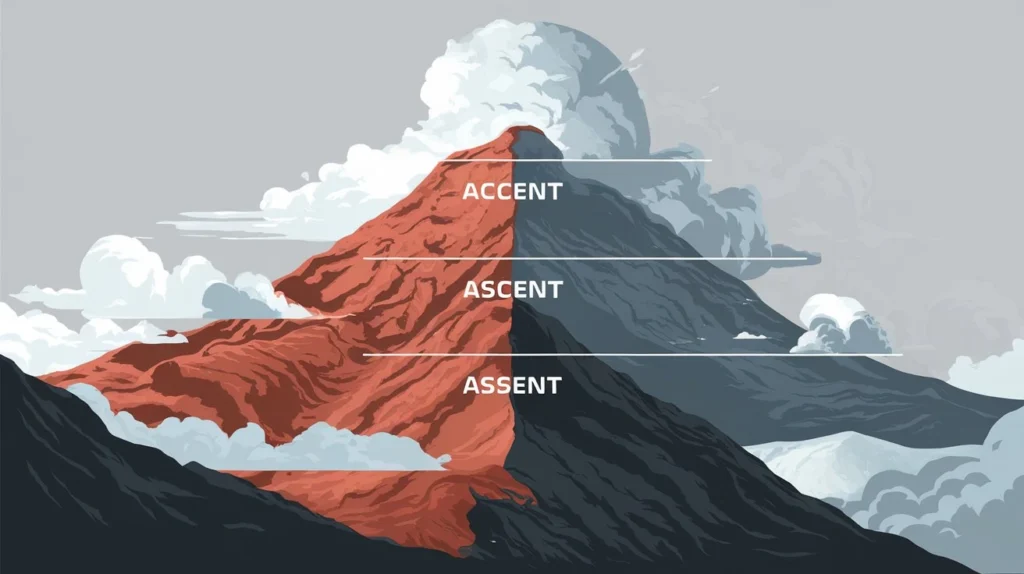
An accent refers to how someone pronounces words or to a distinctive feature, like an accent mark on a letter. An ascent means a climb or upward movement, for example the ascent of a hill.
An assentmeans agreement or approval, often used in formal contexts like voting or official statements. Knowing which word fits your meaning prevents misunderstanding and keeps writing precise. In this article I will explain each word clearly, give pronunciation tips, show usage examples, and point out common mistakes. I will also analyze parts of speech in key sentences and check verb tense and agreement so you can write simply and well.
Parts-of-speech analysis
Below I break each introduction sentence into the main parts of speech and check verbs for correct tense and subject–verb agreement. This step-by-step analysis helps you see how sentences are built.
“Accent vs ascent vs assent” is a common triad of words that trip up writers and speakers because they sound similar but mean very different things
- Nouns: Accent vs ascent vs assent (noun phrase as topic), triad, words, writers, speakers, things
- Verbs: is (linking verb, present simple — singular subject “Accent vs ascent vs assent” → is), trip up(phrasal verb used in infinitive or present; here that trip up writers is a relative clause; trip is present simple plural behavior of triad? Actually the relative clause subject is that referring to triad of words — better read as words that trip up writers; trip up used as present simple), sound (present simple; plural subject they → sound), mean (present simple; plural subject they → mean)
- Adjectives: common, very, different (very is adverb modifying different)
- Adverbs: very, similar (here similar is adjective; very modifies it)
- Prepositions: of, because, but (conjunction)
- Pronouns/Determiners: they (implied), that (relative pronoun)
- Grammar check: Present simple is used for a general statement. Subject–verb agreement is correct: the noun phrase as a whole takes is; within the relative clause the plural referent they (the words) takes soundand mean.
An accent refers to how someone pronounces words or to a distinctive feature, like an accent mark on a letter
- Nouns: accent, how, someone, words, feature, mark, letter
- Verbs: refers (present simple; singular subject accent → refers), pronounces (present simple; singular subject someone → pronounces)
- Adjectives: distinctive
- Prepositions: to, on
- Pronouns: someone
- Conjunctions: or, like
- Grammar check: Correct use of refers to and parallel objects (pronunciation or distinctive feature); verbs agree with their subjects.
An ascent means a climb or upward movement, for example the ascent of a hill
- Nouns: ascent, climb, movement, example, hill
- Verbs: means (present simple; singular subject ascent → means)
- Adjectives/Adverbs: upward (adjective or adverb modifying movement)
- Prepositions: of, for
- Grammar check: Simple definitional sentence; verb tense correct.
An assent means agreement or approval, often used in formal contexts like voting or official statements
- Nouns: assent, agreement, approval, contexts, voting, statements
- Verbs: means (present simple; singular assent), used (past participle in passive construction often usedmodifying assent)
- Adverbs: often
- Prepositions: in, like
- Grammar check: Passive phrase often used is correct; verb forms match subjects.
Knowing which word fits your meaning prevents misunderstanding and keeps writing precise
- Nouns: knowing (gerund), word, meaning, misunderstanding, writing
- Verbs: prevents, keeps (present simple; gerund subject treated as singular → prevents, keeps)
- Adjectives: precise
- Grammar check: Subject–verb agreement correct for gerund subject.
In this article I will explain each word clearly, give pronunciation tips, show usage examples, and point out common mistakes
- Pronoun: I
- Verbs: will explain, give, show, point out (future simple; parallel verb forms)
- Nouns: article, word, tips, examples, mistakes
- Grammar check: Future tense used for roadmap; parallel structure correct.
I will also analyze parts of speech in key sentences and check verb tense and agreement so you can write simply and well
- Pronouns: I, you
- Verbs: will analyze, check, can write (future + modal)
- Nouns: parts of speech, sentences, verb tense, agreement
- Conjunctions/Prepositions: so (shows purpose)
- Grammar check: Tense and modal use appropriate; clause structure clear.
Quick definitions: accent, ascent, assent
Accent (noun / sometimes verb)
- Meaning (noun): The way someone pronounces words, indicating regional background, social group, or second-language influence. Example senses: He has a British accent.
- Meaning (noun 2): A distinguishing feature, such as a decorative mark: accent mark (é).
- As verb (less common): To accent something is to emphasize it: She accented the final syllable.
Parts-of-speech note: Accent is mainly a noun. When used as a verb, it follows normal verb conjugation: accent, accents, accented, accenting.
Ascent (noun)
- Meaning: An upward movement; a climb. Example: The ascent to the summit took three hours.
- Parts-of-speech note: Ascent is a noun only. Use prepositions like to, up, of with it.
Assent (noun / verb)
- Meaning (noun): Agreement or approval. Example: The council gave assent to the proposal.
- Meaning (verb): To agree or approve. Example: She assented to the plan.
- Parts-of-speech note: Assent can be a noun or a verb; when a verb it conjugates: assent, assents, assented, assenting.
Pronunciation and how to tell them apart
Pronunciation differences help listeners pick the correct word.
- Accent — /ˈæk.sənt/ (stress on the first syllable: ACK-sent). As a verb, stress may shift in some dialects but commonly stays on the first syllable.
- Ascent — /əˈsent/ or /əˈsɛnt/ (stress on the second syllable: uh-SENT). Note the vowel in the first syllable is a schwa /ə/.
- Assent — /əˈsent/ as well (stress on the second syllable: uh-SENT). Assent and ascent are homophones in many dialects.
Important point: Ascent and assent often sound identical in speech. Context is what tells meaning. Accent sounds different because the stress is on the first syllable and the vowel is different.
Parts-of-speech in pronunciation note: Pronunciation does not change the part of speech, but it changes how listeners interpret your intended meaning. When two words are homophones, listeners rely on syntax and context.
Etymology and word history
Understanding roots can help memorize meanings.
- Accent comes from Latin accentus (accent, song), from ad- (to) + cantus (song). Think of speech melody.
- Ascent comes from Latin ascensus, from ascendere meaning to climb. Root scend- relates to climbing.
- Assent comes from Latin assentire, meaning to agree, from ad- (to) + sentire (feel). It links to consent and sentiment.
Grammar note: The Latin roots show why ascent and assent share sound patterns: different Latin prefixes + verbal roots created similar-sounding English words. Etymology clarifies that ascent = climb, assent = agree.
Usage: how to use each word in sentences
I provide clear sentences and analyze parts of speech, verbs, and modifiers so you can see correct use.
Accent — examples and analysis
- She has a strong southern accent.
- Parts of speech: She (pronoun), has (verb, present simple), a (article), strong (adjective), southern(adjective), accent (noun).
- Grammar note: Present simple used for fact.
- The designer added a bright accent color to the room.
- Parts of speech: designer (noun), added (past verb), a (article), bright (adjective), accent color (noun phrase), to (preposition), the room (noun).
- Grammar note: Accent used as noun meaning distinguishing feature.
- He accented the last syllable for emphasis.
- Parts of speech: He (pronoun), accented (past verb), the last syllable (noun phrase), for (preposition), emphasis (noun).
- Grammar note: Accented is verb form; active voice.
Ascent — examples and analysis
- Their ascent of the mountain was slow but steady.
- Parts of speech: Their (possessive pronoun), ascent (noun), of (preposition), the mountain (noun phrase), was (past verb), slow (adjective), but (conjunction), steady (adjective).
- Grammar note: Past tense for completed event.
- We began the ascent at dawn.
- Parts of speech: We (pronoun), began (past verb), the (article), ascent (noun), at (preposition), dawn(noun).
- Grammar note: Use begin with ascent to denote start of climb.
Assent — examples and analysis
- The board gave its assent to the merger.
- Parts of speech: The board (noun phrase), gave (past verb), its (possessive pronoun), assent (noun), to(preposition), the merger (noun phrase).
- Grammar note: Formal noun use.
- When asked, she assented without hesitation.
- Parts of speech: When (conjunction), asked (past participle in passive clause), she (pronoun), assented(past verb), without (preposition), hesitation (noun).
- Grammar note: Assented conjugated correctly; passive participle used in subordinate clause.
Contextual examples and mini-dialogues
Short dialogues show how context resolves homophones.
At a language class:
- Teacher: “Listen to this accent: /ˈæk.sənt/ — say it with the stress on the first syllable.”
- Student: “Accent — got it.”
- Grammar note: Imperative listen and noun explanation.
On a hiking trip:
- Guide: “Our ascent begins here; it will take two hours.”
- Hiker: “Do we need ropes for the ascent?”
- Grammar note: Noun ascent repeated; clear physical context.
In a council meeting:
- Chair: “We need assent from the board to proceed.”
- Member: “All in favor, raise your hand to show assent.”
- Grammar note: Noun and verb uses; formal register.
Common mistakes and how to fix them
People confuse these words in writing and speech. Below are frequent mistakes and corrections.
- Mixing ascent and assent in writing
- Wrong: The committee gave ascent to the motion.
- Fix: The committee gave assent to the motion.
- Why: Ascent = climb; assent = agreement. Check meaning, not sound.
- Using accent where assent is intended
- Wrong: She accented to the plan.
- Fix: She assented to the plan. or She agreed to the plan.
- Why: Accent as verb means emphasize, not agree.
- Confusing accent (pronunciation) with accent (mark)
- Wrong: Put an accent on the e to assent the vowel.
- Fix: Put an accent mark on the e to mark the vowel.
- Why: Assent is unrelated; use accent mark for diacritics.
- Pronunciation confusion leading to wrong word choice
- Problem: Hearing /əˈsent/ and writing ascent instead of assent when you mean agreement.
- Fix: Use syntax: if sentence needs agreement, choose assent; if it needs climb, choose ascent.
Grammar tip: When in doubt, rephrase the sentence to avoid homophones: The council approved the motion (instead of gave assent).
American vs British English: any differences?
In meaning and spelling, accent, ascent, and assent are the same in American and British English. Pronunciation differences are regional but do not change meanings.
- Accent: Same in both; regional accents differ widely.
- Ascent vs assent: Both dialects often make these words homophones (/əˈsent/). Use context to disambiguate.
- Collective nouns and grammar: No specific issues tied to these three words.
Practical note: When writing for an international audience, prefer clarity: use climb instead of ascent if you fear misunderstanding, or use agreement instead of assent in plain texts.
Idiomatic expressions and related collocations
These words appear in idioms and set phrases.
- Accent on — to emphasize: place accent on detail or accentuate meaning highlight.
- Example: He put the accent on clarity.
- Make an ascent — the formal phrase for climbing.
- Example: They made the ascent at dawn.
- Give assent / receive assent — formal legal phrasing.
- Example: Royal assent — in constitutional monarchies, the monarch’s approval of legislation.
Grammar note: Collocations often fix prepositions: accent on, ascent to, assent to. Learn these pairings to avoid errors.
Practical writing tips
- Check meaning, not sound. When you hear /əˈsent/, ask: do I mean climb or agree?
- Use synonyms to reduce confusion: agreement (for assent), climb (for ascent), pronunciation or dialect (for accent).
- Proofread with a checklist: look for ascent/assent errors and check context.
- Use full words in formal writing: gave assent is fine in legal text; use approved in plain business writing.
- Teach pronunciation by syllable stress: Accent = ACK-sent; ascent/assent = uh-SENT.
- Avoid homophone ambiguity in speech: add brief clarifiers: “assent, i.e., agreement.”
- Watch verb forms: assent as a verb takes regular conjugation: assents, assented.
- Be precise with diacritics: say accent mark or diacritic rather than accent when referring to written marks.
- Rephrase if audience is non-native: use simpler synonyms to avoid confusion.
- Practice sample sentences: write or speak short sentences using each word and check parts of speech.
Rewrite: enhanced grammar, clarity, and style
Below is a tightened, clearer version of the core explanations, rewritten to improve flow and vocabulary while keeping language simple.
Polished summary: Accent, ascent, and assent are distinct words that sometimes sound alike. An accent relates to pronunciation or a notable feature. An ascent is a climb or rise. An assent is formal agreement. Listen for stress: ACC-ent vs uh-SENT; when writing, choose the word that matches meaning, not sound. If you need to be clear, use synonyms: pronunciation, climb, agreement.
Conclusion
Key takeaways:
- Accent = pronunciation or distinguishing feature.
- Ascent = climb, upward movement.
- Assent = agreement, approval (noun) or to agree (verb).
- Pronunciation: accent stresses the first syllable; ascent and assent stress the second.
- Context and syntax resolve homophone confusion. Use synonyms or rephrase in mixed-audience settings.
Practice writing short sentences that use each word correctly. Proofreading and choosing plain synonyms in uncertain situations reduce errors and improve clarity.
FAQs
- Q: Are ascent and assent the same word? A: No. Ascent means climb. Assent means agreement. They may sound the same, but their meanings differ.
- Q: How do I pronounce accent? A: ACC-ent (/ˈæk.sənt/) with stress on the first syllable.
- Q: How do I pronounce ascent and assent? A: Both are usually pronounced uh-SENT (/əˈsent/), stress on the second syllable.
- Q: Which word means approval? A: Assent means approval or to agree.
- Q: Which word means a climb? A: Ascent means a climb. Use climb if you want simpler language.
- Q: Can accent be a verb? A: Yes. To accent means to emphasize something (e.g., accent a syllable).
- Q: Is assent common in everyday speech? A: Not very; it is more common in formal or legal contexts. Use agreein casual speech.
- Q: How can I avoid mixing them up? A: Check the context: if you mean speech or marks, choose accent; if climbing, choose ascent; if agreeing, choose assent.
- Q: Are there regional differences? A: No major differences in meanings. Pronunciations vary by accent; ascent/assent often remain homophones.
- Q: Any quick memory trick? A: Accent starts with a and has stress first — think A-CCENT. Ascent/assent end with -sent — think upward senT(ascent) and agreement senT (assent).